Audience Segmentation for Highly Relevant Ads
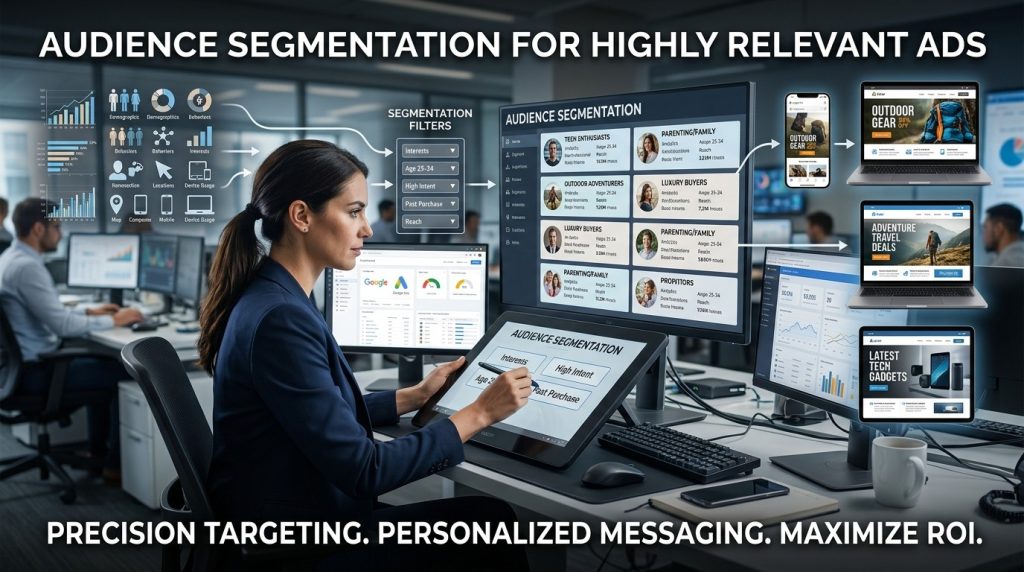
Audience Segmentation helps brands deliver relevant ads by matching messages to needs, timing, and behavior, which improves response, trust, efficiency, and long-term campaign performance.
Audience Segmentation matters because ads work better when they feel specific rather than generic. People do not respond equally to every message, even when the product is strong. They react to whether the message fits their situation, their expectations, and their current level of awareness. Audience Segmentation helps marketers stop treating the market like one large crowd and start recognizing it as a set of smaller groups with different motivations.
Audience Segmentation is especially useful because attention is limited. When someone sees an ad, they decide very quickly whether it feels relevant. If the message appears to understand their problem, they are more likely to pause, read, and click. If it feels broad or irrelevant, they ignore it. Audience Segmentation improves that first impression by making the message feel more personal from the start.
Audience Segmentation also reduces wasted spend. When the same ad is shown to everyone, some people may be interested, but many will not be. That lowers efficiency and makes campaign learning harder. Audience Segmentation allows teams to build different messages for different groups, which usually leads to better engagement, stronger conversion rates, and a clearer understanding of what the market actually wants.
What segmentation really means in advertising
Audience Segmentation is the practice of dividing a larger audience into smaller groups that share something meaningful. That something might be behavior, demographics, intent, geography, interests, purchase stage, or past interactions. Audience Segmentation works because people with similar traits often respond to similar triggers. If the segment is defined well, the message can be written with much more precision.
Audience Segmentation is not about making the audience feel small or boxed in. It is about recognizing that people at different stages need different information. A first-time visitor may need education. A returning visitor may need reassurance. A ready-to-buy user may need a stronger offer. Audience Segmentation helps each person receive the kind of message most likely to move them forward.
Audience Segmentation also helps brands avoid conflicting messages. Without segmentation, a campaign can try to say too many things at once. That weakens clarity. With Audience Segmentation, the brand can match message to need. That makes the ad feel tighter, more confident, and more useful to the person seeing it. The more clearly the ad reflects the audience, the better the response tends to be.
Why psychology matters so much
Audience Segmentation is powerful because buying behavior is not purely logical. People notice ads through the lens of fear, desire, convenience, trust, and timing. Audience Segmentation helps marketers align with those emotional filters instead of fighting them. If the audience is worried about risk, the message should reduce that fear. If they want speed, the message should emphasize ease. If they want status, the message should make value visible.
Audience Segmentation also works because people like being understood. When an ad speaks directly to a familiar problem, the viewer feels seen. That feeling builds trust faster than vague messaging. Audience Segmentation creates that effect by making the ad appear more thoughtful and more relevant. The result is often better engagement, but the deeper reason is that people are more willing to listen when they believe the message fits their reality.
Audience Segmentation should therefore be guided by more than surface data. It should reflect the emotions behind the behavior. A good strategy asks not only who the audience is, but why they are likely to care. Once the emotional layer is understood, the ad can be built around the thing that matters most to the segment instead of around a general assumption.
The building blocks of a strong segment

Audience Segmentation becomes useful when the team knows what variables matter most. Some segments are built around demographics like age, income, or location. Others are built around behaviors like clicks, purchases, app usage, or repeat visits. Others are built around intent, such as whether someone is researching, comparing, or ready to buy. Audience Segmentation is strongest when the variables are chosen because they influence the response, not because they are easy to collect.
Audience Segmentation should also respect context. Two people with the same age or job title may still respond differently if one is a new buyer and the other is already a loyal customer. That is why the most effective segments often combine several variables rather than relying on one signal alone. Audience Segmentation gets sharper when the data reflects actual decision-making patterns.
Audience Segmentation also benefits from simplicity. If the segments become too complicated, the team may stop using them. A useful structure usually starts with a few clear groups and then expands as the campaign matures. The goal is not to build dozens of segments at once. The goal is to create useful distinctions that improve targeting, creative, and conversion.
Why marketers need to think in layers
Audience Segmentation is easier to use when the team thinks in layers. One layer may define the broad market. Another may separate high-intent users from low-intent users. Another may identify loyal customers, recent visitors, or people reacting to a particular trigger. Audience Segmentation becomes more actionable when those layers work together instead of competing with each other.
Audience Segmentation also helps marketers avoid a common mistake: assuming one segment defines the whole market. In reality, different users often need different levels of proof, urgency, and language. A beginner may need education, while a veteran user may want speed and efficiency. Audience Segmentation helps the team deliver the right depth of message to the right person.
Audience Segmentation should therefore be planned before the campaign launches, not only after performance drops. When the structure is set early, ads can be matched to each audience more cleanly. That usually leads to better performance and fewer false conclusions about what the market wants.
Using past behavior to shape ad relevance
Audience Segmentation becomes far more accurate when it includes behavior. Past behavior shows what people have already done, which often predicts what they are likely to do next. A visitor who viewed pricing twice may need a stronger conversion message than someone who only read a blog post. Audience Segmentation allows those differences to influence the creative and the call to action.
Audience Segmentation based on behavior also helps reduce waste. It prevents the same offer from being shown to people who are not ready for it. That makes the campaign more efficient and less annoying. Audience Segmentation is especially useful here because it helps align message intensity with actual readiness. People who have already shown interest often need a different kind of push than people who are just discovering the brand.
Audience Segmentation should also look at engagement history. If someone opens emails, watches demos, or returns to the site often, they are probably closer to a decision. Audience Segmentation helps the team use that information without overcomplicating the workflow. The more clearly past behavior is translated into present action, the more relevant the ad becomes.
Connecting segmentation to personalization
Audience Segmentation and personalization work together. Segmentation gives structure, while personalization gives the message a human feel. Audience Segmentation helps marketers decide which audience should receive which version of the message. Personalization then adapts the copy, proof, and offer to fit the segment more closely. That combination is what makes the ad feel like it was written for the viewer.
Audience Segmentation becomes even more useful when the team identifies the Key Personalization Variables that influence response. Those variables may include company size, role, previous interaction, purchase stage, location, or product interest. Audience Segmentation helps the brand decide which variables matter most for a specific campaign. Once those are clear, the creative can reflect them without sounding forced.
Audience Segmentation should not be treated as a technical layer only. It is also a communication strategy. When people receive messages that reflect their situation, they are more likely to trust the brand and keep moving through the funnel. That is why segmentation and personalization are often strongest when they are designed together from the beginning.
How B2B thinking improves segmentation
Audience Segmentation is often discussed in consumer marketing, but it is just as important in business-to-business campaigns. In B2B, buyers are often more specific about their role, pain points, and process. Audience Segmentation helps a brand speak differently to decision-makers, influencers, managers, and end users. That matters because each person may care about a different outcome.
Audience Segmentation in B2B also reduces confusion in longer buying cycles. A single company may contain several stakeholders, and each stakeholder may respond to a different proof point. Audience Segmentation helps tailor the message so it matches the buyer’s function and level of influence. That makes the campaign more relevant and more useful across the whole journey.
Audience Segmentation should also support account-based and lifecycle strategies. If one company is large enough to require a layered buying process, the same message will not work for every contact. Audience Segmentation allows the team to adapt the tone, depth, and offer to the audience’s role. That is where B2B Personalization Methods become especially useful because they show how message relevance improves when the campaign respects the context of the buyer.
How referral behavior reveals audience differences
Audience Segmentation is also useful when studying how people share and recommend products. Not every customer behaves the same way after a good experience. Some users become vocal advocates, while others stay quiet even if they like the brand. Audience Segmentation helps marketers identify which groups are more likely to respond to social proof, referrals, or recommendations.
Audience Segmentation can be informed by observing how different users react to incentives. The Cash App Referral Program is a useful example because it showed how a simple, clear reward can spread quickly when the message fits the user’s motivation. Audience Segmentation can help a brand understand which kinds of users are likely to share, which users need more reassurance, and which users are motivated by immediate value rather than long-term loyalty.
Audience Segmentation also applies internally. The Employee Referral Program is a good reminder that people trust recommendations from peers when the fit is strong and the message is easy to explain. In the same way, Audience Segmentation helps external campaigns feel more credible because the message can be adapted to the audience’s trust level. The better the fit, the more likely the person is to act.
Segment types that often work well
Audience Segmentation can be built around many variables, but a few types are especially common. Demographic segments are useful when broad traits matter. Behavioral segments work well when past actions predict future responses. Psychographic segments help when attitudes and values influence the decision. Contextual segments are valuable when time, device, or environment changes how the message should be delivered.
Audience Segmentation is often strongest when these types are combined. A segment might include returning mobile visitors who viewed pricing, or enterprise prospects who downloaded a case study and work in a specific region. Audience Segmentation becomes more meaningful when it reflects a real marketing decision rather than a generic label. The segment should help the team decide what message to send, what proof to use, and what offer to test.
Audience Segmentation should also be revisited over time. What worked last quarter may not work now. Markets shift, behavior changes, and competitors adapt. Audience Segmentation stays useful when it is updated regularly and aligned with current performance rather than static assumptions.
Why ad relevance depends on segment quality

Audience Segmentation only creates better ads if the segments themselves are meaningful. A weak segment will produce weak relevance. That is why the quality of the segment matters more than the number of segments. Audience Segmentation should identify groups that differ in useful ways, not just in ways that sound nice in a report.
Audience Segmentation also affects the ad’s promise. If the segment is broader, the message may need to be more educational. If the segment is narrower and more advanced, the message can be more direct. Audience Segmentation gives the marketer a clearer sense of what to emphasize. That usually improves click-through rate, conversion rate, and post-click engagement because the ad is answering a more specific need.
Audience Segmentation also helps teams avoid accidental mismatch. Without a clear structure, a campaign may send a beginner offer to an advanced user or a premium message to a value shopper. Those mistakes reduce trust. Audience Segmentation reduces that risk by making the communication more precise from the beginning.
A simple table for segmentation thinking
| Segment basis | Example | Why it matters |
|---|---|---|
| Behavior | Past site visits | Shows readiness |
| Intent | Research vs purchase | Shapes offer depth |
| Demographics | Age, role, region | Adds context |
| Engagement | Email opens, clicks | Reveals interest level |
| Value stage | New, active, loyal | Improves timing |
Audience Segmentation becomes much easier to use when the team can see the logic laid out clearly. That table format can also help internal teams agree on what each segment means and how it should be used in campaigns.
Why timing is part of segmentation
Audience Segmentation is not only about who people are. It is also about when they are most receptive. A user who just discovered the brand may need a softer message, while a user who has already returned multiple times may be ready for a stronger call to action. Audience Segmentation helps marketing teams align the timing of the ad with the stage of the buyer.
Audience Segmentation should also account for channel timing. Someone who sees an ad in a social feed may respond differently than someone who finds the brand through search or email. The same person can move through different states of readiness depending on the moment. Audience Segmentation gives the team a way to reflect that timing in the creative and the offer.
Audience Segmentation is therefore not just a targeting exercise. It is a timing strategy. When the message arrives at the right moment, it feels useful instead of intrusive. That is one of the clearest signs that the segmentation is working.
Why clarity beats complexity
Audience Segmentation should always improve clarity, not create confusion. If the campaign needs a long explanation to define the segment, the structure may be too complicated. Audience Segmentation works best when the team can quickly understand who the segment is, what they care about, and what message they should see.
Audience Segmentation can become difficult when there are too many overlapping layers. The solution is not to avoid segmentation. The solution is to make sure each segment has a clear purpose. A segment should help with one or two major decisions. If it does not, it probably needs to be simplified. The best systems are useful because they are easy to apply, not because they are impressive on paper.
Audience Segmentation should also be understandable outside the marketing team. Sales, product, and leadership should be able to interpret it without confusion. When the whole company understands the segmentation logic, campaigns become easier to align across the funnel.
How segmentation supports testing
Audience Segmentation makes testing more meaningful because it allows the team to isolate what works for whom. A message that performs well with one group may fail with another. Without segmentation, that difference gets blurred. Audience Segmentation helps the team learn which creative, offer, and proof point work best for each group.
Audience Segmentation also helps reduce wasted experiments. If every test is shown to the wrong audience, the results will be noisy. A better segment makes the result more reliable. Audience Segmentation gives the test a fair chance to succeed or fail for the right reasons. That improves learning and makes optimization more efficient.
Audience Segmentation should therefore be part of the testing plan from the start. The test is not only about which ad wins. It is also about which audience responds to which message and why. That kind of insight is much more useful for long-term growth.
Using audience data to improve creative
Audience Segmentation becomes most valuable when it informs the actual ad creative. A segment that cares about speed should see speed-focused messaging. A segment that values trust should see proof and reassurance. Segmentation gives the creative team a clearer starting point so the copy, image, and offer feel more aligned with the viewer’s expectations.
Audience Segmentation can also improve emotional resonance. The message does not have to sound robotic to be relevant. In fact, the best ads often feel human because they reflect a real concern or goal. Segmentation helps the creative team do that more accurately. It gives the ad a better chance to feel like a useful answer rather than an interruption.
Audience Segmentation also helps avoid creative fatigue. If everyone sees the same message, attention drops. If the message changes based on segment, the brand can keep the communication fresher and more relevant for longer. That usually improves performance over time.
Practical use in different industries
Audience Segmentation is useful in nearly every industry because most markets contain more than one type of buyer. In retail, some buyers are price-sensitive while others want convenience or style. In software, some buyers want simplicity while others want depth of features. Audience Segmentation helps each industry speak to the right motivation.
Audience Segmentation is especially important in markets with longer decision cycles. If the buyer needs more proof, more education, or more internal alignment, the campaign should reflect that. Segmentation allows the brand to give one group a short, direct message and another group a more detailed one. That flexibility usually leads to better outcomes.
Audience also improves cross-channel planning. A brand can use one segment for search, another for paid social, and another for email nurture. The same person may move through several audiences over time. Audience Segmentation helps the team coordinate those touches so the message builds instead of repeats unnecessarily.
Why measurement should follow the segment

Audience Segmentation is only helpful if performance can be measured by group. If the team does not know which segment converted, the insight is incomplete. Audience should therefore be paired with tracking that shows how each group behaves across the funnel. That makes it easier to see which segments produce not just clicks, but real outcomes.
Segmentation also helps with budget allocation. If one group converts much better than another, the team can invest more in that segment or adjust the message for the weaker group. Segmentation therefore turns measurement into action. The data is not just recorded. It is used to improve the campaign.
Audience should be reviewed regularly so the team can see whether the segment logic is still accurate. A segment that once performed well may become less relevant later. The better the measurement routine, the easier it is to keep the segmentation strategy current and useful.
Common mistakes to avoid
Audience Segmentation can fail if it becomes too broad. If the audience groups are too large, the ad still feels generic. It can also fail if the team creates too many tiny segments that are hard to manage. Audience Segmentation works best in the middle ground, where the groups are distinct enough to matter but simple enough to use.
Audience can also be weakened by poor data quality. If the source data is wrong, the segment will be wrong too. That creates confusion and can damage trust in the entire system. Another common mistake is ignoring the buyer stage. A person who is just learning about the category should not get the same message as someone who is almost ready to buy.
Audience should also avoid overfitting the campaign to a narrow assumption. The segment should be based on real patterns, not just one isolated result. If the strategy is too rigid, it may miss new opportunities or fail to adapt when the market shifts.
Why it matters for trust
Audience Segmentation improves trust because it helps ads feel more relevant and less random. People are more willing to pay attention when the message appears to understand their situation. Segmentation makes that possible by aligning the message with the audience’s likely needs and expectations.
Segmentation also helps brands sound more thoughtful. A message that matches the user’s context often feels more credible. That credibility can lead to better engagement because the viewer feels understood instead of pressured. When trust rises, performance usually follows.
Audience Segmentation should therefore be seen not only as a targeting tactic but also as a relationship tactic. The more relevant the message, the more respectful it feels. That is why segmentation has such a strong effect on ad quality and conversion behavior.
Final perspective before building campaigns
Segmentation is most powerful when it becomes part of the creative and strategic process, not just a spreadsheet exercise. The best campaigns use segmentation to shape message, offer, timing, and proof. That makes ads more relevant, more efficient, and more persuasive.
Audience Segmentation also helps teams think clearly about what different groups need at different stages. When that understanding is built into the ad plan, the campaign becomes easier to improve. The result is usually better engagement and less wasted effort.
Segmentation is not a trick. It is a discipline. The more seriously a brand takes it, the more likely it is to create ads that actually feel relevant to the people seeing them.
Conclusion
Audience Segmentation helps marketers move from broad messaging to highly relevant ads that speak to real needs, real timing, and real motivations. When a brand understands who it is talking to, what that person cares about, and how ready they are to respond, the ad becomes more useful and less noisy. That usually improves trust, engagement, and efficiency across the whole campaign. Audience Segmentation is also valuable because it helps teams test smarter, personalize more accurately, and make better decisions with less waste. In competitive markets, relevance often wins, and segmentation is one of the clearest ways to build it.
Frequently Asked Questions (FAQ)
1. What is Audience Segmentation?
Audience Segmentation is the process of dividing a larger audience into smaller groups that share meaningful traits so ads can be more relevant and effective.
2. Why is it important for ads?
It helps ads feel more specific, which usually improves attention, trust, and conversion while reducing wasted spend on irrelevant viewers.
3. What are common segment types?
Common types include demographic, behavioral, psychographic, contextual, and intent-based segments. Many campaigns work best when several are combined.
4. How does it improve personalization?
It helps marketers choose the right message, proof, and offer for each group so the ad feels more human and more useful.
5. Can segmentation help B2B campaigns?
Yes. It is especially useful in B2B because different decision-makers often need different messages, proof points, and levels of detail.
6. What role do Key Personalization Variables play?
They help identify which factors matter most for tailoring the message, such as role, previous behavior, product interest, or buying stage.
7. How do B2B Personalization Methods fit in?
They show how message relevance improves when campaigns are tailored to the context of the buyer and the stage of the buying process.
8. Can segmentation support referral behavior?
Yes. Different users share and respond differently, so segmentation helps identify who is likely to engage with referral or social proof messages.
9. What is the biggest mistake?
The biggest mistake is either making segments too broad to matter or too complex to manage. Useful segmentation should be clear and practical.
10. How often should segments be reviewed?
They should be reviewed regularly because markets, behaviors, and performance patterns change over time.