Optimizing Funnel Stages for Faster Lead Flow
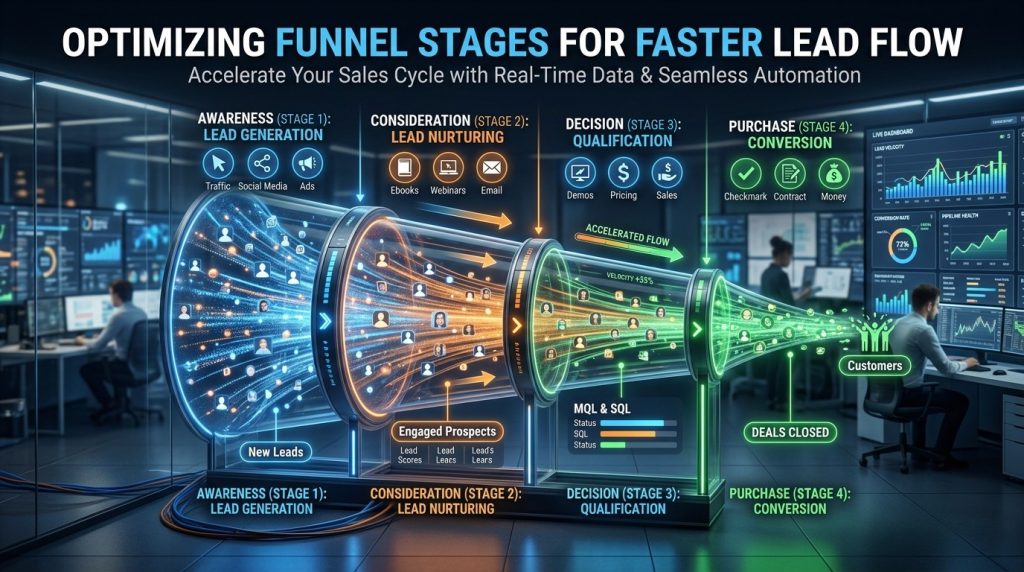
Optimizing Funnel Stages helps businesses reduce conversion friction, qualify prospects faster, improve buyer journeys, and move more leads from awareness to sales efficiently.
A marketing funnel is not simply a series of webpages, emails, advertisements, and sales calls. It is a behavioral system that determines how easily a potential customer moves from uncertainty toward action.
When prospects move quickly through the right stages, businesses generate more qualified opportunities without necessarily increasing traffic. When prospects become stuck, the organization can waste advertising budgets, sales time, and customer attention without realizing where the real problem exists.
That is why Optimizing Funnel Stages should begin with understanding how people make decisions.
A prospect does not wake up thinking about your funnel.
They think about a problem.
They may be trying to increase revenue, reduce costs, solve an operational issue, save time, improve performance, avoid risk, or achieve a personal goal. Your funnel exists to help that person progress from recognizing the problem to confidently choosing a solution.
The faster this journey happens without sacrificing qualification or trust, the stronger the commercial outcome can become.
However, faster does not mean aggressive.
A funnel that pushes people forward before they are ready can increase short-term activity while damaging conversion quality. The objective is to remove unnecessary hesitation rather than eliminate legitimate decision-making.
Effective Optimizing Funnel Stages therefore balances three things:
- Speed
- Relevance
- Readiness
When these three elements work together, lead flow becomes both faster and more predictable.
What Are Funnel Stages?
Most funnels can be simplified into several psychological stages.
A typical journey may look like:
Awareness → Interest → Consideration → Evaluation → Decision → Purchase → Retention → Advocacy
Some businesses use different terminology, but the underlying behavior remains similar.
At each stage, prospects have different questions.
Someone in awareness may ask:
“Do I have a problem?”
Someone in consideration may ask:
“Which solutions exist?”
Someone evaluating options may ask:
“Which solution is safest?”
Someone near purchase may ask:
“Why should I choose you?”
A major Optimizing Funnel Stages mistake is giving every prospect the same message regardless of their position in the decision process.
A person discovering a problem does not need the same information as a prospect comparing pricing pages.
The Funnel Is Psychological, Not Just Technical
Marketers frequently think in terms of clicks, pages, forms, and campaigns.
Customers think in terms of risk, relevance, trust, effort, value, urgency, and confidence.
That difference explains why technically functional funnels can still underperform.
A landing page may load perfectly.
A form may work perfectly.
The CRM may capture every submission.
Yet leads can remain slow because the messaging fails to resolve the customer’s psychological hesitation.
Optimizing Funnel Stages means identifying those hidden barriers.
The Four Major Sources of Funnel Friction
Funnel friction is anything that makes a prospect hesitate, become confused, lose interest, or postpone action.
Four categories appear frequently.
Information Friction
The prospect does not have enough information to make the next decision.
For example, your landing page may explain what the product does but not who it is designed for.
Cognitive Friction
The prospect must think too hard.
Too many choices, complicated explanations, technical terminology, or unclear comparisons can slow decision-making.
Trust Friction
The customer is uncertain whether your claims are credible.
They may wonder:
“Will this actually work?”
“Can I trust this company?”
“Will I regret buying?”
“Is there a hidden condition?”
Action Friction
The customer wants to proceed but the process is inconvenient.
Long forms, unclear CTAs, unnecessary account creation, weak scheduling systems, or slow response times can create avoidable abandonment.
The strongest Optimizing Funnel Stages strategies reduce all four.
The Relationship Between Traffic and Lead Flow
Traffic is often treated as the primary growth metric.
But traffic alone does not create revenue.
A business can double website visitors and see almost no increase in sales if visitors encounter friction after arriving.
Consider this simplified example:
10,000 visitors
1,000 leads
250 qualified leads
80 sales opportunities
25 customers
Now imagine the company improves several stages.
11,000 visitors
1,400 leads
420 qualified leads
125 opportunities
42 customers
The second funnel did not rely exclusively on more traffic.
It improved movement.
That distinction is critical.
Optimizing Funnel Stages often produces more leverage than endlessly increasing acquisition spend.
Stage One: Optimizing Awareness
Awareness is where prospects first encounter a problem, brand, concept, or possible solution.
At this stage, customers may not understand their problem clearly.
They may know something is wrong but lack language for describing it.
Match Content to Problem Awareness
Effective awareness-stage content should help prospects identify and understand the problem.
Useful formats include:
- Educational articles
- Short videos
- Industry reports
- Explainers
- Checklists
- Research summaries
- Social content
- Beginner guides
Avoid forcing a sales pitch immediately.
A prospect who is still discovering the problem has not necessarily earned a purchase offer.
A strong Optimizing Funnel Stages strategy meets the customer at their current level of awareness.
Use Problem-Led Messaging
Compare these two headlines.
“Advanced Revenue Optimization Software”
versus
“Find Where Your Sales Pipeline Loses High-Intent Leads”
The second headline immediately identifies a problem.
Problem specificity creates relevance.
Relevance creates attention.
Attention creates the possibility of progression.
Stage Two: Optimizing Interest
Once prospects recognize a problem, they begin exploring possible solutions.
This stage is about education and curiosity.
People start consuming:
- Guides
- Product comparisons
- Webinars
- Case studies
- Tutorials
- Expert opinions
- Feature explanations
The key question becomes:
“Could this solution help me?”
Make the Next Step Obvious
Do not make prospects guess what to do next.
Your CTA should logically extend the current content.
For an educational article, the next step could be a detailed guide.
For a comparison page, the next step could be a demo.
For a high-intent pricing page, the next step could be consultation or purchase.
The CTA should match psychological readiness.
This is one of the most important principles in Optimizing Funnel Stages.
Stage Three: Optimizing Consideration
At the consideration stage, prospects understand the problem and are evaluating possible approaches.
They are often comparing vendors, methods, pricing models, features, and expected results.
This stage is heavily influenced by perceived risk.
Reduce Decision Uncertainty
Customers commonly hesitate because they cannot predict outcomes.
Use evidence such as:
- Customer results
- Case studies
- Reviews
- Demonstrations
- Before-and-after examples
- Product screenshots
- Transparent pricing
- Guarantees where appropriate
- Expert explanations
Evidence works because it gives the brain something concrete to evaluate.
Help Prospects Compare
A business should not assume that customers automatically understand why its solution is different.
Comparison tables, buyer guides, feature breakdowns, and use-case examples can reduce decision complexity.
The goal is not simply to claim superiority.
The goal is to make evaluation easier.
That is another powerful application of Optimizing Funnel Stages.
Stage Four: Optimizing Evaluation
Evaluation is where high-intent prospects ask detailed questions.
They may visit pricing pages multiple times.
They may talk with sales.
They may read reviews.
They may compare competitors.
They may ask colleagues for opinions.
At this stage, generic marketing is less effective.
Specificity becomes more persuasive.
Answer the Questions Buyers Are Actually Asking
A strong evaluation experience should cover:
What does it cost?
Who is it for?
Who is it not for?
How difficult is implementation?
How long until value appears?
What support exists?
What happens if it does not work?
What are the limitations?
How does it compare with alternatives?
Transparent answers often reduce friction more effectively than additional promotional language.
Stage Five: Optimizing Decision
At the decision stage, prospects are close to acting.
Yet many businesses continue adding information instead of removing obstacles.
This is where Optimizing Funnel Stages often requires simplification.
Remove Last-Minute Friction
Look for:
- Complicated checkout
- Too many form fields
- Unclear pricing
- Hidden fees
- Weak guarantees
- Confusing CTAs
- Slow page speed
- Poor mobile experience
- Difficult scheduling
- Lack of payment choices
A customer near purchase should not have to solve another puzzle.
Create Confidence Before the Click
Before the final action, reinforce:
Value
Safety
Clarity
Convenience
Proof
For example, a CTA such as “Submit” provides almost no psychological information.
A CTA such as “Schedule Your Free Strategy Call” communicates the outcome more clearly.
Stage Six: Optimizing Qualification
Not every lead should move directly to sales.
If your funnel produces thousands of low-quality leads, faster lead flow may actually create operational problems.
Qualification should therefore be intelligent.
Ask:
Does the prospect match the ideal customer profile?
Do they have the relevant problem?
Can they afford the solution?
Are they within the service area?
Do they have realistic buying intent?
Do they have authority or influence over the decision?
The objective is not maximum lead volume.
It is maximum useful lead flow.
Stage Seven: Optimizing Sales Handoffs
One of the biggest hidden leaks in many funnels occurs between marketing and sales.
Marketing considers the lead qualified.
Sales believes the lead is weak.
The prospect receives a generic follow-up.
Days pass.
Interest disappears.
A clean handoff process can dramatically improve speed.
Define Lead Qualification Rules
Marketing and sales should agree on criteria such as:
- Company fit
- Problem relevance
- Engagement level
- Budget
- Timeline
- Decision authority
- Purchase intent
A lead should arrive with context.
Instead of saying:
“Someone filled out the form.”
Sales should know:
“The prospect downloaded a comparison guide, visited pricing twice, viewed the implementation page, and requested a demo.”
Context changes conversations.
Understanding Lead Velocity
Lead velocity describes how quickly prospects progress through the funnel.
Suppose two businesses generate 500 leads monthly.
Business A takes 35 days to move qualified leads into sales conversations.
Business B takes 9 days.
Even if their lead counts are identical, Business B has a potentially stronger operating model.
Why?
Because shorter cycles can mean:
- Faster feedback
- Better sales productivity
- Lower lead decay
- More predictable forecasting
- Faster revenue realization
Optimizing Funnel Stages is therefore closely connected to response time and decision-cycle reduction.
Lead Decay: The Silent Funnel Killer
Interest is temporary.
A prospect who was highly motivated Monday may become distracted by Friday.
This is especially important for high-consideration purchases.
Lead decay can happen because:
The problem becomes less urgent.
A competitor contacts the prospect.
The prospect forgets the company.
Internal priorities change.
Budget gets redirected.
Another vendor responds faster.
That is why speed matters.
Respond While Intent Is High
An automated confirmation immediately after form submission can reassure the prospect.
But automation should not become the entire experience.
High-intent leads often benefit from rapid human follow-up.
A useful principle is:
The higher the buying intent, the faster the human response should become.
Building a Stronger Sales Funnel Architecture
Every funnel has a structure, whether intentionally designed or not.
Sales Funnel Architecture determines how traffic, content, offers, qualification, sales interactions, and customer retention connect.
A useful architecture might include:
Traffic source → Educational content → Lead magnet → Qualification → Sales conversation → Proposal → Purchase → Onboarding
The exact structure changes by business model.
B2B Funnel Structure
A B2B funnel may require:
Awareness content → Lead capture → Qualification → Demo → Stakeholder evaluation → Proposal → Negotiation → Purchase
Ecommerce Funnel Structure
An ecommerce journey may look like:
Discovery → Product page → Cart → Checkout → Purchase → Repeat purchase
Service Business Funnel Structure
A service company may use:
Search or referral → Landing page → Inquiry → Qualification → Consultation → Proposal → Agreement
Optimizing Funnel Stages requires examining the complete pathway rather than optimizing pages individually.
Why Funnel Architecture Must Reflect Customer Intent
The best architecture does not begin with company departments.
It begins with customer decisions.
Marketing teams may think:
“We need a lead magnet.”
Customers think:
“I need to know whether this solution is right for my situation.”
That difference matters.
Build the funnel around decisions, not internal organizational structure.
Creating Intent-Based Funnel Segmentation
Not every visitor has the same intent.
A first-time visitor may need education.
A returning visitor may need proof.
A pricing-page visitor may need reassurance.
A demo-request visitor may need speed.
Behavior-based segmentation allows businesses to respond differently.
High-Intent Signals
Examples include:
- Pricing page visits
- Demo requests
- Contact form submissions
- Multiple return sessions
- Product comparison views
- Case study consumption
- Proposal requests
- Checkout initiation
These behaviors suggest stronger readiness.
Low-Intent Signals
Examples may include:
- One brief session
- General article reading
- Social engagement
- First-time discovery
- Broad informational searches
Low-intent visitors should not necessarily be pushed aggressively toward sales.
This distinction makes Optimizing Funnel Stages more efficient.
The Role of Landing Pages
Landing pages are often treated as isolated conversion tools.
Their real function is continuity.
The message in the advertisement should connect naturally with the landing page.
The landing page should continue into the form or offer.
The confirmation page should continue into the next step.
This creates psychological continuity.
Message Match
Imagine an advertisement promising:
“Reduce Sales Response Time With Automated Lead Routing.”
The landing page should immediately reinforce that same value proposition.
A completely different headline creates cognitive friction.
Customers wonder:
“Did I click the wrong thing?”
Message match increases confidence because the journey feels expected.
Forms: Shorter Is Not Always Better
A common recommendation is to reduce every form to two or three fields.
That is useful in some cases but not universally.
A sales organization may require enough information to qualify a lead.
The key is proportionality.
Ask only for information that has a clear purpose.
For low-friction content downloads, fewer fields may be appropriate.
For high-value consultations, additional qualification may be justified.
Optimizing Funnel Stages means designing the form according to the value exchange.
Improving Call-to-Action Psychology
CTAs are behavioral instructions.
Weak CTAs create uncertainty.
“Learn More” can mean almost anything.
“Get the Pricing Guide” creates a clearer expectation.
“Book a 20-Minute Strategy Call” communicates both action and time commitment.
Reduce Commitment Anxiety
Large commitments create fear.
Instead of asking for a major commitment immediately, introduce progressive micro-commitments.
For example:
Read guide → View examples → Calculate potential value → Schedule consultation
Each step increases familiarity.
Familiarity can reduce perceived risk.
This is particularly effective for complex B2B purchases.
Trust Signals and Conversion Speed
Trust signals help customers feel safer moving forward.
Useful signals include:
- Reviews
- Customer logos
- Security information
- Guarantees
- Certifications
- Case studies
- Transparent policies
- Expert credentials
- Clear contact information
Trust signals should be relevant.
A customer considering an expensive service needs stronger evidence than someone downloading a free checklist.
The Power of Social Proof
People naturally look to others when evaluating uncertainty.
Customer reviews can therefore influence conversion.
But generic praise is often weaker than specific evidence.
Compare:
“Great company!”
with:
“We reduced our response time from several hours to under thirty minutes after implementing the system.”
The second statement gives the prospect a concrete outcome to evaluate.
Using Case Studies to Accelerate Decisions
Case studies can bridge the gap between abstract claims and real-world evidence.
A strong case study should explain:
The problem
The context
The intervention
The process
The measurable result
The lesson
Do not present only perfect success stories.
Showing real challenges can make the narrative more credible.
Pricing Transparency and Funnel Speed
Hidden or unclear pricing creates anxiety.
Customers often interpret uncertainty as risk.
Even when exact pricing cannot be shown, businesses can provide:
Starting prices
Pricing ranges
Cost factors
Package descriptions
Typical engagement sizes
Customized pricing explanations
Clear expectations reduce wasted conversations and improve qualification.
Email Sequences for Funnel Acceleration
Email can support customers who are not ready to act immediately.
A useful sequence might include:
Email 1: Deliver promised value
Email 2: Explain the problem more deeply
Email 3: Introduce the solution
Email 4: Provide proof
Email 5: Address objections
Email 6: Present the next logical step
Email 7: Reinforce urgency or opportunity
The sequence should follow buyer psychology rather than simply repeating promotional messages.
Personalization Without Being Creepy
Personalization works when it improves relevance.
Useful personalization might reflect:
Industry
Role
Problem
Product interest
Previous interaction
Geographic relevance
Buying stage
Unnecessary personalization can feel invasive.
The goal should be:
“This message understands my situation.”
Not:
“This company is tracking everything I do.”
Using Behavioral Data to Identify Funnel Bottlenecks
Analytics becomes powerful when used diagnostically.
Look for stage-level changes.
Example:
Landing page conversion: 11%
Lead-to-qualified: 3%
Qualified-to-demo: 42%
Demo-to-proposal: 55%
Proposal-to-close: 8%
The largest opportunity may not be traffic.
It may be the transition from proposal to close.
This is why Optimizing Funnel Stages should focus on relative performance rather than isolated metrics.
Funnel Metrics Every Business Should Monitor
A useful dashboard may include:
| Funnel Stage | Key Metric | What It Tells You |
|---|---|---|
| Awareness | Qualified traffic | Acquisition quality |
| Interest | Engagement | Content relevance |
| Consideration | Lead conversion | Offer strength |
| Qualification | MQL-to-SQL | Lead quality |
| Sales | Opportunity rate | Sales readiness |
| Decision | Close rate | Purchase confidence |
| Retention | Churn | Customer value |
| Advocacy | Referral rate | Satisfaction and trust |
Metrics become valuable when compared over time.
A single conversion number does not tell you whether the funnel is healthy.
Diagnosing a High-Traffic, Low-Lead Funnel
If traffic is strong but leads are weak, examine:
Message match
Offer relevance
Landing page clarity
CTA visibility
Trust signals
Form friction
Mobile usability
Page speed
Audience quality
Search intent
The problem may be the audience rather than the page.
For example, broad informational traffic can create thousands of visitors with little purchase intent.
The answer is not always “optimize the button.”
Sometimes the acquisition strategy must change.
Diagnosing a High-Lead, Low-Sales Funnel
This problem is often more expensive because the business may believe marketing is performing well.
Investigate:
Lead quality
Qualification standards
Sales speed
Sales follow-up
Offer-market fit
Pricing
Product expectations
Sales messaging
Objection handling
Competitive alternatives
Customer readiness
A high number of leads does not guarantee commercial value.
Optimizing Funnel Stages must ultimately connect to revenue quality.
Diagnosing Slow Lead Response
Even an excellent funnel loses value when sales response is slow.
Review:
Lead notification systems
CRM routing
Sales assignment rules
Working hours
Escalation procedures
Follow-up automation
Lead ownership
Human response capacity
If leads wait too long, intent can decline before the first meaningful conversation occurs.
A/B Testing Funnel Stages the Right Way
Optimization without testing can become guesswork.
A/B testing allows teams to compare alternatives.
Possible tests include:
Headline A vs. headline B
Short form vs. longer form
CTA wording
Offer type
Page layout
Proof placement
Pricing presentation
Email subject line
Demo structure
But testing too many variables simultaneously can make results difficult to interpret.
Test One Meaningful Variable
A strong experiment begins with a hypothesis.
For example:
“Adding a clear implementation timeline will reduce uncertainty for high-intent visitors and increase demo requests.”
Then create a measurable experiment.
This makes optimization scientific rather than emotional.
Avoiding False Optimization
A change can improve one metric while damaging another.
For example:
Shortening a form may increase lead volume but decrease lead quality.
Adding aggressive pop-ups may increase email subscriptions while damaging user experience.
Increasing sales calls may increase activity but reduce qualified opportunity efficiency.
Always examine downstream impact.
This is one of the most important principles in Optimizing Funnel Stages.
Using Micro-Conversions
Not every customer is ready for the primary conversion.
Micro-conversions can reveal movement.
Examples include:
Scroll depth
Video completion
Calculator usage
Guide downloads
Feature comparison views
Pricing interactions
Newsletter subscriptions
Tool usage
Return visits
These behaviors can help identify intent before a full lead conversion occurs.
Funnel Optimization and Customer Experience
A funnel should not feel like a trap.
Customers should feel that each step provides value.
If every stage asks for something without giving something back, friction increases.
A strong funnel creates a fair exchange:
Attention → Value
Information → Relevance
Contact details → Useful resource
Conversation → Expertise
Purchase → Outcome
This reciprocal structure supports sustainable conversion.
Why Urgency Can Accelerate Lead Flow
Urgency can reduce procrastination.
But artificial urgency damages trust.
Legitimate urgency may come from:
Limited implementation capacity
Real deadlines
Seasonal demand
Upcoming price changes
Contract deadlines
Time-sensitive business problems
When urgency reflects reality, it can help customers prioritize decisions.
When urgency is fabricated, customers may become skeptical.
Creating a Better First Five Minutes
The first few minutes after conversion are valuable.
A strong experience could include:
Immediate confirmation
Clear expectations
Helpful resources
Scheduling access
Assigned ownership
Relevant next steps
When customers immediately understand what happens next, uncertainty decreases.
This is especially important in B2B funnels.
The Importance of Follow-Up Consistency
Inconsistent follow-up creates unpredictable experiences.
One prospect receives three messages.
Another receives none.
Another receives a generic automated sequence.
A structured follow-up framework improves reliability.
For example:
Immediate confirmation
Same-day qualification
First human response
Scheduled follow-up
Post-call recap
Proposal follow-up
Decision support
Long-term nurture
The exact timing should match the buying cycle.
Optimizing Funnel Stages for Different Buying Cycles
Not every product should have the same funnel speed.
A low-cost consumer product may require seconds.
A complex enterprise contract may require months.
The goal is not forcing every customer through the shortest possible path.
The goal is eliminating unnecessary delay.
Short Buying Cycle
Focus on:
Clarity
Trust
Convenience
Checkout simplicity
Medium Buying Cycle
Focus on:
Education
Comparison
Proof
Objection handling
Long Buying Cycle
Focus on:
Stakeholder confidence
Risk management
Implementation planning
ROI evidence
Relationship building
This is why Optimizing Funnel Stages must be adapted to product complexity.
The Role of Content at Every Funnel Stage
Content should not be treated as a traffic machine only.
Different content can serve different psychological purposes.
Awareness content creates problem recognition.
Consideration content creates solution understanding.
Evaluation content reduces risk.
Decision content removes objections.
Post-purchase content reinforces confidence.
A mature content system supports the entire customer journey.
Internal Alignment and Funnel Performance
Funnels often break because teams optimize different goals.
Marketing wants more leads.
Sales wants fewer but better leads.
Customer success wants realistic expectations.
Leadership wants revenue growth.
Without alignment, customers experience inconsistent messaging.
Internal alignment ensures that Optimizing Funnel Stages improves the entire journey rather than one department’s dashboard.
Crisis Preparedness and Funnel Resilience
Even companies with excellent funnels can face unexpected disruptions.
A sudden public issue, service outage, policy change, or reputational event can cause prospects to hesitate.
During such situations, communication must be coordinated across acquisition and conversion touchpoints.
Clear escalation processes and coordinated communication are essential, which is why Crisis Management Teams can have a meaningful role in protecting customer confidence across the funnel.
The key lesson is that conversion optimization should not operate separately from broader customer trust.
Using Customer Questions as Conversion Data
Every question is evidence.
If customers repeatedly ask the same question before purchasing, your funnel may be missing information.
Sales calls are particularly valuable because they reveal actual objections.
Create a “Why Customers Hesitate” document.
Track questions such as:
“Is implementation difficult?”
“How long does setup take?”
“Do you support my industry?”
“What happens if we cancel?”
“How quickly will we see results?”
Then incorporate those answers into the funnel.
Turning Sales Objections Into Content
Instead of treating objections as sales-only information, turn them into educational assets.
If prospects repeatedly worry about setup, publish an implementation guide.
If they worry about cost, create a pricing explanation.
If they worry about outcomes, create a case study.
If they worry about compatibility, publish a comparison or integration guide.
This creates a feedback loop between sales and marketing.
Optimizing for Emotional Confidence
Customers do not make decisions through logic alone.
They also experience:
Fear
Excitement
Curiosity
Suspicion
Hope
Frustration
Relief
Confidence
An effective funnel acknowledges those emotional states.
A pricing page may need reassurance.
A high-risk service may require proof.
A complicated software solution may need simplicity.
A premium offer may need status and confidence signals.
Psychological context matters.
Creating Funnel Momentum
Momentum occurs when each step makes the next step easier.
For example:
Article → Relevant checklist
Checklist → Personalized assessment
Assessment → Results
Results → Consultation
Consultation → Proposal
Proposal → Decision
Every transition should feel natural.
A funnel loses momentum when customers suddenly encounter a completely different experience.
The Momentum Test
Ask yourself:
“After completing this action, what is the most logical next action?”
Then ask:
“Why would the customer want to take it?”
If the answer is unclear, the stage transition may need redesigning.
The 7-Step Funnel Optimization Process
A repeatable process makes optimization easier.
Step 1: Map the Current Funnel
Document every stage from traffic to revenue.
Step 2: Measure Stage Conversion
Calculate movement between each stage.
Step 3: Identify the Largest Bottleneck
Find where prospects disproportionately stop.
Step 4: Diagnose the Cause
Use analytics, surveys, recordings, sales feedback, and customer interviews.
Step 5: Create a Hypothesis
Determine what change should reduce the identified friction.
Step 6: Test the Change
Run a controlled experiment where possible.
Step 7: Measure Downstream Impact
Do not stop at immediate conversion.
Track qualification, sales, retention, and revenue effects.
This creates a continuous optimization loop.
A Practical Funnel Optimization Audit
Use this table for a quick review:
| Question | Healthy Signal | Warning Signal |
|---|---|---|
| Is the audience relevant? | High-intent traffic | High bounce with low intent |
| Is the offer clear? | Immediate understanding | Repeated questions |
| Is the CTA obvious? | Strong next-step action | Low interaction |
| Is trust established? | Proof visible | Skepticism |
| Is qualification effective? | Good sales fit | Large lead waste |
| Is response fast? | Quick human contact | Long delays |
| Is sales messaging aligned? | Consistent positioning | Conflicting claims |
| Is the decision easy? | Low uncertainty | High abandonment |
| Is follow-up consistent? | Predictable sequence | Lost prospects |
| Is retention strong? | Repeat customers | High churn |
Advanced Funnel Optimization: Revenue Per Visitor
Conversion rate is useful, but it is not enough.
Suppose Funnel A converts 5% of visitors while Funnel B converts 3%.
At first glance, Funnel A looks better.
But if Funnel B produces customers worth three times more, the lower conversion rate may produce greater revenue.
This is why advanced Optimizing Funnel Stages should consider:
Revenue per visitor
Revenue per lead
Revenue per qualified lead
Customer lifetime value
Acquisition cost
Sales cycle length
Gross margin
The best funnel is not necessarily the one producing the most actions.
It is the one producing the most valuable outcomes efficiently.
Advanced Segmentation by Customer Value
You can also optimize stages differently according to customer value.
High-value prospects may receive:
Personalized demos
Senior sales involvement
Detailed ROI analysis
Custom implementation plans
Dedicated onboarding
Lower-value prospects may benefit from:
Self-service resources
Automated education
Simple checkout
Standardized onboarding
Matching service intensity to customer value improves efficiency.
Using Lead Scoring
Lead scoring assigns points to behaviors and characteristics.
For example:
Pricing page visit: +5
Demo request: +15
Case study view: +4
Company fit: +10
Return visit: +3
Low-fit industry: -10
The exact scoring model must be validated.
A lead score should predict meaningful outcomes, not simply reward activity.
Lead Quality Versus Lead Quantity
A funnel producing fewer qualified leads may outperform one producing enormous numbers of poor leads.
This is especially true when sales capacity is limited.
Imagine:
2,000 leads → 40 sales opportunities
versus:
800 leads → 70 sales opportunities
The second system generates less noise and potentially greater revenue.
Optimizing Funnel Stages should therefore prioritize qualified movement.
The Role of Automation
Automation can improve speed by removing repetitive tasks.
Useful automation includes:
Lead routing
Email confirmations
Lead scoring
Appointment reminders
Follow-up notifications
CRM updates
Task creation
Content delivery
But automation should not eliminate human judgment where trust or complexity matters.
The best automation removes administrative delay while preserving meaningful human interaction.
When Automation Hurts Funnel Performance
Automation becomes harmful when customers feel trapped inside a system.
Warning signs include:
Repeated irrelevant emails
No way to reach a human
Broken workflows
Incorrect personalization
Duplicate messages
Irrelevant recommendations
Slow escalation
A faster funnel is not a better funnel if customers feel ignored.
Funnel Optimization and Mobile Behavior
Mobile users may have less patience and less screen space.
Review:
Headline readability
CTA visibility
Form usability
Page speed
Navigation
Tap targets
Image loading
Checkout simplicity
A desktop funnel can perform very differently on mobile.
Since many discovery interactions happen on smaller screens, mobile experience should be evaluated throughout the funnel rather than only at the homepage.
Accessibility and Funnel Conversion
Accessibility improvements can also reduce friction.
Clear typography, readable contrast, descriptive labels, logical navigation, and straightforward forms help more users understand and complete actions.
Good accessibility often overlaps with good usability.
When customers can easily understand the interface, the funnel becomes easier to navigate.
Retention Is Part of the Funnel
The funnel should not end at purchase.
A customer who buys once but churns immediately may indicate that the acquisition promise and delivery experience are misaligned.
Post-purchase Optimizing Funnel Stages should focus on:
Onboarding
Activation
Product education
Support
Success milestones
Renewal
Upsell
Advocacy
A healthy customer journey creates value after conversion.
Turning Customers Into Advocates
Satisfied customers can become future acquisition channels.
Advocacy can emerge through:
Reviews
Referrals
Testimonials
Case studies
Community participation
Word-of-mouth
The transition from customer to advocate is easier when customers experience strong outcomes.
Therefore, the funnel eventually becomes circular:
Marketing creates customers → Customers create proof → Proof creates new prospects.
Building a Continuous Optimization Culture
Funnel optimization should not be a once-a-year project.
Markets change.
Competitors change.
Customers change.
Technology changes.
Expectations change.
Therefore, review funnel performance regularly.
Ask:
What changed?
Where did conversion improve?
Where did it decline?
Which objections increased?
Which traffic sources produce the best customers?
Which experiments worked?
Which experiments failed?
Which assumptions are no longer true?
Continuous learning creates durable competitive advantage.
A 30-Day Funnel Optimization Plan
Week One: Diagnose
Map the funnel.
Collect conversion data.
Identify bottlenecks.
Review analytics.
Interview sales and support teams.
Week Two: Improve Messaging
Clarify positioning.
Improve headlines.
Strengthen CTAs.
Add missing objections.
Improve proof.
Week Three: Reduce Friction
Simplify forms.
Improve response speed.
Repair broken workflows.
Improve mobile usability.
Align sales handoffs.
Week Four: Test
Launch high-impact experiments.
Measure stage-level conversion.
Monitor lead quality.
Review downstream revenue.
Document lessons.
This creates an actionable starting point rather than an abstract optimization strategy.
The Most Important Funnel Optimization Questions
Before making any change, ask:
What does the customer currently want?
What prevents them from taking the next step?
Is the problem informational, emotional, technical, or operational?
What evidence would increase confidence?
What unnecessary effort can we remove?
What happens after the conversion?
Will this improvement create better customers or simply more leads?
These questions help prevent shallow optimization.
Final Strategic Principles
The strongest funnel systems share several characteristics.
They understand customer intent.
They reduce uncertainty.
They provide the right information at the right moment.
They make the next action obvious.
They respond quickly.
They qualify intelligently.
They connect marketing with sales.
They measure downstream outcomes.
They use testing instead of assumptions.
They improve continuously.
Most importantly, they recognize that customers do not move through funnels because a company wants them to.
They move because the next decision feels relevant, safe, valuable, and manageable.
That is the core principle behind Optimizing Funnel Stages.
When businesses design every stage around customer psychology rather than internal assumptions, lead flow can become faster without becoming pushy. Prospects receive better information, sales teams receive stronger opportunities, and customers experience a smoother journey from problem recognition to purchase.
Conclusion
Optimizing Funnel Stages is ultimately about removing the friction that prevents qualified prospects from moving forward. The strongest funnels combine relevance, trust, speed, clarity, and measurable value at every stage. Instead of focusing only on traffic or lead volume, businesses should examine how people behave between each transition and identify why they hesitate. Better messaging, stronger proof, intelligent qualification, faster follow-up, simpler experiences, and continuous testing can significantly improve lead velocity. The best optimization strategy is never about forcing customers through a funnel faster. It is about making every next step feel so relevant and easy that qualified prospects naturally keep moving toward a confident decision.
Frequently Asked Questions (FAQ)
1. What does Optimizing Funnel Stages mean?
Optimizing Funnel Stages means improving each part of the customer journey so qualified prospects can move from awareness to conversion with less unnecessary friction.
This can involve improving messaging, landing pages, forms, CTAs, lead qualification, follow-up, sales handoffs, trust signals, content, and post-purchase experiences.
The objective is not simply more leads. The goal is better movement and better commercial outcomes.
2. Why is Optimizing Funnel Stages important for lead generation?
A business can generate substantial traffic but still struggle to produce qualified leads.
Optimizing Funnel Stages helps identify where prospects stop progressing and why.
For example, the problem may be unclear messaging, poor offer relevance, weak proof, complicated forms, slow sales response, or poor qualification.
Fixing these issues can increase the value of existing traffic without requiring proportional increases in acquisition spending.
3. Which funnel stage should businesses optimize first?
Start with the stage showing the greatest meaningful bottleneck.
Do not automatically optimize the homepage or top-of-funnel traffic.
Analyze movement across the entire journey and determine where the largest amount of valuable intent is being lost.
A small improvement at a critical late-stage bottleneck may create more revenue than a major improvement at an early awareness stage.
4. Does a shorter funnel always convert better?
No.
A shorter funnel may work well for simple or low-cost purchases but can create problems for complex, expensive, or high-risk decisions.
Some customers need education, proof, comparisons, and stakeholder approval.
The objective should be removing unnecessary steps rather than removing necessary decisions.
5. How can businesses increase lead velocity?
Businesses can improve lead velocity through clearer messaging, stronger stage transitions, faster response times, better lead routing, improved qualification, automated follow-up, useful content, and simplified conversion paths.
However, speed should not come at the expense of lead quality.
The ideal outcome is faster movement among prospects who genuinely fit the business.
6. What causes prospects to abandon a funnel?
Common causes include unclear value, low trust, excessive complexity, poor pricing transparency, weak proof, irrelevant offers, long forms, technical problems, slow responses, and uncertainty about what happens next.
Customer interviews, analytics, session behavior, surveys, and sales feedback can help reveal which issue is most significant.
7. How do you know whether a funnel is optimized?
A funnel should be evaluated using both conversion and business outcomes.
Useful measures include conversion rates, qualified lead rates, sales opportunities, close rates, customer acquisition cost, revenue per visitor, sales cycle length, retention, and customer lifetime value.
A funnel that generates more leads but fewer customers is not necessarily optimized.
8. How often should businesses optimize their funnels?
Funnel optimization should be continuous rather than occasional.
Businesses should monitor performance regularly, especially after major changes in traffic sources, pricing, products, competitors, customer expectations, or market conditions.
Formal experiments can be scheduled monthly or quarterly depending on traffic volume and organizational capacity.
9. Can automation improve funnel performance?
Yes. Automation can reduce administrative delays through lead routing, confirmations, scoring, reminders, follow-up tasks, and CRM updates.
However, automation becomes harmful when it creates irrelevant communication or prevents customers from reaching humans when human judgment is needed.
The strongest systems automate repetition while preserving meaningful personal interaction.
10. What is the biggest mistake companies make when optimizing funnels?
One of the biggest mistakes is optimizing individual metrics without considering the complete customer journey.
For example, a company may increase form submissions but accidentally reduce lead quality.
Another may increase sales calls but create more unqualified conversations.
Effective optimization looks beyond isolated metrics and evaluates whether improvements create better customers, faster revenue, stronger retention, and a better overall experience.