How to Build a Scalable Outbound Sales Funnel
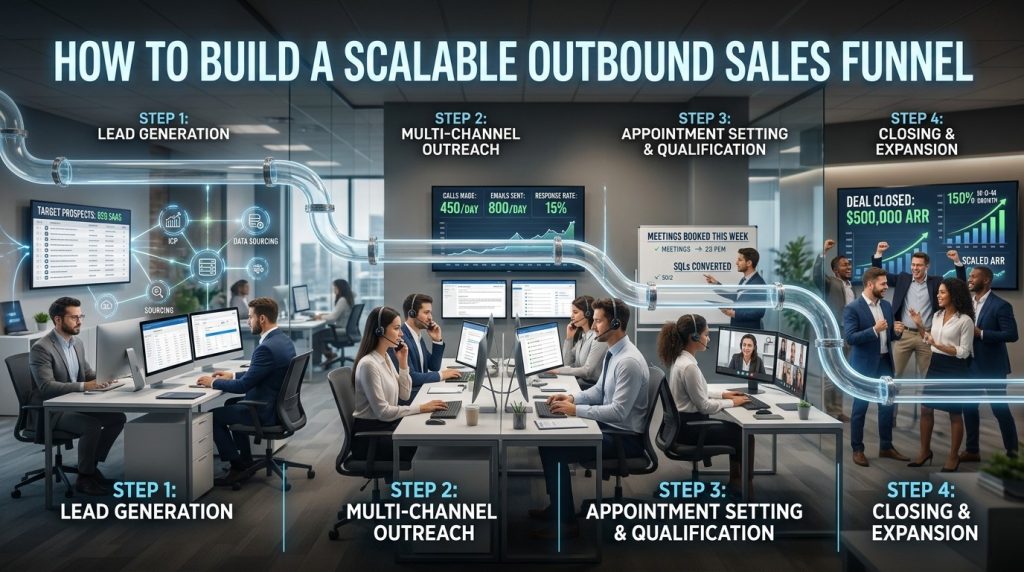
A scalable outbound system turns targeted prospects into qualified opportunities through research, personalization, automation, structured follow-up, measurement, and continuous optimization without sacrificing relevance.
Outbound sales is often misunderstood as simply sending cold emails or making large numbers of cold calls. In reality, a successful outbound operation is a coordinated revenue system that identifies the right prospects, starts relevant conversations, qualifies interest, develops opportunities, and moves qualified buyers toward a purchasing decision.
A Scalable Outbound Sales Funnel is designed to repeat this process consistently while allowing the business to increase prospect volume without increasing operational complexity at the same rate.
That distinction matters.
A small company might manually research fifty prospects, write personalized messages, track conversations in spreadsheets, and close a few deals. That approach can work initially, but it becomes difficult to maintain when the target grows from fifty prospects to five hundred, five thousand, or fifty thousand.
The objective of a Scalable Outbound Sales Funnel is therefore not merely volume. It is controlled growth.
A strong system creates a predictable relationship between prospecting activity, engagement, qualification, meetings, opportunities, and revenue. It also creates feedback loops so the organization can identify which segments, messages, channels, and offers generate the highest-quality results.
This guide explains how to build that system from the ground up, including funnel architecture, audience research, offer positioning, prospecting, outreach sequences, qualification, technology, metrics, optimization, and long-term scaling.
What Is a Scalable Outbound Sales Funnel?
A Scalable Outbound Sales Funnel is a repeatable process for proactively reaching potential customers, generating interest, qualifying prospects, creating sales opportunities, and converting those opportunities into revenue at increasing volume.
Unlike inbound marketing, where prospects often discover a business through search engines, social media, referrals, or content, outbound selling starts with the company identifying potential buyers.
The fundamental stages usually include:
- Ideal customer identification
- Prospect research
- Lead list development
- Segmentation
- Messaging
- Outreach
- Engagement
- Qualification
- Sales conversation
- Proposal or offer
- Negotiation
- Closing
- Retention and expansion
A well-designed Scalable Outbound Sales Funnel connects these stages so information moves smoothly from one step to the next.
The system should answer several important questions:
Who should we contact?
Why should they care?
Which problem are we solving?
Why should they trust us?
What action should they take next?
What happens after they respond?
How do we know whether the process is working?
How can we increase output without destroying quality?
These questions become the strategic foundation of the funnel.
Why Businesses Need an Outbound Sales System
Businesses often experience one of two problems.
The first is inconsistent prospecting. Sales representatives prospect when pipelines are empty, then stop when opportunities increase. Several weeks later, the pipeline becomes empty again.
The second problem is inefficient scaling. Companies increase outreach volume dramatically but see response rates and conversion rates decline.
A Scalable Outbound Sales Funnel solves both problems by creating consistency.
Instead of treating prospecting as an occasional activity, the organization creates a dependable acquisition mechanism.
This creates several benefits:
More Predictable Pipeline Generation
Consistent prospecting makes future opportunities less dependent on luck.
Better Resource Allocation
Sales teams can spend more time on qualified opportunities and less time manually searching for prospects.
Stronger Measurement
Each stage can be tracked to determine exactly where performance is improving or declining.
More Reliable Forecasting
When conversion patterns are stable, organizations can estimate how much activity is required to produce a target number of opportunities.
Easier Team Training
A documented system gives new sales representatives a repeatable framework rather than forcing them to invent their own process.
Start With the Ideal Customer Profile
The first mistake many outbound teams make is beginning with a contact list instead of a customer definition.
A larger list is not automatically a better list.
A Scalable Outbound Sales Funnel becomes stronger when the business knows exactly which organizations and people are most likely to benefit from the offer.
An ideal customer profile should include characteristics such as:
- Industry
- Company size
- Revenue range
- Geography
- Business model
- Growth stage
- Technology stack
- Current challenges
- Buying triggers
- Budget capacity
- Decision-making structure
- Typical sales cycle
For B2B businesses, also define the roles that influence the purchase.
A problem may be experienced by one employee, evaluated by another, approved by a manager, and financially authorized by an executive.
Understanding these relationships improves targeting.
Build Buyer Personas
The ideal customer profile describes the organization.
The buyer persona describes the person.
A useful persona should clarify:
What are they responsible for?
What goals are they measured against?
What frustrates them?
What risks do they want to avoid?
What solutions have they tried?
What causes them to investigate new solutions?
What objections are likely to appear?
What language do they use to describe their problems?
This information directly influences messaging.
A Scalable Outbound Sales Funnel becomes more persuasive when the outreach speaks to the prospect’s actual business context rather than using generic sales language.
Develop a Clear Value Proposition
Prospects do not care that a company wants more customers.
They care about their own priorities.
That means the value proposition should connect the offer with a meaningful business outcome.
Weak positioning might sound like:
“We provide comprehensive digital services.”
Stronger positioning might communicate:
“We help multi-location businesses reduce qualified lead acquisition costs by improving landing-page conversion and campaign attribution.”
The second statement is more specific.
It tells the prospect:
Who it is for.
What problem is addressed.
What outcome is possible.
That creates relevance.
A Scalable Outbound Sales Funnel depends heavily on this clarity because the value proposition appears in emails, call scripts, landing pages, LinkedIn messages, sales presentations, proposals, and follow-up sequences.
The Value Proposition Formula
A useful framework is:
Target Customer + Problem + Solution + Business Outcome
For example:
“We help SaaS companies with high customer acquisition costs improve trial-to-paid conversion through lifecycle optimization.”
The objective is not to make the sentence impressive.
The objective is to make it immediately understandable.
Build the Sales Funnel Architecture
Before scaling outbound activity, document the full process.
This is your Sales Funnel Architecture.
The architecture should show exactly how a prospect moves from identification to revenue.
A basic structure can look like:
| Stage | Objective | Primary Activity | KPI |
|---|---|---|---|
| Targeting | Identify fit | ICP research | ICP accuracy |
| Prospecting | Build pipeline | Lead sourcing | Qualified contacts |
| Outreach | Create awareness | Email/calls/social | Response rate |
| Engagement | Generate interest | Conversations | Positive replies |
| Qualification | Confirm opportunity | Discovery | Qualified meetings |
| Opportunity | Develop need | Sales calls | Opportunity rate |
| Proposal | Present solution | Offer creation | Proposal rate |
| Negotiation | Resolve concerns | Follow-up | Close probability |
| Close | Generate revenue | Contracting | Win rate |
| Expansion | Increase value | Retention/upsell | Customer LTV |
The goal of the architecture is visibility.
When a deal disappears, the team should be able to determine where and why it happened.
That makes improvement possible.
Build a High-Quality Prospect Database
Your database is the fuel of outbound sales.
A poor database creates poor results even when the messaging is excellent.
A prospect record may contain:
Company name.
Website.
Industry.
Company size.
Location.
Decision-maker.
Job title.
Professional profile.
Business email.
Technology signals.
Recent company developments.
Potential pain points.
Buying trigger.
Lead source.
Pipeline stage.
Last interaction.
Next action.
The more relevant information available, the easier it becomes to personalize outreach.
However, more data is not automatically better.
The objective is actionable data.
If a field does not influence segmentation, personalization, qualification, or follow-up, it may not deserve priority.
A Scalable Outbound Sales Funnel should also have clear data standards so every salesperson records information consistently.
Segment Prospects Before Outreach
One message should not be sent to every prospect.
Segmentation creates relevance.
You can segment by:
Industry
Different industries experience different operational problems.
Company Size
A ten-person company may have very different needs from a five-thousand-person enterprise.
Job Role
A CEO may care about strategic growth while a marketing manager may care about campaign efficiency.
Buying Stage
Some prospects are unaware of the problem. Others are actively evaluating solutions.
Trigger Event
Recent funding, leadership changes, expansion, hiring, product launches, acquisitions, or new market entries can indicate changing needs.
Existing Technology
A business using a competing platform may require a different message than a company still working manually.
Effective segmentation is one of the biggest advantages of a Scalable Outbound Sales Funnel because it allows teams to increase volume while maintaining relevance.
Research Before You Reach Out
Cold outreach becomes considerably more effective when it is based on context.
Research does not mean writing a personalized essay for every prospect.
Instead, identify one or two meaningful facts.
Examples include:
A new market expansion.
A recently launched product.
A new executive.
A hiring trend.
A relevant public challenge.
A technology change.
A strategic initiative.
That information can become the bridge between the prospect’s current situation and your offer.
For example:
“I noticed your company recently expanded into the U.K. market. That often creates additional pressure on demand generation and sales coordination.”
This feels more relevant than:
“We are a leading provider of sales solutions.”
The psychology is simple: relevance reduces resistance.
A prospect who feels understood is more likely to continue reading.
Create a Strong Outbound Message
A good outbound message does not need to be complicated.
It needs to answer a few questions quickly:
Why you?
Why me?
Why now?
What next?
A practical structure is:
Observation → Problem → Relevance → Value → CTA
Observation
Show that you understand something about the prospect.
Problem
Connect that observation to a business challenge.
Relevance
Explain why your solution may be useful.
Value
Communicate a specific outcome.
CTA
Offer a clear and low-friction next step.
This structure works because it follows the customer’s thought process.
Use Multiple Channels Intelligently
A Scalable Outbound Sales Funnel should not rely entirely on one communication platform.
Different channels create different advantages.
Email provides asynchronous communication.
Cold calls create immediate conversations.
LinkedIn can provide professional context.
Events can create high-trust interactions.
Direct messages can support warm follow-up.
Retargeting can reinforce awareness.
The objective is not to contact prospects everywhere at the same time.
The objective is to create coordinated touchpoints.
For example:
Day 1: Email.
Day 2: Social engagement.
Day 4: Follow-up email.
Day 6: Call attempt.
Day 9: Value-based message.
Day 13: Final follow-up.
The exact timing should be tested.
A Scalable Outbound Sales Funnel should use data to determine which channel combinations actually create qualified conversations.
Build an Outbound Sequence
One message rarely creates a sales opportunity.
People ignore messages.
They become busy.
They forget.
They may need additional information before responding.
That is why follow-up matters.
A sequence should add information rather than repeating the same sentence.
Touch One: Introduction
Establish relevance.
Touch Two: Problem Insight
Share a useful observation.
Touch Three: Proof
Provide evidence, case context, or a useful result.
Touch Four: Objection Handling
Address a common concern.
Touch Five: Low-Friction CTA
Offer an easy next step.
Touch Six: Breakup or Permission Message
Respectfully close the sequence while leaving the door open.
This approach is more effective than sending “Just following up” five times.
Personalization at Scale
Many companies believe scalability and personalization are opposites.
They are not.
The answer is structured personalization.
Create modular message components based on variables such as:
Industry.
Role.
Pain point.
Trigger.
Product category.
Business size.
Current solution.
That allows sales teams to personalize the most important parts without manually rewriting entire messages.
For example:
“Hi [Name], I noticed [Trigger]. Companies at this stage often face [Problem]. We help [Industry] teams improve [Outcome].”
The framework stays consistent.
The context changes.
That is how a Scalable Outbound Sales Funnel preserves relevance while increasing volume.
Design an Effective Qualification Process
Generating replies is not the same as generating opportunities.
Some prospects are curious but have no budget.
Some have budget but no urgency.
Some have urgency but lack authority.
Some are not a fit at all.
Qualification prevents sales teams from wasting time.
Common qualification dimensions include:
Need
Does the prospect have a real problem?
Impact
How important is the problem?
Authority
Can the contact influence or approve the purchase?
Budget
Is there financial capacity?
Timeline
When does the prospect expect to solve the problem?
Fit
Does the solution match the business?
Urgency
Why should the problem be solved now?
Qualification should feel like a conversation rather than an interrogation.
The purpose is to understand whether there is a legitimate mutual opportunity.
Create a Strong Discovery Call
A discovery call should not become a twenty-minute product demonstration.
The best discovery conversations begin with questions.
Examples:
“What prompted you to explore this now?”
“How are you currently handling the problem?”
“What is working?”
“Where are you seeing friction?”
“What happens if the problem remains unsolved?”
“What would a successful outcome look like?”
“Who else is involved in the decision?”
The answers reveal both business pain and buying motivation.
This allows the salesperson to position the offer around the prospect’s actual needs.
A Scalable Outbound Sales Funnel becomes more effective when the discovery process is standardized but the conversation remains human.
Understand Buying Psychology
Outbound sales is fundamentally psychological.
Prospects are constantly evaluating risk.
Their internal questions may include:
Can I trust this company?
Will this solution actually work?
Is the problem worth solving?
Will implementation become difficult?
Will my team support the change?
What if the decision fails?
That means sales messaging should reduce uncertainty.
Use Social Proof
Case studies, testimonials, customer results, expert validation, and recognizable clients can reduce perceived risk.
Demonstrate Specificity
Specific examples often feel more credible than generic promises.
Show Understanding
A prospect is more likely to trust a business that understands the problem accurately.
Make the Next Step Easy
A complicated CTA creates friction.
A simple conversation request often works better.
These psychological principles should be built into every Scalable Outbound Sales Funnel.
Handle Objections Before They Become Deal Breakers
Objections are not always rejection.
Often they are requests for clarity.
Common outbound objections include:
“We already have a provider.”
“We do this internally.”
“Not interested.”
“Send information.”
“Too expensive.”
“Now is not a good time.”
“Check back later.”
The response should not become defensive.
Instead, acknowledge the concern and investigate the context.
For example:
“That makes sense. Out of curiosity, what is your current approach doing especially well, and where would you still like to improve?”
That question reopens the conversation without creating unnecessary pressure.
Create Trust Before Asking for a Sale
Cold prospects do not owe you their attention.
Trust must be earned.
A trust-building sequence can include:
Useful insights.
Relevant industry observations.
Case studies.
Educational resources.
Specific recommendations.
Transparent communication.
Professional follow-up.
This is why content and outbound sales can reinforce each other.
A prospect may receive an email, search your brand, read an article, review your social presence, and only then agree to a meeting.
When the surrounding brand experience supports the outbound message, conversion becomes easier.
Integrate Content Into the Funnel
Content can strengthen outbound campaigns by answering questions prospects may have before a sales conversation.
Useful assets include:
Case studies.
Industry reports.
Comparison guides.
Checklists.
ROI calculators.
Research summaries.
Implementation guides.
Technical explainers.
Customer stories.
Instead of using content as a generic attachment, connect it to the prospect’s situation.
A financial services prospect may receive a compliance-focused guide.
A SaaS company may receive a retention benchmark.
A retail business may receive a conversion checklist.
That context increases perceived usefulness.
A Scalable Outbound Sales Funnel can use the same content assets across many carefully defined segments.
Connect Outbound With Mobile and Digital Touchpoints
Modern prospects rarely stay inside one channel.
After receiving an outbound message, they may search the company on mobile devices, browse the website, visit social profiles, or consume short-form content.
That means the outbound experience should connect with broader digital acquisition systems.
Mobile Marketing Strategies can support this by reinforcing brand familiarity, providing remarketing opportunities, and simplifying the transition from outreach to website engagement.
The objective is consistency.
The prospect should see the same value proposition, positioning, and brand promise across channels.
Use CRM Automation Correctly
CRM systems are essential for scaling because they provide visibility across the pipeline.
A good CRM should track:
Lead status.
Contact information.
Activities.
Responses.
Meetings.
Opportunities.
Deal stages.
Revenue.
Tasks.
Follow-ups.
Loss reasons.
Without consistent CRM usage, scaling becomes difficult because management loses visibility.
Automation can help trigger:
Follow-up tasks.
Lead assignment.
Meeting reminders.
Pipeline alerts.
Inactive-lead notifications.
Lead scoring.
Reporting.
However, automation should support human judgment rather than replace it.
A Scalable Outbound Sales Funnel becomes dangerous when automation sends irrelevant communication faster than humans can correct it.
Build Lead Scoring
Not every prospect deserves equal attention.
Lead scoring helps sales teams prioritize.
A score might consider:
Company fit.
Job seniority.
Engagement.
Website behavior.
Email interaction.
Buying signals.
Technology fit.
Recent trigger events.
For example:
+10 points for target industry.
+15 for executive role.
+20 for high-intent page visit.
+25 for demo request.
-10 for poor company fit.
-20 for invalid use case.
The specific scoring model should be customized.
The goal is to identify where sales attention is most likely to produce business value.
Measure the Funnel With the Right Metrics
A Scalable Outbound Sales Funnel should be measurable from top to bottom.
Important metrics include:
Prospecting Metrics
Number of targeted accounts.
Number of qualified contacts.
Data accuracy.
New prospects added.
Outreach Metrics
Delivery rate.
Open rate where measurable.
Response rate.
Positive response rate.
Meeting-booked rate.
Qualification Metrics
Qualified meeting rate.
Opportunity creation rate.
Pipeline value.
Sales Metrics
Proposal rate.
Win rate.
Average deal size.
Sales cycle length.
Financial Metrics
Customer acquisition cost.
Revenue per account.
Pipeline contribution.
Customer lifetime value.
Return on sales investment.
The key principle is to measure quality, not just volume.
Calculate Funnel Conversion Rates
Suppose a campaign contacts 1,000 prospects.
If 80 respond positively, the positive response rate is:
80 ÷ 1,000 × 100 = 8%
Suppose 40 of those responses become qualified meetings:
40 ÷ 80 × 100 = 50%
Suppose 12 meetings become opportunities:
12 ÷ 40 × 100 = 30%
Suppose 3 opportunities close:
3 ÷ 12 × 100 = 25%
Now the team understands the relationship between activity and revenue.
This is where the concept of scalability becomes measurable.
If three closed deals require twelve opportunities, and twelve opportunities require forty qualified meetings, management can work backward to estimate the activity required for a revenue target.
Diagnose Funnel Leaks
When revenue declines, do not immediately increase outreach volume.
First identify where the leak exists.
Low Responses
Potential problems:
Poor targeting.
Weak message.
Wrong channel.
Weak relevance.
Poor deliverability.
High Responses but Few Meetings
Potential problems:
Weak CTA.
Poor qualification.
Unclear value.
Slow follow-up.
Many Meetings but Few Opportunities
Potential problems:
Weak qualification.
Poor discovery.
Bad ICP.
Low urgency.
Many Opportunities but Few Wins
Potential problems:
Pricing.
Competitive positioning.
Weak proof.
Product mismatch.
Poor objection handling.
Slow sales process.
This diagnostic approach prevents teams from solving every problem with more activity.
Optimizing Funnel Stages
Optimizing Funnel Stages should happen systematically rather than through random experimentation.
Start by identifying the lowest-performing stage.
Then form a hypothesis.
For example:
“Positive responses are low because the message focuses on our company instead of the prospect’s business problem.”
Test a revised message.
Measure the result.
If performance improves consistently, document the change.
Then move to the next bottleneck.
This creates a continuous improvement loop:
Measure → Diagnose → Hypothesize → Test → Learn → Document → Scale.
A Scalable Outbound Sales Funnel should be treated as an evolving operating system.
Build a Testing Framework
Testing can include:
Subject lines.
Opening sentences.
Offers.
Calls to action.
Message length.
Social proof.
Targeting.
Sequence timing.
Channel order.
Landing pages.
Sales scripts.
A/B testing should isolate meaningful variables.
If ten things change simultaneously, the team cannot determine what actually caused the improvement.
Testing also requires enough data.
A tiny sample can create misleading conclusions.
The purpose of testing is not to declare winners quickly.
The purpose is to discover repeatable patterns.
Improve Follow-Up Speed
Speed matters because interest can decline.
A prospect who responds with curiosity today may have a different priority two weeks later.
That is why response processes should be clearly documented.
Define:
Who receives the response?
How quickly should they respond?
What happens after a positive reply?
What happens after a question?
What happens after an objection?
What happens when the prospect goes silent?
Operational clarity can significantly improve funnel performance.
Automation can create alerts, but human responsiveness remains critical.
Create Sales and Marketing Alignment
Outbound performance becomes stronger when marketing and sales collaborate.
Marketing can provide:
Audience research.
Content assets.
Competitive insights.
Messaging frameworks.
Campaign analysis.
Brand positioning.
Sales can provide:
Objection data.
Customer language.
Common pain points.
Lost-deal reasons.
Buyer questions.
Competitive information.
Together, these insights improve the funnel.
A Scalable Outbound Sales Funnel should therefore not be owned by sales alone. Marketing, sales operations, customer success, and leadership can all contribute information that improves revenue performance.
Train Sales Representatives With a Repeatable System
A funnel cannot scale beyond the people operating it.
New representatives need clear guidance on:
ICP.
Messaging.
Qualification.
CRM usage.
Call structure.
Objection handling.
Follow-up.
Proposal process.
Escalation.
Reporting.
Training should include role-playing.
Simulate:
Positive replies.
Indifferent prospects.
Aggressive objections.
Pricing concerns.
Competitor comparisons.
Decision-maker conversations.
The objective is to build judgment rather than force employees to memorize robotic scripts.
Protect Brand Reputation During Outbound Scaling
Rapid outbound growth can create reputational risk.
When outreach becomes irrelevant, excessive, deceptive, or poorly targeted, prospects may associate the brand with spam.
That damage can extend beyond a single campaign.
Sales teams should therefore use clear targeting, professional communication, appropriate frequency, accurate information, and respectful follow-up.
Brand reputation becomes even more important when handling mistakes.
When an outbound campaign causes confusion or frustration, principles associated with Mastering the Brand Apology can help explain how accountability, transparency, and customer-centered communication can restore trust.
A Scalable Outbound Sales Funnel should scale quality and relevance—not just message counts.
Build an Offer That Reduces Friction
Your offer affects conversion dramatically.
A prospect may reject a meeting because the perceived commitment feels too high.
Instead of:
“Book a 60-minute product demonstration.”
Consider:
“Join a 15-minute fit assessment.”
The second option feels smaller.
Useful low-friction offers can include:
Quick audits.
Benchmark reports.
Personalized recommendations.
Short strategy sessions.
Diagnostic calls.
Free assessments.
Relevant educational resources.
The offer should still provide genuine value.
Develop a Strong Handoff Process
Marketing and sales handoffs can create significant friction.
When an opportunity moves from prospecting to sales, the receiving representative should understand the context.
A handoff record can include:
Why the prospect responded.
What problem was discussed.
What solution interests them.
What objections appeared.
Who else is involved.
What timeline was mentioned.
What the next step is.
This prevents prospects from repeating themselves.
A Scalable Outbound Sales Funnel should make the customer’s experience feel continuous even when multiple employees are involved.
Scale Carefully: The Four Levers of Growth
There are four major ways to increase outbound revenue.
Increase Prospect Volume
Reach more qualified prospects.
Improve Conversion Rates
Generate more responses and meetings from the same volume.
Increase Average Deal Size
Target larger accounts or expand the offer.
Increase Retention and Expansion
Generate additional revenue from existing customers.
Many companies focus entirely on volume.
That is often a mistake.
Improving conversion efficiency can be significantly more powerful because it increases output without requiring proportional increases in activity.
Automate Repetitive Work, Not Relationships
Automation is valuable for:
Data enrichment.
Lead routing.
Task creation.
CRM updates.
Scheduling.
Reporting.
Follow-up reminders.
Campaign management.
Automation becomes risky when it tries to simulate genuine human understanding.
Prospects can recognize generic communication quickly.
Therefore:
Automate processes.
Personalize messaging.
Humanize conversations.
This distinction protects both conversion rates and brand reputation.
Use AI to Increase Outbound Efficiency
Artificial intelligence can help outbound teams with:
Research summaries.
Prospect classification.
Account prioritization.
Message drafting.
Call summaries.
CRM updates.
Objection analysis.
Lead scoring.
Pattern detection.
Performance reporting.
AI can reduce repetitive work, allowing sales representatives to spend more time on high-value conversations.
However, generated messages should be reviewed for accuracy, relevance, tone, and contextual fit.
The system should help salespeople think faster, not encourage careless mass outreach.
A Scalable Outbound Sales Funnel becomes stronger when AI is used to support judgment instead of replacing judgment.
Create a Revenue Forecasting Model
Forecasting should begin with historical conversion rates.
Imagine your funnel produces:
1,000 targeted prospects.
100 meaningful responses.
50 qualified meetings.
20 opportunities.
5 closed deals.
If the average contract value is $5,000, the resulting revenue is:
5 × $5,000 = $25,000.
Now management can ask:
How many additional deals are needed?
How many opportunities are required?
How many meetings are required?
How much prospecting capacity is needed?
This allows the sales organization to work backward from revenue instead of forward from activity.
That is one of the clearest characteristics of a mature Scalable Outbound Sales Funnel.
Understand Unit Economics
Scaling makes sense only when the economics remain healthy.
Track:
Customer acquisition cost.
Average contract value.
Gross margin.
Sales cycle.
Rep productivity.
Lifetime value.
Payback period.
The funnel may technically produce more customers while becoming less profitable.
For example, doubling acquisition volume while tripling acquisition cost is not necessarily growth worth celebrating.
Scaling should improve or preserve economic efficiency.
When Should You Scale Outbound?
Do not scale immediately after one successful campaign.
First confirm:
The ICP is accurate.
The offer resonates.
The messaging works.
The conversion process is stable.
The CRM is reliable.
Follow-up is consistent.
The economics are acceptable.
The team can handle increased volume.
Once the process is repeatable, scaling becomes less risky.
A Scalable Outbound Sales Funnel should be proven before it is aggressively expanded.
A Practical 90-Day Implementation Plan
Days 1–30: Foundation
Define the ICP.
Create buyer personas.
Develop messaging.
Build the database.
Document funnel stages.
Configure CRM fields.
Create qualification criteria.
Develop outbound assets.
Create initial sequences.
Days 31–60: Launch
Start controlled outreach.
Monitor response quality.
Conduct discovery calls.
Document objections.
Analyze channel performance.
Improve targeting.
Test message variations.
Train sales representatives.
Days 61–90: Optimization
Identify bottlenecks.
Improve weak stages.
Strengthen qualification.
Automate repetitive processes.
Refine lead scoring.
Increase winning segments.
Reduce low-quality activity.
Create forecasting models.
At this stage, the business should have enough information to determine which parts of the system deserve investment.
Advanced Funnel Strategy: Account-Based Outbound
For high-value B2B sales, account-based outbound can be especially useful.
Instead of targeting thousands of unrelated contacts, sales teams identify a smaller set of high-value organizations.
Then they research multiple stakeholders within each account.
The strategy may involve:
Executive outreach.
Department-level messaging.
Relevant content.
Personalized insights.
Account research.
Multi-threaded conversations.
Strategic follow-up.
This approach can produce deeper engagement because the outreach is based on account context rather than individual contact data alone.
Multi-Thread the Decision-Making Process
Large purchases often involve multiple stakeholders.
A single contact can disappear, change roles, lose internal support, or become unavailable.
Therefore, build relationships with several relevant people.
Potential stakeholders may include:
Executive sponsor.
Department leader.
End user.
Procurement.
Finance.
Technical evaluator.
Legal.
Understanding each stakeholder’s concerns creates stronger opportunities.
A Scalable Outbound Sales Funnel should therefore be designed around buying groups, not just individual contacts when the sales cycle requires it.
Build a Feedback Loop After Every Lost Deal
Lost opportunities are valuable sources of intelligence.
Record why deals are lost.
Examples:
Price.
Timing.
Competition.
No decision.
Missing feature.
Implementation concern.
Internal priority.
Poor fit.
Then aggregate those reasons.
Patterns often appear.
Maybe pricing is not actually the main issue. Perhaps the offer is reaching companies without enough urgency.
Maybe competitors are not winning because of price but because they have better proof.
Loss data can improve:
Targeting.
Positioning.
Offers.
Sales training.
Product development.
Forecasting.
This creates a powerful feedback cycle.
The Difference Between Volume and Scalability
Volume means sending more.
Scalability means producing more output without proportional increases in complexity or cost.
For example:
A salesperson manually sends 100 personalized emails per day.
Another system allows a trained team to reach 1,000 relevant prospects per day with segmentation, automation, controlled personalization, consistent CRM tracking, and human review.
The second system is closer to scalability.
However, automation without quality can create negative scalability.
You may generate more messages but fewer qualified conversations.
That is why the Scalable Outbound Sales Funnel should always balance:
Volume.
Relevance.
Conversion.
Cost.
Quality.
Customer experience.
Common Outbound Funnel Mistakes
Mistake 1: Targeting Everyone
A broad market usually produces weak relevance.
Mistake 2: Selling Too Early
The prospect may not yet understand the problem.
Mistake 3: Writing About Yourself
Prospects care primarily about their own outcomes.
Mistake 4: Over-Personalizing
Personalization that feels artificial can be worse than concise relevance.
Mistake 5: Ignoring Follow-Up
One message rarely represents a complete process.
Mistake 6: Measuring Vanity Metrics
High activity does not guarantee revenue.
Mistake 7: Scaling Before Validation
Increasing volume before fixing the funnel multiplies inefficiency.
Mistake 8: Treating Every Lead Equally
High-fit accounts deserve greater attention.
Mistake 9: Relying Completely on Automation
Relationships require judgment and human communication.
Mistake 10: Ignoring Brand Experience
Outbound creates expectations that the rest of the customer journey must fulfill.
The Complete Scalable Outbound Sales Funnel Framework
A mature framework can be summarized as:
Research → Target → Segment → Personalize → Reach → Engage → Qualify → Discover → Propose → Negotiate → Close → Retain → Learn → Optimize → Scale
Each stage should have:
A clear objective.
A measurable KPI.
An owner.
A documented process.
A defined next step.
A feedback mechanism.
When these elements exist, the funnel becomes easier to manage.
The organization can identify bottlenecks.
Sales managers can coach specific behaviors.
Marketing can support weak areas.
Leadership can forecast outcomes.
Operations can improve efficiency.
That is the true purpose of building a Scalable Outbound Sales Funnel.
Final Strategic Checklist
Before scaling, verify the following:
Is the ICP clearly documented?
Are prospects segmented?
Is prospect data accurate?
Is the value proposition specific?
Does every sequence have a clear purpose?
Are follow-ups structured?
Is qualification consistent?
Is CRM usage standardized?
Are conversion rates measured?
Are lost deals analyzed?
Are team members trained?
Are automation rules documented?
Is the customer experience consistent?
Are privacy and communication standards being respected?
Are unit economics healthy?
Can increased volume be handled without sacrificing quality?
If the answer to most of these questions is yes, the organization has a strong foundation for predictable outbound growth.
Conclusion
Building a scalable outbound operation is not about sending more messages; it is about building a repeatable revenue system that consistently creates relevant conversations. A Scalable Outbound Sales Funnel begins with precise targeting, strong positioning, quality data, thoughtful outreach, effective qualification, and disciplined follow-up. From there, CRM automation, measurement, testing, AI assistance, and sales training help increase efficiency without sacrificing the human element. The most successful teams continuously identify funnel leaks, learn from objections and lost deals, improve conversion rates, and scale only after the underlying process is proven. When targeting, messaging, technology, people, economics, and customer experience work together, outbound sales can become a predictable and sustainable growth engine.
Frequently Asked Questions (FAQ)
1. What is a Scalable Outbound Sales Funnel?
A Scalable Outbound Sales Funnel is a repeatable sales system that identifies target prospects, initiates conversations, qualifies opportunities, and converts suitable prospects into customers while allowing the organization to increase volume efficiently.
2. Why is outbound sales still important?
Outbound sales allows companies to proactively reach specific customers rather than waiting for demand to appear. It is particularly useful when businesses have clearly defined target accounts, specialized products, or predictable buyer profiles.
3. How do I create a scalable outbound funnel?
Start by defining the ideal customer profile, researching prospects, segmenting audiences, developing relevant messaging, building outreach sequences, establishing qualification criteria, configuring CRM processes, and measuring each funnel stage.
4. What is the most important stage of an outbound funnel?
There is no single universally most important stage. However, targeting and qualification are foundational because poor-fit prospects create problems throughout the rest of the funnel.
5. How many follow-ups should an outbound sequence include?
The ideal number depends on the market, buyer, channel, offer, and response behavior. Instead of using an arbitrary number, create a sequence that adds value, tests different approaches, and stops when continued contact becomes inappropriate or unproductive.
6. How can I personalize outbound messages at scale?
Use structured personalization based on industry, role, business challenge, buying trigger, company characteristics, and relevant context. Modular templates can preserve consistency while allowing important details to change for each segment.
7. What metrics should I track?
Track qualified prospect volume, response rate, positive response rate, meetings booked, qualified meeting rate, opportunity rate, win rate, average deal size, sales cycle, acquisition cost, pipeline value, and revenue generated.
8. Can AI improve outbound sales?
AI can support prospect research, prioritization, message drafting, lead scoring, call summarization, CRM updates, objection analysis, and performance reporting. Human review remains important for accuracy, relevance, judgment, and relationship-building.
9. When should a company scale outbound activity?
Scale after the company has evidence that its ICP, offer, messaging, qualification process, follow-up, CRM workflow, and unit economics are working consistently. Scaling a broken process generally increases inefficiency.
10. What is the biggest mistake when building an outbound funnel?
The biggest mistake is focusing on outreach volume before establishing relevance and process quality. More activity cannot compensate for poor targeting, weak positioning, inaccurate data, inadequate qualification, or an inefficient sales process.