Fixing Funnel Leaks : Where Outbound Prospects Drop Off
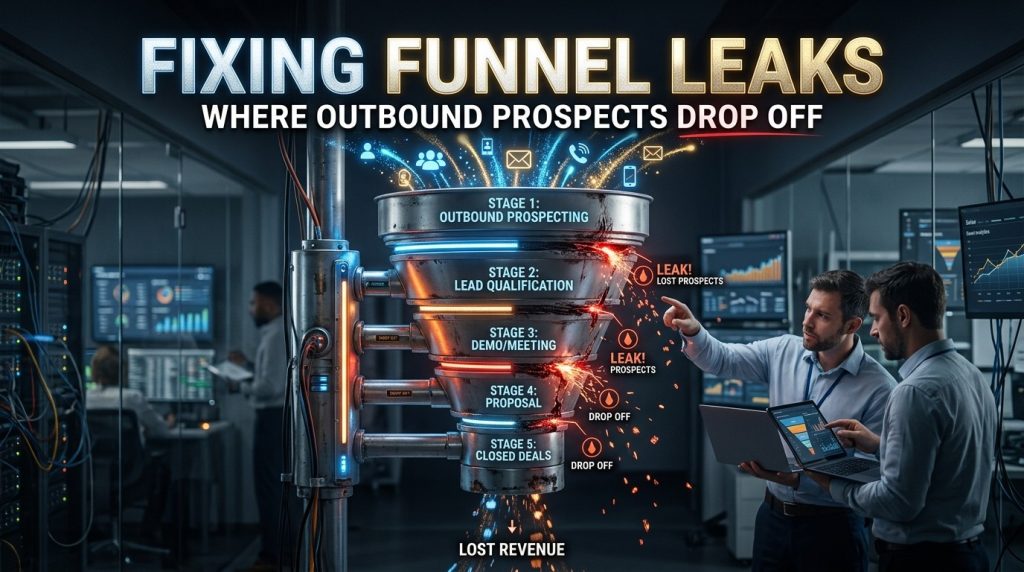
Outbound funnels lose prospects at predictable moments, and Fixing Funnel Leaks requires identifying friction, intent gaps, message problems, follow-up failures, and conversion barriers systematically.
Outbound prospecting rarely fails because a team cannot generate enough names. More often, performance breaks down between stages. A prospect may notice an email but never reply, respond positively but never book, attend a meeting but never move forward, or receive a proposal and quietly disappear. These gaps create hidden revenue losses because the funnel can look healthy at the top while producing weak outcomes at the bottom.
That is why Fixing Funnel Leaks is not simply about sending more messages. It is about understanding what happens to prospects as they move from awareness to engagement, qualification, opportunity, and decision. Every stage creates a different psychological question. Prospects ask whether the message is relevant, whether the problem matters, whether the sender is credible, whether the next step feels worthwhile, and whether the perceived risk of continuing is acceptable.
A strong outbound system therefore treats every drop-off as evidence. When response rates fall, the issue may be targeting. When replies happen but meetings do not, the problem may be message-to-action alignment. When meetings happen but opportunities stall, the problem may be qualification, urgency, authority, trust, or commercial fit.
Fixing Funnel Leaks begins by replacing assumptions with stage-level evidence. Instead of saying “the campaign is not working,” teams should identify exactly where prospects stop moving and why. Once the actual leak becomes visible, the correction becomes far more practical.
Why Outbound Funnels Leak in the First Place
Every outbound funnel contains friction. Some friction is intentional because qualifying prospects is part of selling. Other friction is accidental and comes from unclear messaging, poor timing, weak positioning, excessive steps, irrelevant offers, or inconsistent follow-up.
Fixing Funnel Leaks starts with separating healthy filtering from destructive friction. A prospect who declines because the solution is genuinely irrelevant is not necessarily a funnel problem. A prospect who repeatedly expresses interest but cannot understand the next step represents a different issue.
The distinction matters because teams can easily optimize the wrong metric. Increasing reply volume can look positive while generating more low-intent conversations. Increasing booked meetings can also appear successful if many meetings are poorly qualified and never become real opportunities.
The useful question is not simply, “Where did the prospect leave?” The better question is, “What changed between the moment the prospect showed interest and the moment they stopped progressing?”
The Funnel Is a Sequence of Psychological Decisions
Outbound conversion is rarely one decision. It is a series of small decisions.
A prospect first decides whether to pay attention. Then they decide whether the message is relevant. Then they decide whether responding is worth the effort. After responding, they evaluate whether the conversation deserves more time. During a sales call, they assess credibility, fit, risk, urgency, and expected value. Later, they may need internal agreement before taking commercial action.
Fixing Funnel Leaks requires examining those decisions individually instead of treating the funnel as one large conversion event.
For example, a campaign may have strong open rates and weak replies. That indicates attention without sufficient motivation. Another campaign may generate replies but very few meetings. That suggests curiosity without enough perceived value in the proposed next step.
A third campaign may produce many meetings and few opportunities. Here the acquisition layer may be functioning while qualification or positioning is broken.
Not Every Drop-Off Is a Problem
Prospects are expected to leave.
Some are outside the target market. Some have no relevant pain. Some are already committed to another provider. Others may have budget constraints or internal priorities that make the timing wrong.
Fixing Funnel Leaks should focus on avoidable losses rather than trying to force every prospect through every stage.
The goal is not maximum movement at all costs. The goal is meaningful movement from qualified prospects.
Map the Outbound Funnel Before Changing It
Before improving performance, document the actual funnel.
A typical outbound journey may look like:
| Funnel Stage | Prospect Action | Main Question | Common Leak |
|---|---|---|---|
| Targeting | Enters campaign | Is this audience appropriate? | Poor fit |
| First touch | Sees message | Is this relevant to me? | Weak relevance |
| Engagement | Reads or interacts | Is this worth attention? | Generic message |
| Response | Replies | Should I start a conversation? | Low motivation |
| Booking | Accepts meeting | Is this worth my time? | High friction |
| Discovery | Shares information | Can this solve my problem? | Weak discovery |
| Qualification | Confirms fit | Is this commercially viable? | Poor qualification |
| Proposal | Reviews offer | Is the value credible? | Unclear economics |
| Decision | Approves or rejects | Is the risk acceptable? | Trust or urgency |
| Close | Signs or pays | Is action easier than delay? | Process friction |
Fixing Funnel Leaks becomes easier when each stage has a clearly defined entry and exit condition.
Without that definition, teams often mix together leads, responses, qualified conversations, opportunities, and customers. Once those categories are separated, the real bottleneck becomes easier to see.
Leak #1: Poor Prospect Targeting
The earliest and often most expensive leak happens before outreach even begins.
A sales team can write excellent messages and still perform badly when the prospect list is wrong. When targeting is weak, every later metric becomes distorted.
Fixing Funnel Leaks at this stage means examining whether the people being contacted actually experience the problem being discussed.
Check the Ideal Customer Profile
An ideal customer profile should be operational, not decorative.
It should identify characteristics that help predict relevance, such as company type, business model, market, team size, technology environment, role, use case, growth stage, or specific operational conditions.
The more precise the profile, the easier it becomes to adapt messaging.
A company may technically match a broad industry category while having no reason to buy. A role may hold the right job title but lack responsibility for the problem. A business may have the right size but be focused on a different strategic priority.
Fixing Funnel Leaks means going beyond surface-level attributes.
Look for Trigger-Based Fit
Strong outbound lists often become more useful when built around triggers.
A trigger may include hiring activity, expansion, a product launch, a new executive, a technology change, funding, geographic expansion, new compliance requirements, or an operational shift.
Triggers do not guarantee purchase intent, but they can create context for a relevant conversation.
Fixing Funnel Leaks becomes much more effective when targeting reflects current business circumstances instead of static demographic categories.
Leak #2: Weak First-Touch Relevance
Even a well-targeted prospect may ignore an outreach message if the opening does not communicate relevance quickly.
People scan communications under heavy attention pressure. They do not initially care how much research the sender performed. They care whether the message appears connected to something meaningful in their world.
Fixing Funnel Leaks at the first-touch stage requires stronger relevance signals.
A useful message usually connects three ideas: the prospect’s situation, the problem created by that situation, and a reason to consider a different approach.
For example, a generic message might describe the sender’s service. A more relevant message can refer to a recognizable business condition and explain why it may create a measurable challenge.
Avoid the “About Us” Opening
Many outbound messages begin with company history, service descriptions, awards, or broad claims.
Those details can matter later, but they rarely create enough motivation for initial engagement.
Fixing Funnel Leaks often means moving attention away from the seller and toward the prospect.
A buyer should be able to understand within seconds why the message could be relevant.
Make the Value Concrete
“Improve growth,” “increase efficiency,” and “drive better results” are broad claims.
More useful messaging connects the benefit with a specific business mechanism.
For instance, reducing response delays in a sales workflow has a clearer connection to revenue than simply promising “better sales performance.”
Fixing Funnel Leaks requires language that helps prospects mentally connect the problem to a measurable consequence.
Leak #3: Messaging That Does Not Match the Channel
A message that works in email may not work in LinkedIn, direct messaging, cold calling, or another outreach environment.
Each channel creates different expectations about length, context, speed, and social behavior.
Fixing Funnel Leaks therefore requires adapting the message to the communication environment.
For example, a detailed email can support more explanation. A shorter social message may need to create relevance first and continue the conversation later.
Teams that copy identical messaging across channels often create artificial friction because the message feels unnatural in the environment.
This is where Adapting Channel Messaging becomes an important operational discipline rather than a creative exercise.
Match Message Length to Attention
The right question is not “How short can this be?”
The better question is “How much information is necessary for this stage?”
A first message should not attempt to complete the entire sales presentation. It needs enough information to establish relevance and create a credible next step.
Fixing Funnel Leaks often means removing unnecessary information rather than adding more persuasive language.
Match the CTA to Buyer Readiness
A common outbound mistake is asking for too much too soon.
A cold prospect may not want a thirty-minute call after reading one message. They may be more comfortable answering a simple question, confirming ownership of a problem, or reviewing a useful resource.
Fixing Funnel Leaks involves reducing the psychological distance between the current stage and the requested action.
Leak #4: The Prospect Replies but Does Not Book
This is one of the most important diagnostic points.
When prospects respond but fail to book a meeting, the campaign has already created some level of interest. The problem may therefore exist in the transition from conversation to commitment.
Fixing Funnel Leaks here means studying the handoff.
Was the next step clear? Was the request too large? Did the salesperson respond quickly enough? Did the reply address the prospect’s specific concern? Was the scheduling process simple?
A positive reply is not the same as buying intent. It is an invitation to continue learning.
Reduce Scheduling Friction
Every extra step increases the chance of abandonment.
Requiring the prospect to exchange multiple emails, choose from confusing options, or complete a long form can create unnecessary resistance.
Fixing Funnel Leaks may be as simple as creating a clear scheduling path with reasonable options and enough context to explain why the meeting is useful.
Do Not Convert Every Reply Into a Sales Pitch
A prospect who says, “Tell me more” is asking for information.
Immediately responding with a hard close can create psychological resistance.
A better transition provides a concise explanation, confirms the problem, and then introduces a logical next step.
Fixing Funnel Leaks requires respecting the stage of intent rather than treating every positive signal as permission for an aggressive pitch.
Leak #5: Weak Discovery Calls
A booked meeting can create a false sense of success.
Teams may celebrate appointment volume while ignoring what happens during the conversation.
If discovery is weak, prospects may leave without a clear reason to continue.
Fixing Funnel Leaks at this stage requires moving beyond scripted presentation.
Diagnose Before Prescribing
Effective discovery explores the current situation before presenting a solution.
Useful questions examine the existing process, obstacles, business consequences, previous attempts, internal priorities, desired outcome, and timing.
The objective is not to interrogate the prospect. It is to understand whether the problem is important enough to solve.
Fixing Funnel Leaks becomes easier when sales conversations generate usable evidence rather than vague statements of interest.
Quantify the Problem
A pain point becomes more actionable when the business impact is understood.
That impact may involve lost revenue, wasted labor, delayed growth, higher acquisition costs, lower conversion, operational risk, or missed opportunities.
The exact metric depends on the business model.
Fixing Funnel Leaks means identifying whether the prospect perceives the problem strongly enough to justify changing something.
Leak #6: Poor Qualification
Not every interested prospect belongs in the sales pipeline.
When qualification standards are weak, sales teams spend time on conversations that are unlikely to progress.
Fixing Funnel Leaks requires defining what constitutes a qualified opportunity.
A practical qualification framework can examine problem relevance, business impact, authority, resources, timeline, existing alternatives, and willingness to change.
The exact framework may differ across companies, but the principle remains consistent: qualification should help identify realistic paths to value.
Separate Interest From Intent
A prospect can be interested in a topic without being ready to purchase.
Someone may ask for information, attend a webinar, or engage repeatedly because the subject is educationally useful.
Fixing Funnel Leaks requires distinguishing curiosity from commercial intent.
This prevents sales teams from interpreting every interaction as a pipeline signal.
Create Explicit Stage Criteria
Each pipeline stage should have a documented definition.
For example, a qualified opportunity might require a validated business problem, an appropriate stakeholder, a credible business case, and an identifiable next step.
Fixing Funnel Leaks becomes much easier when stage movement depends on evidence rather than optimism.
Leak #7: Weak Follow-Up After the Meeting
One of the most common outbound breakdowns occurs after a good conversation.
The salesperson believes the meeting went well. The prospect agrees to “stay in touch.” Then nothing happens.
This is often a process problem.
Fixing Funnel Leaks requires treating post-meeting follow-up as part of the sales experience, not administrative cleanup.
A strong follow-up should capture what was discussed, what matters to the prospect, what was agreed, who owns each action, and what happens next.
Recap the Prospect’s Priorities
People respond more positively when follow-up reflects their own stated objectives.
Rather than sending a generic thank-you message, summarize the specific issue discussed and connect it to the next action.
Fixing Funnel Leaks becomes more systematic when the prospect can easily see continuity between the meeting and the proposed next step.
Set a Date, Not a Vague Intention
“Let me know when you are ready” creates a dead end.
A defined next step keeps momentum visible.
Even when the prospect is not ready to purchase, a specific review date can preserve the relationship and create a natural reason to reconnect.
Fixing Funnel Leaks is often about preserving momentum that would otherwise disappear.
Leak #8: Proposal and Pricing Friction
A prospect can believe in the solution and still reject the buying process.
Common proposal problems include unclear scope, confusing pricing, excessive customization, unexplained fees, generic language, weak proof, and too many decisions.
Fixing Funnel Leaks in this stage requires reducing uncertainty.
Make the Commercial Story Easy to Understand
A proposal should answer practical questions.
What is being provided? What problem does it address? What is included? What is the expected process? What does the buyer need to do? What are the commercial terms? What happens after approval?
Fixing Funnel Leaks means making those answers obvious rather than forcing the prospect to decode a complicated document.
Connect Cost With the Business Problem
Price becomes harder to evaluate when the underlying problem is undefined.
A proposal should connect the investment with the business outcome or operational change being pursued.
That does not mean making unrealistic ROI promises. It means helping the buyer understand what the purchase is intended to accomplish.
Fixing Funnel Leaks requires clarity, not exaggerated certainty.
Leak #9: Trust Is Too Weak
Outbound prospects are often being approached by people they do not know.
Trust therefore has to be earned in small increments.
Evidence can include relevant examples, process transparency, useful expertise, credible references, customer stories, clear expectations, and consistent communication.
Fixing Funnel Leaks at the trust stage involves reducing uncertainty around the seller and the proposed outcome.
Use Proof Carefully
Proof is strongest when it resembles the prospect’s context.
A case study from a completely unrelated business may have less persuasive value than a smaller example that matches the buyer’s situation.
Fixing Funnel Leaks means prioritizing relevance over volume.
Avoid Overclaiming
Aggressive claims can create skepticism.
Promises such as “guaranteed growth” or “instant results” may attract attention but can reduce credibility when the evidence does not support them.
A transparent explanation of what the solution can and cannot do is often more useful for serious buyers.
Fixing Funnel Leaks should improve trust, not merely increase short-term clicks.
Leak #10: Internal Buying Friction
Sometimes the prospect personally supports the purchase but cannot make the decision alone.
Other stakeholders may include finance, legal, operations, procurement, IT, management, or another business unit.
Fixing Funnel Leaks requires recognizing that the person in your pipeline may not be the entire buying group.
Identify Stakeholders Early
Ask who else will be involved in evaluating or approving the decision.
The question should feel practical rather than manipulative.
Understanding the buying process allows the seller to prepare appropriate evidence for each stakeholder.
Fixing Funnel Leaks becomes easier when hidden decision-makers are considered before the final proposal stage.
Give the Champion Useful Internal Material
A strong internal champion may need to explain the purchase to colleagues.
Helpful material can include a concise business case, implementation outline, expected benefits, commercial summary, risk considerations, and frequently asked questions.
Fixing Funnel Leaks means supporting the buying process beyond the initial conversation.
Diagnose Funnel Leaks With Stage-by-Stage Metrics
Funnel analysis becomes useful when every stage has a measurable conversion event.
Consider tracking:
| Metric | What It Helps Diagnose |
|---|---|
| Positive response rate | Relevance and message resonance |
| Qualified response rate | Targeting quality |
| Response-to-meeting rate | CTA and conversation quality |
| Meeting attendance rate | Scheduling and perceived value |
| Meeting-to-opportunity rate | Discovery and qualification |
| Opportunity-to-proposal rate | Fit and commercial alignment |
| Proposal-to-close rate | Trust, value, risk, pricing |
| Average sales-cycle length | Buying friction |
| Revenue per qualified lead | Overall commercial quality |
Fixing Funnel Leaks is much harder when teams only track open rates and total leads.
Look for Conversion Gaps
Suppose 1,000 prospects receive outreach and 80 reply. That tells you something about engagement. But the next question is how many of those 80 become qualified conversations.
If only 10 progress, the largest problem may not be initial outreach.
Fixing Funnel Leaks means locating the largest meaningful conversion gap rather than automatically optimizing the first visible metric.
Use Cohort Analysis
Aggregate numbers can hide important differences.
Compare performance by industry, persona, campaign, offer, channel, message angle, salesperson, company size, and trigger.
A funnel may perform poorly overall while performing strongly within one specific segment.
Fixing Funnel Leaks becomes more precise when the data reveals which conditions produce different outcomes.
Find Behavioral Signals Behind Drop-Offs
Numbers tell you where the funnel changes. Behavioral evidence helps explain why.
Review sales calls, reply patterns, objection themes, meeting notes, proposal questions, and reasons for lost opportunities.
Fixing Funnel Leaks becomes more reliable when quantitative and qualitative evidence are combined.
Build a Drop-Off Reason Taxonomy
Create consistent categories for why prospects stop progressing.
Examples might include:
- No current priority
- Budget unavailable
- Wrong stakeholder
- Poor fit
- Existing solution
- Timing issue
- Lack of trust
- Unclear value
- Implementation concern
- Pricing concern
- Internal approval delay
- No response after proposal
The categories should remain stable enough to identify patterns.
Fixing Funnel Leaks becomes significantly easier when lost opportunities are explained consistently rather than recorded simply as “closed lost.”
Fixing Funnel Leaks With Message Testing
Testing should answer a specific question.
Changing subject lines, opening messages, offers, CTAs, and follow-up structures simultaneously makes it difficult to understand what caused improvement or decline.
Fixing Funnel Leaks requires controlled experimentation wherever possible.
Test One Major Variable at a Time
You can test message angle, CTA type, personalization depth, offer format, proof style, or follow-up timing.
The goal is not perfect laboratory science. The goal is to generate interpretable evidence.
Fixing Funnel Leaks benefits from disciplined testing because sales teams often make decisions based on isolated anecdotes.
Measure Down-Funnel Outcomes
A message producing more responses is not automatically better for revenue.
One version may generate many low-quality replies while another generates fewer but more qualified opportunities.
Fixing Funnel Leaks means measuring beyond the first conversion event.
Fixing Funnel Leaks Through Better Follow-Up
Many outbound campaigns stop too early.
A prospect may respond positively today and become unavailable next week. That does not always mean rejection.
Useful follow-up adds context, relevance, proof, or a simple reason to restart the conversation.
Fixing Funnel Leaks requires a follow-up system that is persistent without becoming repetitive.
Create Follow-Up Logic
Instead of sending identical reminders, assign a purpose to each touch.
An early follow-up might clarify the original offer. Another may share relevant proof. Another may address a common obstacle. A later message may provide an easy way to pause the conversation.
Fixing Funnel Leaks becomes easier when every follow-up has a reason to exist.
Use Timing Based on Buyer Context
There is no universal best follow-up interval.
Timing depends on urgency, sales cycle, industry, buying complexity, and communication channel.
Fixing Funnel Leaks means learning from actual response patterns rather than blindly following generic outreach rules.
Use Channel Mix Without Creating Chaos
Adding more channels does not automatically repair a broken funnel.
If the core offer is unclear, using email, social, calls, and other platforms simply distributes the same problem across more places.
Fixing Funnel Leaks should begin with the underlying conversion issue.
A channel can help when it adds useful context or reaches prospects in a complementary environment.
For example, one channel may introduce the problem while another supports social proof or conversation continuity.
The important principle is consistency without repetition.
CRM Data Quality Matters
Funnel diagnosis depends on reliable data.
Missing stages, inconsistent opportunity values, outdated statuses, duplicate records, and incomplete loss reasons can make a healthy funnel appear broken or hide a real problem.
Fixing Funnel Leaks therefore requires CRM hygiene.
Every stage should have required fields that support diagnosis without creating unnecessary administrative burden.
Automate What Should Not Depend on Memory
Automation can help with reminders, task assignment, stage updates, notifications, and reporting.
But automation should not replace judgment.
A system that automatically sends five generic follow-ups may create more friction than value.
Fixing Funnel Leaks is about using automation to protect consistency while keeping human decisions at the points where context matters.
Fixing Funnel Leaks With Customer Psychology
Prospects continuously evaluate risk.
Even when the potential upside is attractive, uncertainty can stop action.
Psychological friction often comes from questions such as:
Will this actually work for my company?
Will implementation disrupt operations?
Will my team accept it?
What happens if the result is weaker than expected?
Will I look responsible for a bad purchase?
Fixing Funnel Leaks means reducing those uncertainties through evidence, clarity, transparency, and manageable next steps.
Create Micro-Commitments
Large decisions are easier when broken into smaller commitments.
A prospect can first agree to exchange information, then attend a short discussion, then validate fit, then review a proposal.
Each step should create enough value to justify the next.
Fixing Funnel Leaks becomes more effective when the funnel respects the prospect’s perceived effort.
Preserve Buyer Autonomy
Pressure may create temporary movement but can damage trust.
Give prospects enough information to make an informed decision.
Explain what happens next, what is optional, what is required, and what assumptions the recommendation depends on.
Fixing Funnel Leaks should reduce uncertainty without creating artificial urgency.
A Practical Funnel Leak Audit
A weekly audit can reveal problems before they become revenue problems.
Start with volume by stage. Then compare conversion rates. Then examine the reasons for drop-off.
Fixing Funnel Leaks can follow a simple sequence:
First, identify the stage with the largest meaningful loss.
Second, segment the data to determine whether the problem is universal or concentrated.
Third, review actual conversations and prospect feedback.
Fourth, identify the most plausible cause.
Fifth, change one major element.
Sixth, measure downstream impact.
Seventh, document the result.
This creates an improvement loop instead of random optimization.
Funnel Audit Questions
Ask:
Where do qualified prospects stop progressing?
Which message or offer is associated with that stage?
What objections appear most often?
Is the next step clear?
Is there unnecessary effort between stages?
Are salespeople following the same process?
Are stage definitions being applied consistently?
Does the CRM contain enough information to explain losses?
Fixing Funnel Leaks becomes a repeatable management process when these questions are reviewed regularly.
Example: Diagnosing a Leaky Outbound Campaign
Imagine a campaign targeting operations leaders.
The team sends 2,000 messages. A reasonable number of prospects respond, but only a small percentage book meetings. The initial reaction might be that the campaign needs more contacts.
A stage analysis reveals something else.
The targeting is appropriate. The message creates curiosity. Prospects ask for details. But the CTA immediately requests a thirty-minute sales call with a booking link.
The leak is therefore between interest and commitment.
Fixing Funnel Leaks in this case may involve introducing a smaller next step, clarifying the business problem, and giving the prospect a stronger reason to invest calendar time.
Another campaign may produce excellent meeting rates but low opportunity creation. There, the solution may involve better qualification rather than better prospecting.
The lesson is simple: the same symptom—low revenue—can come from completely different funnel failures.
How to Prioritize Fixes
When multiple leaks exist, avoid changing everything simultaneously.
Prioritize based on three practical dimensions: size of the affected population, commercial impact, and confidence in the diagnosis.
A small leak affecting 100 prospects may matter less than a moderate leak affecting 10,000 qualified prospects.
Fixing Funnel Leaks requires focusing attention where an improvement can create meaningful downstream value.
Distinguish High-Volume From High-Value Leaks
A high-volume stage may not be the most economically important.
Suppose many unqualified leads disappear early while a smaller number of qualified opportunities repeatedly stall after proposals.
The second issue may deserve greater analysis because those prospects represent more commercial value.
Fixing Funnel Leaks means combining conversion data with pipeline economics.
From Funnel Metrics to Revenue Insights
A mature outbound team eventually asks not only how many prospects progress, but how much revenue is created by each stage.
This changes the optimization conversation.
Instead of asking whether a campaign generated more replies, the team can ask whether it generated more qualified pipeline and revenue relative to acquisition effort.
Fixing Funnel Leaks becomes commercially meaningful when the funnel is connected to business outcomes.
This is also where financial analysis matters. A channel can appear expensive when measured by cost per lead but efficient when measured by revenue per qualified opportunity.
Likewise, a low-cost channel can generate significant waste if the prospects it produces rarely advance.
That is why Measuring Outreach Channels ROI should be connected to stage-level outcomes rather than surface engagement alone.
Common Mistakes When Fixing Funnel Leaks
One mistake is optimizing the wrong stage.
Another is assuming every drop-off comes from messaging.
Another is adding more follow-ups when the real issue is poor targeting.
Another is changing pricing before confirming whether the prospect understands the value.
Another is judging campaign quality from one week of data.
Fixing Funnel Leaks requires patience with the diagnosis while remaining fast with experimentation.
Mistake: Treating Every Objection as a Price Issue
Prospects sometimes mention price because the value is unclear, the timing is wrong, the budget is genuinely unavailable, or they do not trust the expected outcome.
Fixing Funnel Leaks requires identifying the actual objection underneath the statement.
Mistake: Adding Personalization Without Relevance
Personalization can become decorative.
Mentioning a prospect’s job title, company name, or recent post does not necessarily make an offer relevant.
Useful personalization connects known context to a plausible business reason for the conversation.
Fixing Funnel Leaks should make personalization meaningful rather than merely visible.
Build a Better Outbound Operating System
The strongest funnels are not dependent on individual heroics.
They use documented targeting rules, message frameworks, qualification definitions, CRM standards, follow-up sequences, reporting structures, and review processes.
Fixing Funnel Leaks becomes sustainable when the organization learns from each campaign.
Create a Funnel Review Rhythm
A weekly review can focus on current bottlenecks.
A monthly review can compare campaigns, personas, offers, channels, and revenue outcomes.
A quarterly review can challenge the broader assumptions behind targeting, positioning, and sales process design.
Fixing Funnel Leaks works best when learning is continuous rather than reactive.
A Step-by-Step Framework for Fixing Funnel Leaks
The process can be summarized into seven stages.
Stage One: Map
Document every funnel stage from prospect selection to close.
Write the entry condition, exit condition, owner, and conversion event for each stage.
Stage Two: Measure
Collect stage-level volume and conversion rates.
Do not depend on a single top-line metric.
Stage Three: Segment
Compare results across personas, industries, company types, campaigns, channels, and offers.
Stage Four: Diagnose
Review calls, replies, objections, lost reasons, and sales notes to understand the human reason behind the numbers.
Stage Five: Test
Change one meaningful variable at a time and establish an observation period.
Stage Six: Validate
Measure both immediate and downstream outcomes.
A higher reply rate is not useful if opportunity quality falls sharply.
Stage Seven: Standardize
When a change consistently improves the right outcome, document it and integrate it into the operating process.
Fixing Funnel Leaks becomes a competitive capability when successful improvements are converted into repeatable systems.
What a Healthy Outbound Funnel Looks Like
A healthy outbound funnel does not have zero drop-off.
Instead, it has understandable movement.
Unqualified prospects leave early. Relevant prospects engage. Qualified prospects progress. Decision-makers understand the value. Buying friction is managed. Follow-up is consistent. Loss reasons are recorded.
Fixing Funnel Leaks means making that progression clearer and more efficient.
The goal is not to eliminate human choice from the process. Prospects should always have the freedom to decline. The goal is to ensure qualified prospects do not disappear because the business created unnecessary confusion, effort, or uncertainty.
The Long-Term Advantage of Fixing Funnel Leaks
Outbound success is often discussed as a volume game, but mature teams understand that efficiency compounds.
Improving targeting reduces wasted outreach. Better relevance increases qualified engagement. Stronger discovery improves opportunity quality. Better follow-up protects momentum. Clearer proposals reduce uncertainty. Cleaner qualification improves seller productivity.
Fixing Funnel Leaks at one stage can therefore improve several later stages.
The most valuable improvement may not create a dramatic change in one metric. It may remove a small amount of friction from multiple stages, producing a meaningful cumulative effect.
That is why funnel optimization deserves ongoing attention.
A useful outbound funnel is not static. Buyer expectations change. Channels evolve. Competitors improve. Offers become outdated. Sales teams learn. Markets shift.
Fixing Funnel Leaks is therefore not a one-time repair job. It is an operating discipline built around observing behavior, identifying friction, testing improvements, and protecting what works.
Conclusion
Fixing Funnel Leaks starts with understanding where qualified prospects stop progressing and what causes that interruption. Strong outbound performance depends on accurate targeting, relevant messaging, clear CTAs, effective discovery, qualification, follow-up, trust, and simple buying processes. Each stage should be measured separately so teams can distinguish healthy filtering from avoidable friction. The most useful improvements come from combining funnel data with real prospect behavior, testing specific changes, and evaluating downstream commercial outcomes. When the process becomes systematic, Fixing Funnel Leaks stops being reactive troubleshooting and becomes a repeatable method for improving prospect experience, sales efficiency, pipeline quality, and revenue performance.
Frequently Asked Questions (FAQ)
What does Fixing Funnel Leaks mean in outbound sales?
Fixing Funnel Leaks means identifying the stages where qualified prospects stop progressing and removing avoidable friction that prevents them from moving toward a meaningful sales outcome.
Why do outbound prospects usually drop off?
Prospects may drop off because the message is irrelevant, the offer is unclear, the CTA requires too much effort, qualification is weak, trust is insufficient, pricing is confusing, or internal buying processes create delays.
How can I identify the biggest funnel leak?
Compare conversion rates at every stage, segment the data, and then review actual conversations, objections, and loss reasons. The largest meaningful conversion gap deserves deeper investigation.
Is a low reply rate always a messaging problem?
No. A low reply rate can result from poor targeting, weak timing, an unsuitable offer, channel mismatch, insufficient relevance, or message quality. The entire acquisition context should be examined.
Should every outbound reply become a sales meeting?
No. A reply can represent curiosity, information seeking, or genuine buying interest. The next step should match the prospect’s level of intent and the amount of effort being requested.
How often should outbound funnels be reviewed?
Weekly reviews are useful for spotting active problems, while monthly and quarterly reviews can reveal broader patterns across channels, segments, campaigns, and commercial outcomes.
What metrics matter most for outbound funnel optimization?
Important metrics include qualified response rate, response-to-meeting rate, meeting attendance, meeting-to-opportunity conversion, opportunity-to-proposal conversion, proposal-to-close conversion, sales-cycle length, and revenue generated.
Can better follow-up fix a weak outbound funnel?
Follow-up can recover some opportunities, but it cannot compensate for fundamentally poor targeting or an irrelevant offer. Follow-up works best when the earlier stages already create genuine relevance.
How do I prevent CRM data from hiding funnel leaks?
Use consistent stage definitions, required fields, standard loss reasons, accurate opportunity values, and regular data reviews. Reliable CRM data allows teams to diagnose patterns rather than rely on assumptions.
How long does it take to improve an outbound funnel?
The timeframe depends on traffic volume, sales-cycle length, data quality, and the size of the change being tested. Some friction points respond quickly, while larger process improvements require longer observation.