Using Data Signals for Precise Message Tailoring
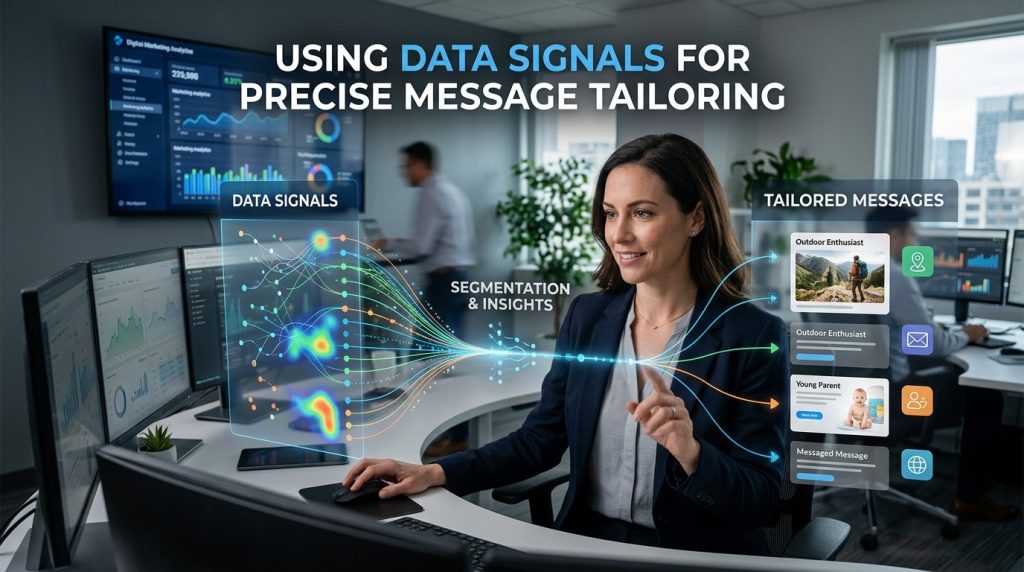
Data Signals for Precise Message Tailoring help marketers match the right message to the right buyer by using behavioral, firmographic, and contextual signals to improve relevance, trust, and conversion.
Modern buyers expect communication that feels relevant, timely, and informed. Data Signals for Precise Message Tailoring help brands meet that expectation by turning raw customer activity into useful guidance for messaging. Instead of relying on broad assumptions, marketers can use observable signals to decide what content, offer, or tone will resonate best.
This matters because generic messaging is easy to ignore. When a prospect sees something that reflects their situation, role, or stage in the journey, attention increases. Data Signals for Precise Message Tailoring make that possible by connecting audience behavior with message selection. In practice, that means better engagement, fewer wasted touches, and a smoother path toward action.
The strongest personalization does not feel forced. It feels helpful. Data Signals for Precise Message Tailoring support that feeling by making marketing more responsive to real user intent. That is why they are valuable not only for acquisition, but also for retention, nurture, and Referral Marketing Optimization.
What Data Signals Mean
Data signals are observable pieces of information that indicate intent, context, or relevance. They can come from browsing behavior, email engagement, firmographic records, CRM activity, or product usage. Data Signals for Precise Message Tailoring use those indicators to shape the message so it fits the audience better.
Some signals are direct, like a pricing-page visit or a demo request. Others are indirect, like repeated visits to a category page or a download from a specific industry topic. Data Signals for Precise Message Tailoring help marketers interpret both kinds so they can respond with the right level of specificity.
The main benefit is that data turns guesswork into evidence. Instead of asking what the audience might want, teams can ask what the audience has already shown interest in. Data Signals for Precise Message Tailoring make that question easier to answer in a practical, repeatable way.
Why They Matter
People respond better when a message matches their needs. If the content is too broad, it feels like noise. If it is too specific in the wrong way, it feels awkward. Data Signals for Precise Message Tailoring help find the balance by grounding the message in evidence.
This is especially important in B2B environments, where buying cycles are longer and multiple stakeholders are involved. A marketing message that matches stage, role, and business need is more likely to move the conversation forward. Data Signals for Precise Message Tailoring help teams create that match without depending on manual assumptions.
They also reduce friction. A buyer who has already explored a product’s pricing or integrations does not want a beginner-level message. Data Signals for Precise Message Tailoring make it easier to avoid that mismatch and deliver a more relevant experience.
Signal Categories
The most useful personalization programs usually rely on several signal types at once. Data Signals for Precise Message Tailoring work best when marketers combine behavioral, firmographic, contextual, and intent-based inputs. Each category adds a different layer of understanding.
Behavioral signals show what people do. Firmographic signals show who they are as an account. Contextual signals show the situation they are in. Intent signals show how close they may be to taking action. Data Signals for Precise Message Tailoring become much stronger when those layers are used together.
Main signal groups
-
Behavioral signals.
-
Firmographic signals.
-
Contextual signals.
-
Intent signals.
-
Lifecycle signals.
Behavior-Based Personalization

Behavior is often the strongest signal because it reflects actual interest. If a visitor views pricing, downloads a guide, or returns to the same page multiple times, they are telling you something useful. Data Signals for Precise Message Tailoring use that behavior to adjust the message in a way that feels timely.
This is where B2B Personalization Methods become especially useful. A visitor who is comparing options may need a case study, while someone who is early in research may need educational content. Data Signals for Precise Message Tailoring help teams decide which message belongs in each situation.
The value of behavior-based personalization is simplicity. You do not have to predict intent from a profile alone. You can respond to actions directly. Data Signals for Precise Message Tailoring help marketers do that at scale without making the process feel manual.
Firmographic Relevance
Not every buyer should see the same message. Industry, company size, location, and business model all influence what matters most. Data Signals for Precise Message Tailoring help teams use those differences to make content feel more relevant.
For example, a startup may care about speed and ease of use, while an enterprise buyer may care about governance and integration. Data Signals for Precise Message Tailoring allow marketers to adapt the framing so the value proposition feels more aligned with the account’s reality.
This is also where Key Personalization Variables matter. The strongest variables are the ones that actually change the user’s needs or expectations. Data Signals for Precise Message Tailoring are more effective when those variables are chosen carefully and used consistently.
Firmographic examples
-
Industry.
-
Company size.
-
Region.
-
Revenue band.
-
Business model.
Context and Timing
Context often determines whether the message lands well. A prospect on mobile may need a shorter, clearer message than someone on desktop. A visitor arriving from a referral may need a different tone than someone arriving from paid search. Data Signals for Precise Message Tailoring help teams adapt to those differences.
Timing matters too. Someone visiting during business hours may behave differently than someone browsing late at night. A returning visitor may be closer to action than a first-time visitor. Data Signals for Precise Message Tailoring help make those timing cues usable in messaging.
This improves the experience because people tend to trust content that fits the moment. If the message feels out of sync with the situation, it can create friction. Data Signals for Precise Message Tailoring reduce that mismatch and help the communication feel natural.
Message Mapping
The real goal is not to collect signals for their own sake. The goal is to use them to choose the right message. Data Signals for Precise Message Tailoring help teams map each signal to a message type, offer, or content asset that fits the audience state.
A strong message map links signal type to content outcome. For example, a pricing-page visit may trigger a comparison sheet, while a webinar download may trigger a deeper educational follow-up. Data Signals for Precise Message Tailoring become actionable when those mappings are documented and repeatable.
This also helps sales and marketing work together. If both teams understand which signals mean what, follow-up becomes more consistent. Data Signals for Precise Message Tailoring can then support a shared messaging strategy instead of disconnected campaigns.
Trust and Social Proof

People are more likely to act when they see proof that others like them have succeeded. Data Signals for Precise Message Tailoring can help determine which proof points to show, such as testimonials, industry-specific examples, or customer stories. That increases trust.
This is where High-Converting Testimonials become powerful. When the testimonial matches the viewer’s role, industry, or challenge, it feels more believable. Data Signals for Precise Message Tailoring help surface those testimonials at the right time.
The same applies to case studies. A buyer who has demonstrated interest in a specific problem should see proof tied to that problem. Data Signals for Precise Message Tailoring make this kind of matching easier and more effective.
Case Study Strategy
Case studies work best when they mirror the audience’s context. If a prospect works in a similar industry or faces a similar challenge, the example feels more relevant. Data Signals for Precise Message Tailoring help teams choose which case study to show based on observed behavior.
This is where B2B Sales Using Case Studies can become more effective. Sales teams can use the same data logic as marketing to send stories that match the prospect’s likely objections or priorities. Data Signals for Precise Message Tailoring make the handoff more seamless.
Case studies are persuasive because they reduce uncertainty. They show a path that has already worked for someone else. Data Signals for Precise Message Tailoring help ensure that the proof is not generic, but actually applicable to the person reading it.
Signal to Message
Referral Marketing Optimization
Personalization also improves how referral programs perform. Data Signals for Precise Message Tailoring help marketers decide when to ask for referrals, what language to use, and which reward or message to present. That is where Referral Marketing Optimization becomes more effective.
A user who had a smooth onboarding experience may be more likely to refer than someone who is still confused. Data Signals for Precise Message Tailoring help identify those moments so referral prompts appear when satisfaction is highest.
This also supports better follow-up after a referral. If a referred user arrives through a specific source or message, the next communication can reflect that context. Data Signals for Precise Message Tailoring keep the experience coherent and trustworthy, which can improve engagement and sharing.
Data Quality Matters
Good personalization depends on good data. If records are incomplete, duplicated, or outdated, the message may be targeted incorrectly. Data Signals for Precise Message Tailoring only work if the underlying data is clean and reliable.
That means teams need consistent field definitions, correct source tracking, and regular maintenance. If the same user appears in multiple places with conflicting information, personalization can become confusing. Data Signals for Precise Message Tailoring become stronger when the data foundation is stable.
This is also important for measurement. If the signals are inaccurate, teams may think a message worked when it did not. Data Signals for Precise Message Tailoring should be supported by a trusted analytics framework so the results can be evaluated honestly.
Practical Workflow
Implementation Strategy

A good personalization system starts small. Data Signals for Precise Message Tailoring do not need to cover every page or audience segment on day one. It is usually better to begin with a few high-value signals that are easy to track and likely to matter.
One effective approach is to identify the journey stage first. Then choose the signals that best indicate that stage. Data Signals for Precise Message Tailoring become easier to manage when the team agrees on what each signal means and how it should be used.
From there, test and refine. If a message based on one signal performs well, expand the logic. If it does not, adjust the content or the rule. Data Signals for Precise Message Tailoring improve over time through observation and iteration.
Common Mistakes
One common mistake is using too many signals too soon. That can make the system difficult to manage and harder to trust. Data Signals for Precise Message Tailoring work best when the logic is simple enough to maintain.
Another mistake is using weak signals as if they were strong ones. Not every interaction means high intent. Data Signals for Precise Message Tailoring should focus on actions that genuinely change the meaning of the user’s behavior.
A third mistake is personalizing without improving the actual content. If the message is still vague, personalization will not fix it. Data Signals for Precise Message Tailoring should support strong content, not replace it.
Human Psychology
People respond to messages that feel like they were made for them. Data Signals for Precise Message Tailoring work because they reduce the effort needed to interpret relevance. The audience feels understood, and that lowers resistance.
This is tied to cognitive ease. When a message matches the user’s situation, it is easier to process and more likely to be trusted. Data Signals for Precise Message Tailoring help create that experience by removing unnecessary noise.
They also support reciprocity. If the brand appears to understand the user’s needs, the user is more likely to respond positively. Data Signals for Precise Message Tailoring make communication feel more considerate, which strengthens engagement.
Conclusion
Data Signals for Precise Message Tailoring give marketers a practical way to improve message relevance through real evidence instead of guesswork. By using behavior, context, firmographics, and intent signals, teams can choose better content, better timing, and better proof points. That leads to stronger engagement and more efficient marketing.
The biggest advantage is that the message feels helpful rather than forced. When people see content that matches their needs, trust rises and friction falls. Data Signals for Precise Message Tailoring support that outcome across campaigns, nurture, sales follow-up, and Referral Marketing Optimization. In a crowded market, that relevance can become a real competitive advantage.
Frequently Asked Questions (FAQ)
1. What are Data Signals for Precise Message Tailoring?
They are observable indicators used to personalize messages based on behavior, context, and audience needs.
2. Why are they important?
Because they help brands send more relevant messages that are more likely to get a response.
3. What types of signals matter most?
Behavioral, firmographic, contextual, and intent signals are usually the most useful.
4. How do they support Referral Marketing Optimization?
They help time and shape referral prompts so they feel more natural and effective.
5. Why is data quality important?
Because inaccurate data leads to poor targeting and weak personalization results.
6. What is the best way to start?
Begin with a few high-value signals and a clear message map.
7. Can case studies be personalized?
Yes. Use signals to show the most relevant case study for the audience.
8. How do testimonials fit in?
They build trust when they match the audience’s industry, role, or problem.
9. Do these signals help sales?
Yes. Sales teams can use the same logic to make follow-up more relevant.
10. What is the biggest mistake to avoid?
Using too many weak or unreliable signals instead of focusing on meaningful ones.