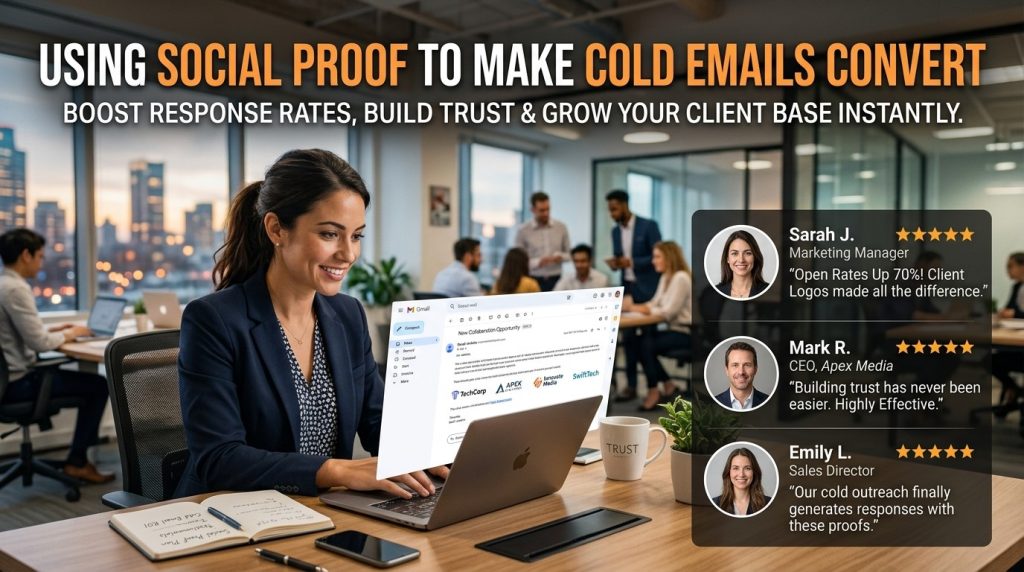
Social proof to Make Cold Emails Convert faster by reducing risk, increasing trust, and giving prospects a believable reason to reply before they even know you.
Social Proof to Make Cold Emails Convert works because cold prospects are not making a pure logic decision. They are making a safety decision. They ask themselves, often in a split second, whether this sender looks credible, whether the offer seems real, and whether people like them have already benefited. That is why trust often matters more than features in the first message.
Social Proof to Make Cold Emails Convert also works because attention is scarce. Buyers do not read every line with equal care. They scan for signals that feel familiar, low-risk, and worth a closer look. When your message shows that other people have already said yes, the reader can relax a little and keep reading instead of mentally rejecting the email too early.
Social Proof to Make Cold Emails Convert becomes even more powerful when you remember that cold email is a stranger-to-stranger interaction. A stranger cannot ask for much trust at once. The first win is not a meeting. The first win is lowering resistance enough that the prospect is willing to give the message a fair read.
Social Proof to Make Cold Emails Convert is therefore less about bragging and more about reassurance. You are not trying to impress the reader with noise. You are trying to make the risk feel smaller. In practice, that means using proof in a way that feels calm, concrete, and relevant to the person receiving the email.
Social Proof to Make Cold Emails Convert also respects human psychology. People borrow confidence from the actions of other people, especially when the other people seem similar to them. If the proof feels close to the buyer’s world, the prospect thinks, “Maybe this is worth my time.” That single shift can change the entire outcome of the first touch.
What counts as proof in a cold email
Social Proof to Make Cold Emails Convert does not require huge brand names every time. A relevant customer quote, a brief result, a recognizable industry, or a specific use case can all work well. The best proof is not the flashiest proof. It is the proof that makes the buyer think, “This looks like my situation.”
Social Proof to Make Cold Emails Convert can come from many places, including testimonials, case studies, review summaries, referenceable customers, short performance results, and even internal stats like adoption or retention. Each one serves a slightly different purpose. The key is to choose the type of proof that matches the stage of awareness and the level of skepticism.
Social Proof to Make Cold Emails Convert becomes stronger when the proof is precise. A vague line about helping “many companies” is weak. A short sentence about helping a team in the buyer’s industry solve a clear problem is stronger. Specificity makes the proof believable, and believability is what helps the email survive the first scan.
Social Proof to Make Cold Emails Convert also works when the proof matches the prospect’s identity. A founder wants different reassurance than a manager. A finance leader wants different reassurance than a marketer. If the signal feels relevant to the reader’s role, size, or industry, the message becomes easier to trust and easier to act on.
Social Proof to Make Cold Emails Convert should never feel like a random badge dump. Too many logos, too many claims, or too many numbers can create the opposite effect and make the message look desperate. A simple proof point often does more than a crowded block of evidence because it feels cleaner and more human.
The psychology behind proof and reply behavior

Social Proof to Make Cold Emails Convert because people use shortcuts when they decide whether a stranger is safe. One of the strongest shortcuts is to look at what similar people have already done. If other buyers in the same kind of role or company found value, the new prospect feels less exposed and more willing to consider the offer.
Social Proof to Make Cold Emails Convert also reduces the fear of making a mistake. In B2B, people worry about wasting time, making a bad recommendation, or choosing the wrong vendor. Proof helps them feel that the decision is not reckless. It frames the offer as a known path instead of an uncertain gamble.
Social Proof to Make Cold Emails Convert can also lower emotional friction. Even when the product is logical, the decision is still emotional. Buyers want to feel smart, supported, and safe. When the email shows that others have already taken the step, the reader is less likely to assume they will be the only one taking a risk.
Social Proof to Make Cold Emails Convert works especially well when the proof is socially close. A prospect trusts a peer more than a celebrity. They trust a similar company more than a giant, unrelated brand. The brain naturally assigns more weight to evidence that looks personally relevant, which is why your proof should feel close to the reader’s environment.
Social Proof to Make Cold Emails Convert is not just about persuasion; it is also about pace. When a buyer feels safer, they move faster. That speed matters in cold outreach because the email does not need to win the entire deal immediately. It only needs to create enough confidence for the next step, which is usually a reply or a click.
Where proof should sit inside the email
Social Proof to Make Cold Emails Convert best when it appears early enough to matter but not so early that it feels forced. Many strong cold emails place the proof in the opening or right after the problem statement. That gives the reader a reason to keep going before they become skeptical or distracted.
Social Proof to Make Cold Emails Convert can also work near the call to action if the email is short and direct. In that format, the proof acts like a final nudge. It reminds the reader that the next step is low-risk because other people have already found the path useful.
Social Proof to Make Cold Emails Convert should be placed where it supports the main message, not where it interrupts it. If the proof is tucked into a strange spot or surrounded by too much noise, readers miss it. The best placement feels natural, like part of the conversation rather than a separate sales tactic.
Social Proof to Make Cold Emails Convert often works well as one sentence after the value proposition. That way, the email first states the problem or opportunity, then follows with evidence that the sender has helped similar buyers. This structure mirrors how people think: first, “What is this?” Then, “Why should I believe it?”
Social Proof to Make Cold Emails Convert can also be split across the email. One line in the opener can establish relevance, and one line near the close can reinforce trust. This is useful when you want the proof to feel understated. A little proof at both ends can feel more balanced than a heavy block in the middle.
Subject lines and opening lines that support proof
Social Proof to Make Cold Emails Convert starts before the body of the email. The subject line creates the first impression, and the opening line decides whether that impression turns into attention. A subject line does not need to explain the proof fully, but it should signal relevance, familiarity, or a known outcome.
Social Proof to Make Cold Emails Convert more effectively when the subject line feels specific and human. A generic subject line can make the email look mass-produced. A more grounded one suggests that the message has a reason to exist. That small difference can improve open rates and set up a better first read.
Social Proof to Make Cold Emails Convert also benefits from opening lines that feel observational instead of pushy. You can mention a challenge the buyer likely cares about, then connect it to a proof point. This pattern keeps the email from sounding like a cold pitch and makes it feel like a useful note from someone who understands the problem.
Social Proof to Make Cold Emails Convert even faster when the proof is implied in the opener. You do not always need to say, “We are trusted by many companies.” Sometimes a line like “Teams in your space often run into this issue” is enough to signal familiarity and reduce the friction of the first paragraph.
Social Proof to Make Cold Emails Convert should always keep the subject line and first line aligned. If the subject suggests one thing and the opening line delivers something else, trust weakens. Consistency matters because the reader is deciding very quickly whether the email is honest, relevant, and worth more attention.
How to build proof from real customers
Social Proof to Make Cold Emails Convert becomes easier when you gather proof assets before you need them. The most useful assets are often already available in customer conversations, onboarding notes, support tickets, renewal feedback, and short testimonial snippets. The job is to collect those signals and turn them into reusable outreach material.
Social Proof to Make Cold Emails Convert with customer quotes that sound natural. A short, plainspoken line from a real user often feels more powerful than a polished marketing statement. Buyers trust language that sounds like it came from someone who actually used the product and felt a real outcome.
Social Proof to Make Cold Emails Convert with outcome-based proof too. If a customer saved time, increased reply rates, improved conversion, or shortened a workflow, those numbers can help. Just make sure the number is understandable and tied to a result the prospect cares about. Metrics work best when they are easy to picture.
Social Proof to Make Cold Emails Convert also improves when you use proof from similar companies. Industry similarity, size similarity, or role similarity can all help. A prospect does not need to love the proof to feel its effect. They only need to think, “That company feels close enough to mine.”
Social Proof to Make Cold Emails Convert through a library of proof snippets that the team can reuse. The smoother your proof system, the faster your writers can create strong emails. When sales and marketing share a small collection of validated quotes, examples, and results, the entire outreach process becomes more consistent and credible.
Writing follow-up emails that keep trust alive

Social Proof to Make Cold Emails Convert even after the first email if your follow-up continues the same trust-building logic. Many teams make the mistake of repeating the same pitch again and again. Better follow-up adds a fresh reason to reply, such as a new proof point, a different outcome, or a more specific use case.
Social Proof to Make Cold Emails Convert through Email Follow-Up Sequences that feel thoughtful instead of loud. A second or third message can introduce a new customer story, a short result, or a relevant comparison that helps the buyer reconsider. The sequence should feel like a helpful progression, not a desperate repeat.
Social Proof to Make Cold Emails Convert best when the follow-up respects timing. Some buyers need space. Some need one more touch. Some are simply busy. A smart sequence gives proof in smaller doses, which lets the prospect build comfort over time without feeling pressured or cornered by too many messages at once.
Social Proof to Make Cold Emails Convert because follow-up is often where trust is earned. The first email gets noticed, but the later touches often create belief. If the proof changes slightly with each message, the sequence becomes more persuasive without becoming repetitive. That makes the conversation feel alive instead of mechanical.
Social Proof to Make Cold Emails Convert when each follow-up has a clear purpose. One email can introduce a customer win. Another can share a short benchmark. Another can offer a low-friction next step. That structure helps the reader see that the outreach is organized around their decision process, not around your calendar.
Avoiding spam triggers while keeping the message human
Social Proof to Make Cold Emails Convert only if the message reaches the inbox and stays readable. Deliverability is part of persuasion. If your formatting looks suspicious, your claims sound exaggerated, or your language feels overly aggressive, the email may never get the fair chance it deserves. Trust starts with inbox placement.
Social Proof to Make Cold Emails Convert better when you avoid spam triggers in outreach by keeping the language clean and direct. That means no unnecessary urgency, no overstuffed formatting, and no shouting through excessive punctuation. A calm, readable email is more likely to feel legitimate and more likely to be opened in the first place.
Social Proof to Make Cold Emails Convert more reliably when the proof itself is not dressed up too heavily. If the email looks like a brochure, the reader may tune out or the system may classify it poorly. A simple text-first approach often performs better because it feels closer to a human message than a marketing blast.
Social Proof to Make Cold Emails Convert when you balance proof with restraint. Too much proof in one message can look suspicious, especially if every line sounds promotional. The strongest emails tend to use one or two grounded proof points and then move on. That simplicity keeps the message credible and easy to process.
Social Proof to Make Cold Emails Convert because good deliverability and good psychology support each other. When the message feels safe to the inbox and safe to the reader, you create a much better chance of reply. That is why technical hygiene and trust signals should always be treated as part of the same system.
Five-star style validation and what it does to the brain
Social Proof to Make Cold Emails Convert partly because the human brain responds strongly to visible approval. Five Star Reviews Psychology explains that people often use rating patterns as a shortcut for confidence. Even before they read the details, the mind treats positive consensus as a signal that the choice is less risky.
Social Proof to Make Cold Emails Convert when reviews, ratings, or customer feedback are presented in a way that feels real rather than inflated. A prospect does not need to be dazzled. They need to feel that other people have already tested the path and found it worthwhile. That is what makes review-based proof so effective in outreach.
Social Proof to Make Cold Emails Convert when you use the psychology of validation without overclaiming. A review is most useful when it reflects the reader’s concern. For example, a comment about speed, responsiveness, or ease of use can be far more persuasive than a generic compliment because it connects directly to the buyer’s decision criteria.
Social Proof to Make Cold Emails Convert when the review signal is short and credible. A long block of praise can feel staged. A compact summary from a real customer feels easier to trust. That is why review language should be clear, specific, and relevant to the problem the prospect is already thinking about.
Social Proof to Make Cold Emails Convert better when you remember that the reader is not merely evaluating your product. They are evaluating the risk of replying to you. Review-backed proof helps answer that hidden question. It says, in effect, “Others trusted this path and were glad they did.”
Advocacy, replies, and turning happy customers into proof
Social Proof to Make Cold Emails Convert more naturally when you build a system for advocacy. Happy customers are often willing to help, but they need a simple way to do it. Advocacy Building Reply Strategies help you turn those good relationships into short, usable proof that can support cold outreach without sounding staged.
Social Proof to Make Cold Emails Convert when you ask for lightweight responses that are easy for customers to give. A short quote, a one-line reaction, or a simple confirmation of a result can become a powerful email asset. The easier the request, the more likely the customer is to respond quickly and honestly.
Social Proof to Make Cold Emails Convert with advocacy that feels reciprocal. Customers are more open to helping when they see value in the relationship and understand how their feedback will be used. When the process feels respectful, they are more likely to provide the kind of evidence that makes outreach stronger.
Social Proof to Make Cold Emails Convert when your team keeps the advocacy loop active. Good results should be collected while they are fresh, not months later when the details are hard to remember. A steady stream of short proof points gives sales and marketing more flexibility in tailoring messages to different audiences.
Social Proof to Make Cold Emails Convert because real customer voices carry more weight than self-promotion. The email becomes more believable when it includes language that came from an actual user, not from a brand team. That is why advocacy should be treated as a core outreach asset, not an afterthought.
A practical framework for using proof in cold emails

Social Proof to Make Cold Emails Convert best when you follow a simple structure. Start with a clear problem or outcome, add one relevant proof point, and finish with one easy next step. That structure works because it mirrors how people naturally move from attention to belief to action.
Social Proof to Make Cold Emails Convert when the proof is matched to the prospect’s stage. Early-stage prospects usually need reassurance that the problem is real and the solution is credible. Mid-stage prospects need proof that similar companies got value. Late-stage prospects need enough confidence to justify a reply, click, or meeting.
Social Proof to Make Cold Emails Convert more consistently when you keep the message concise. In cold outreach, too much detail can slow the reader down. The proof should do one job only: make the next step feel safer. Once that happens, the rest of the email has a much better chance of working.
Social Proof to Make Cold Emails Convert when your team standardizes what works. Build a small set of proof blocks for different industries, roles, and pain points. Then test them against each other. Over time, you will learn which trust signals move the needle fastest and which ones should be retired.
Social Proof to Make Cold Emails Convert into a repeatable process when you measure replies, positive responses, and downstream meetings instead of only opens. The goal is not just attention. The goal is action. Proof is successful when it gives the buyer enough confidence to move one step closer.
How to test and improve your proof strategy
Social Proof to Make Cold Emails Convert more effectively when you test one element at a time. Try a customer quote in one version, a numerical result in another, and an industry-specific example in a third. That way, you learn which kind of proof creates the strongest response for each audience.
Social Proof to Make Cold Emails Convert when you review the reply quality, not just the reply count. A proof point that generates thoughtful responses is often more valuable than one that creates shallow curiosity. Good testing tells you which message creates real interest and which only creates surface-level attention.
Social Proof to Make Cold Emails Convert faster when you listen to the objections that come back. If prospects keep asking whether others like them have used the product, that is a sign your proof needs to be more specific. If they ask about results, your message may need clearer evidence and stronger examples.
Social Proof to Make Cold Emails Convert when your team treats the proof library like a living asset. Update it with fresh results, new testimonials, and better-fit examples. Static proof gets stale. Current proof feels alive. The more current the signal, the more likely it is to feel believable to a new reader.
Social Proof to Make Cold Emails Convert best when the team shares what works across campaigns. A proof point that performs well in one segment may need to be rewritten for another, but the underlying insight is still useful. Continuous learning keeps outreach sharp and prevents the strategy from becoming repetitive.
Conclusion
Social Proof to Make Cold Emails Convert because people trust other people before they trust a new sender. That simple fact changes how cold outreach should be written. Instead of trying to impress with volume, the strongest emails reduce risk, signal relevance, and make the next step feel safe. When you use concise proof, believable customer evidence, and a clean follow-up process, the message becomes easier to read and easier to act on. Over time, that approach improves reply quality, protects deliverability, and builds a stronger reputation in the inbox. That is why this strategy is not a trick. It is a trust system.
Frequently Asked Questions (FAQ)
1. What is the best kind of social proof for cold email?
The best kind is the one that matches the prospect’s world. A short customer quote, a relevant result, or a similar-company example usually works better than a broad claim.
2. How many proof points should one cold email include?
Usually one or two. Too many signals can feel crowded. One clear proof point often makes Social Proof to Make Cold Emails Convert more naturally than a long list.
3. Should I use testimonials in the first email?
Yes, if the testimonial is short, believable, and relevant. A brief line from a real customer can make the first email feel much safer to open and reply to.
4. Does social proof work for all industries?
It works in most B2B contexts, but the format should change. Some industries respond to numbers, while others respond better to peer stories or recognizable company types.
5. How do I avoid sounding salesy?
Keep the language direct, calm, and specific. Speak like a helpful professional, not a marketer trying to force attention.
6. What should I do if I do not have strong customer logos?
Use smaller proof signals such as short quotes, usage results, response metrics, pilot outcomes, or role-relevant examples. Credibility does not always require a big brand name.
7. How often should I refresh my proof assets?
Regularly. Update proof whenever you get a meaningful new result or customer win so the outreach stays current and believable.
8. Can follow-up emails use the same proof?
Yes, but each follow-up should add something new. Repeating the same proof point over and over can make the sequence feel stale.
9. Is there a risk of spam filters rejecting proof-heavy emails?
Yes, if the formatting or language looks promotional. Keep the message clean and natural so Social Proof to Make Cold Emails Convert without hurting deliverability.
10. What is the fastest way to start?
Collect three customer quotes, three short results, and three role-specific examples. Then test them in simple cold email versions and compare replies.