Search Behavior Data : How to Prioritize Leads
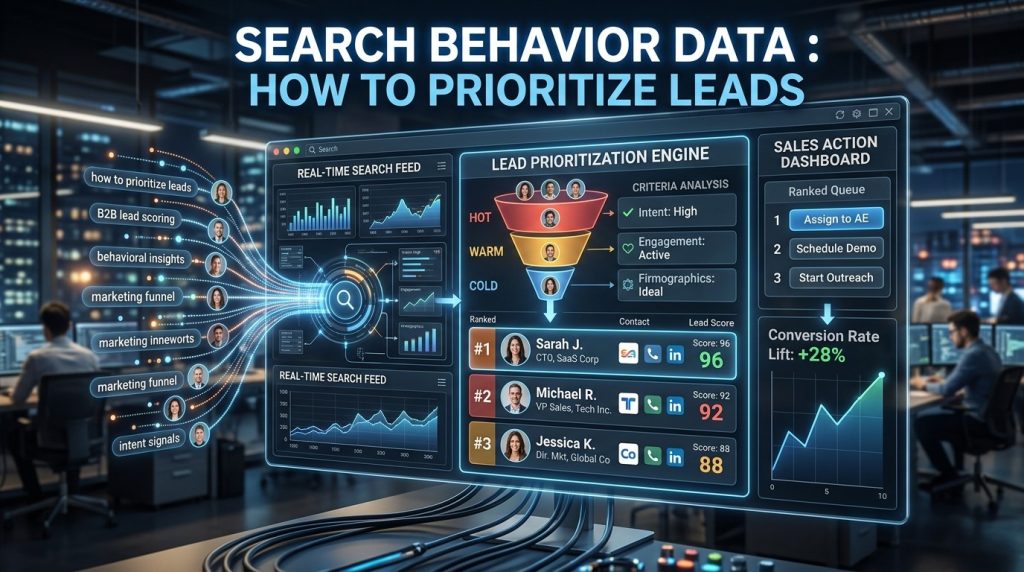
Search signals reveal what prospects care about, where they are in the buying journey, and which leads deserve timely attention before valuable opportunities become difficult to recover.
Lead generation becomes expensive when every contact receives the same level of attention. A visitor who casually searches for an educational topic should not automatically receive the same sales treatment as an account comparing vendors, reviewing pricing, or researching implementation options. The difference is not simply the lead’s demographic profile. It is the context behind the actions they take.
Search Behavior Data gives marketers a way to understand that context. Instead of looking at a form submission as an isolated event, teams can examine search themes, query frequency, engagement patterns, content consumption, and changes in research intensity. Those signals can help identify whether someone is exploring a problem, validating a possible solution, comparing alternatives, or preparing to make a purchase.
This matters because modern buying journeys rarely move in a straight line. A prospect can discover a problem through an informational search, disappear for several weeks, return with comparison queries, and suddenly become highly engaged with commercial content. A useful lead-prioritization system needs to recognize those changes rather than treating the original conversion as the entire story.
The purpose of this guide is to show how marketers can turn research behavior into practical lead-prioritization rules. The goal is not to collect every possible signal. The goal is to identify the signals that meaningfully separate passive interest from genuine buying momentum.
What Is Search Behavior Data?
Search Behavior Data refers to information that shows how people investigate topics, problems, products, services, and solutions through search activity. It can include the subjects they search for, the language they use, the frequency of related searches, how their interests evolve, and whether their searches become increasingly specific.
For marketers, Search Behavior Data becomes valuable when it is connected to business context. A generic query such as “email marketing ideas” can indicate broad learning, while a search such as “enterprise email automation pricing” may indicate a much more commercially relevant stage. The wording does not guarantee purchase intent, but it provides additional context for deciding how the lead should be handled.
A practical framework usually looks at several dimensions:
| Signal | What It Can Indicate | Lead-Prioritization Value |
|---|---|---|
| Query topic | Main problem or interest | Identifies relevance |
| Query specificity | Depth of research | Helps estimate intent |
| Search frequency | Growing or repeated interest | Detects momentum |
| Recency | Current research activity | Highlights timing |
| Commercial terms | Evaluation behavior | Raises potential priority |
| Competitor searches | Active consideration | Adds context |
| Content engagement | Topic validation | Supports qualification |
| Conversion history | Known response behavior | Adds first-party evidence |
The strength of Search Behavior Data is that it can show movement over time. One query may tell you what someone searched. A sequence of related searches can tell you how their thinking is developing.
For example, someone might begin with “what is customer data activation,” move to “customer data activation platforms,” and then search for “customer data platform implementation cost.” Each step reveals a deeper level of investigation. The progression may be more useful than any single query viewed separately.
Another important characteristic is granularity. Search behavior can be analyzed at the individual, company, segment, campaign, or topic level depending on the available data and privacy constraints. B2B teams may find account-level patterns especially useful when multiple employees from the same organization demonstrate interest in a related subject.
However, Search Behavior Data should not be treated as proof of intent. Researchers, students, consultants, competitors, journalists, and existing customers can produce similar search patterns. Strong prioritization therefore combines search signals with other evidence instead of letting one data source make the final decision.
Why Search Behavior Matters for Lead Prioritization
Traditional lead scoring often focuses on explicit information: job title, company size, industry, geography, form completion, and content downloads. Those variables can be useful, but they do not always reveal what a prospect is trying to accomplish right now.
Search Behavior Data adds behavioral context. It helps marketers understand the questions behind a prospect’s research rather than simply recording the fact that a page was visited.
Imagine two contacts from the same industry. Both download the same guide. One has previously searched for educational material about the problem, while the other has recently researched implementation requirements, product comparisons, and pricing models. Their demographic fit may be identical, yet their immediate buying context is different.
This distinction is important because sales capacity is limited. A sales representative can only make a certain number of quality conversations in a day. Prioritization helps allocate that scarce attention toward contacts with stronger evidence of current relevance.
Search Behavior Data can also improve timing. A lead who was inactive three months ago may suddenly begin researching a category again. If the organization can detect that renewed activity, it can reconsider the contact’s priority rather than leaving the record buried in a static database.
The same principle applies to account-based marketing. Several employees from one company searching for related problems may indicate broader organizational interest. A single anonymous visit might mean very little, while a pattern of research across multiple roles can become more meaningful.
Understanding the broader concept of Intent Data Identifies helps marketers connect behavioral signals with readiness instead of interpreting every interaction as equally important.
There is also a psychological benefit. Prospects often reveal their current concerns indirectly through the questions they ask. Search behavior can expose urgency, uncertainty, comparison, cost sensitivity, risk concerns, and implementation questions. Those details can shape both prioritization and messaging.
Search Behavior Data and the Buying Journey
The most useful way to interpret Search Behavior Data is to map it against stages of the buying journey. Search behavior tends to become more specific as the prospect moves from general awareness toward active evaluation, although real journeys can move backward and forward.
1. Awareness Searches
Awareness queries usually focus on definitions, problems, trends, or educational concepts. Examples include:
- What is customer identity resolution?
- Why do leads stop converting?
- How does predictive targeting work?
- Benefits of marketing automation
These searches can reveal topic relevance, but they usually do not justify immediate sales outreach on their own. A better approach is to use them as early-stage signals that can feed nurturing journeys.
2. Problem-Focused Searches
The prospect has identified a challenge and is actively exploring solutions. Queries may sound like:
- How to reduce abandoned leads
- Best way to automate lead qualification
- Why B2B conversion rates are declining
- How to improve sales follow-up
At this stage, Search Behavior Data becomes more actionable because the prospect’s research is connected to a recognized business problem.
3. Solution Searches
Now the prospect begins looking for categories, platforms, methods, or approaches. Examples include:
- Lead scoring software
- Intent-based targeting tools
- Customer intelligence platform
- Automated lead routing
The search is still not a purchase commitment, but it indicates a move beyond general education.
4. Evaluation Searches
Evaluation queries tend to become more specific and comparative. Common patterns include:
- Best lead scoring platform
- Platform A vs platform B
- Enterprise lead qualification tools
- Lead routing software pricing
- CRM integration requirements
Repeated evaluation-oriented searches can justify a higher priority because the prospect is actively narrowing options.
5. Purchase-Readiness Searches
Late-stage queries often involve implementation, pricing, procurement, security, migration, contracts, or technical requirements.
For example:
- Lead scoring implementation cost
- Enterprise CRM integration pricing
- Security requirements for marketing automation
- Vendor onboarding process
- Product demo for enterprise lead routing
Search Behavior Data is particularly useful here because the nature of the questions can indicate that the prospect is thinking about practical adoption rather than simply learning.
The important point is not to assign fixed scores to every phrase. Search intent is contextual. A pricing query from a student researching an assignment is different from the same query coming from a known target account repeatedly visiting product pages.
How to Interpret Search Query Patterns
Individual keywords can be informative, but sequences are usually more revealing. A lead’s research journey often contains patterns that help explain intent.
Search Behavior Data can be organized into four useful dimensions: topic, depth, momentum, and commercial proximity.
Topic Relevance
First, ask whether the search is related to the business’s actual solution. A highly active researcher in an unrelated category should not outrank a moderately active prospect researching the company’s core problem.
Research Depth
Depth measures how far the prospect has moved into the subject. Broad educational phrases generally represent lower commitment than detailed questions about integration, pricing, migration, or specific features.
However, marketers should avoid simplistic assumptions. Some buyers intentionally perform extensive research before speaking to a sales team, while others may contact vendors very early.
Momentum
Momentum is one of the most valuable concepts. Search Behavior Data becomes more useful when the frequency and recency of relevant searches increase.
For example:
Low momentum: one related query six weeks ago.
Moderate momentum: several related searches over the past month.
High momentum: multiple related searches during the past week combined with product engagement and return visits.
Momentum helps distinguish historical interest from active research.
Commercial Proximity
Commercial proximity asks how close the research is to a business decision. Queries about definitions may sit far from a transaction, while searches about pricing, comparisons, implementation, security, and procurement often occur closer to evaluation.
Marketing teams should also watch changes in wording. A prospect moving from “what is predictive lead scoring” to “predictive lead scoring vendors” has changed the nature of the research. That transition deserves attention.
Building a Practical Lead-Prioritization Framework
A useful prioritization model should be simple enough for marketing and sales teams to understand. Overly complicated scoring systems can create false precision and make it difficult to explain why one lead should receive more attention than another.
A strong framework can combine five dimensions:
| Dimension | Example Question | Possible Weight |
|---|---|---|
| Fit | Does the lead match the target customer profile? | 25% |
| Relevance | Are searches connected to our solution? | 20% |
| Recency | Is activity happening now? | 20% |
| Momentum | Is research increasing? | 15% |
| Commercial depth | Is the research evaluation-oriented? | 20% |
These percentages are examples rather than universal rules. Each organization should validate its scoring model against actual sales outcomes.
Search Behavior Data can contribute strongly to the relevance, recency, momentum, and commercial-depth dimensions. Instead of assigning enormous points to one keyword, marketers can evaluate a group of related actions.
For example:
Tier 1: Active priority
The prospect is a strong fit, shows recent research, engages with commercial content, and demonstrates increasing activity.
Tier 2: Engaged nurture
The prospect fits the market and shows relevant research but lacks strong evidence of immediate evaluation.
Tier 3: Educational nurture
The prospect is interested in the broader problem but has not shown meaningful commercial behavior.
Tier 4: Low priority
The research is weakly relevant, outdated, inconsistent, or disconnected from the ideal customer profile.
This approach gives sales teams a clear operating model without pretending that behavioral data can predict human decisions with perfect accuracy.
The right question is not “Does this lead have intent?” It is “What evidence suggests this lead deserves more attention than another lead right now?”
Use Search Behavior Data Beyond Individual Leads
One common mistake is treating behavioral research as useful only for individual contact scoring. Search Behavior Data can also reveal valuable patterns at the segment and account level.
Suppose five employees from the same company begin researching the same solution category within a short period. None of them has submitted a demo form. Individually, each person may look unqualified. Collectively, the pattern may suggest meaningful account-level interest.
This is particularly relevant in B2B marketing, where buying decisions can involve multiple stakeholders. A researcher may not be the decision-maker. Another employee may own the budget, another may evaluate technical requirements, and another may manage implementation.
A sophisticated system therefore examines signals across:
- Contact
- Account
- Department
- Seniority
- Product interest
- Topic cluster
- Time period
Search Behavior Data can also help identify new market segments. If a recurring set of searches starts appearing among a previously overlooked group of companies, marketers may discover a new use case or audience.
For example, a company selling data infrastructure may notice increased research around compliance reporting from a niche vertical. That could eventually inform content, campaigns, sales enablement, and positioning.
This is where Top Intent Data Sources becomes relevant. Different sources can provide different layers of evidence, and the best prioritization frameworks generally avoid relying on one signal type alone.
Combining Search Signals With CRM and First-Party Data
Search activity becomes more actionable when it is connected to information the business already owns. CRM records, website interactions, email engagement, product usage, and historical opportunities can provide context that search behavior alone cannot.
For instance, a prospect may have researched a topic extensively before becoming a lead. If that same contact has now revisited a product page, attended a webinar, and opened recent emails, the combined picture is stronger than any single behavior.
Search Behavior Data can be integrated with first-party signals such as:
Website Behavior
Look at return visits, page depth, product-page interactions, pricing-page views, and repeated visits to related resources.
Content Engagement
A prospect reading several educational articles may still be early-stage, while someone consuming case studies, comparison pages, implementation guides, and product documentation may be further along.
Email Behavior
Email clicks can reinforce search signals when the clicked content matches the subjects being researched.
CRM History
Past opportunities, previous conversations, lead source, role changes, and account history can help marketers distinguish a new opportunity from recycled interest.
Product Usage
For existing customers, research around advanced features or expansion topics can indicate cross-sell or upsell opportunities.
The critical principle is sequence. Search behavior can tell you what the person is researching. CRM and first-party data can help explain who the person is, what relationship already exists, and what actions have happened before.
This prevents marketers from reacting to behavioral signals in isolation.
Using AI and Automation Without Losing Context
Automation can make lead prioritization faster, especially when large volumes of behavioral activity need to be processed continuously. But automation should support interpretation rather than blindly convert every action into a sales trigger.
Search Behavior Data can feed rules that identify topic clusters, detect rising activity, classify query themes, and surface significant changes. Machine learning systems can also help identify patterns across multiple signals that would be difficult to monitor manually.
For instance, an automated workflow might flag an account when:
- Relevant research rises sharply.
- Multiple contacts become active.
- Commercial topics appear after months of inactivity.
- Several high-value pages are visited.
- Search themes shift from educational to evaluative.
- Engagement increases across multiple channels.
The next step should be contextual validation rather than automatic outreach.
An account representative might receive a short explanation such as:
“This target account has shown increased interest in customer data activation, viewed implementation content, and returned to commercial pages three times this week.”
That is more useful than a generic label such as “high intent.”
AI can also help summarize large volumes of signals. Smart Bots can illustrate how automated workflows can route and organize information, while AI Sentiment Analysis shows how AI-based interpretation can add another layer of contextual understanding.
Search Behavior Data should therefore become one input into a broader decision system rather than a black-box score.
From Behavioral Signals to Sales Routing
Lead prioritization only creates business value when it changes what happens next. If the marketing team identifies a high-priority lead but sales receives no clear action, the signal has little practical impact.
Search Behavior Data can be connected to routing rules that determine urgency, ownership, and follow-up type.
For example:
| Behavioral Pattern | Suggested Action |
|---|---|
| High-fit account with rising commercial research | Fast sales review |
| Moderate-fit lead with strong educational engagement | Nurture sequence |
| Existing customer researching expansion topics | Customer success alert |
| Repeated competitor research | Competitive enablement |
| Old research with no recent activity | Keep in nurture |
| High activity but poor company fit | Marketing review |
The goal is not to make automation responsible for the final human decision. Instead, automation should reduce the amount of manual sorting required.
Sales teams also need transparency. If a representative sees a lead marked as high priority, they should be able to understand why. A clear explanation is more trustworthy than an unexplained number.
A practical routing record might include:
Priority reason: Increased research around enterprise lead scoring.
Recent change: Search activity increased over the past seven days.
Supporting evidence: Three content visits, one comparison-page visit, and repeat engagement from two contacts at the same account.
Recommended action: Review account context before personalized outreach.
This model respects uncertainty while still making the signal operational.
Common Mistakes When Using Search Behavior Data
Even advanced teams can misuse behavioral research. The biggest problems typically come from overconfidence, poor data quality, and weak context.
Mistake 1: Treating Every Search as Purchase Intent
People search for many reasons. A single commercial phrase does not automatically mean someone is ready to buy.
Mistake 2: Ignoring Recency
An impressive search pattern from six months ago should not necessarily outrank moderate activity happening this week.
Mistake 3: Scoring Keywords Instead of Journeys
A single keyword can be misleading. A sequence of related searches often provides a clearer picture of progression.
Mistake 4: Forgetting Firmographic Fit
A highly active prospect that does not match the business’s target market may still be a poor sales priority.
Mistake 5: Creating Excessive Scores
A system with dozens of hidden rules can become impossible for sales teams to trust. Keep the logic explainable.
Mistake 6: Ignoring Anonymous Research
Anonymous activity is often valuable at the account or topic level even when an individual identity is unavailable. It should not automatically be treated as useless.
Mistake 7: Overreacting to Sudden Spikes
A sudden increase can come from a news event, industry controversy, educational assignment, or internal corporate activity. Context matters.
Search Behavior Data works best as directional evidence. The more independent signals agree, the more confidence the team can place in the resulting priority.
Privacy, Consent, and Responsible Data Use
Lead prioritization should be effective without becoming intrusive. Behavioral data can be valuable, but organizations need clear governance around how it is collected, stored, combined, and used.
Search Behavior Data should be handled according to the legal and contractual requirements that apply to the organization, its customers, and its markets. Teams should understand which data is directly provided by users, which is inferred, which comes from third parties, and what permissions govern its use.
Transparency also matters. A prospect should not feel that the company knows more about them than they reasonably expected.
Marketers should consider data minimization, retention policies, access controls, vendor governance, and purpose limitation. These practices are not simply compliance exercises. They can also improve data quality by reducing the amount of irrelevant or poorly contextualized information entering the scoring process.
There is another practical benefit to responsible use: trust. A system designed around useful relevance rather than excessive surveillance is more likely to produce messaging that feels helpful.
Search Behavior Data should inform communication without becoming a reason to expose private research activity directly to a prospect.
For example, a sales representative does not need to say, “We saw that your team searched for our pricing page four times.” A more appropriate message might address the underlying business problem, share useful resources, or offer to answer implementation questions.
Measuring Whether Prioritization Actually Works
A lead-scoring system should never be considered finished. Teams should continuously test whether prioritized leads actually produce better business outcomes.
Search Behavior Data can be evaluated against metrics such as:
- Qualified lead rate
- Sales acceptance rate
- Meeting rate
- Opportunity creation
- Pipeline value
- Conversion speed
- Revenue by priority tier
- Disqualification rate
- Sales response time
The most important measurement is not how many leads the model labels as important. It is whether those leads behave differently from the leads that were not prioritized.
Suppose Tier 1 leads generate more meetings but no increase in qualified opportunities. That may indicate that the system is identifying engagement rather than real business potential.
Suppose Tier 2 leads have lower meeting volume but unusually strong opportunity conversion. The company might discover that it has been undervaluing certain research patterns.
Search Behavior Data should therefore be tested through historical analysis and controlled experiments where practical.
Create a Feedback Loop
Marketing should regularly compare predicted priority with actual outcomes.
Sales teams can provide qualitative feedback:
- Which alerts were useful?
- Which alerts felt irrelevant?
- Which signals appeared too late?
- Which signals were misleading?
- Which types of research preceded genuine opportunities?
This feedback can be translated into scoring adjustments.
Watch for False Positives
A high-volume research pattern may look impressive but produce very few opportunities. That is a warning sign.
Watch for False Negatives
Some high-value buyers may show limited visible research because they rely on referrals, internal expertise, or direct vendor contact. A system that only rewards observable research can undervalue these prospects.
That is why Search Behavior Data should improve prioritization, not replace judgment.
A Practical Workflow for Marketers
A simple operating workflow can turn all of these ideas into an actionable system.
Step 1: Define the Ideal Customer
Start with industry, company size, geography, role, use case, budget profile, and known business needs.
Step 2: Build Topic Clusters
Group searches into themes such as problem awareness, solution exploration, comparison, pricing, implementation, and alternatives.
Step 3: Identify Meaningful Behavior Changes
Look for recency, frequency, sequence, and changes in research depth.
Step 4: Connect Signals to First-Party Records
Match available behavioral information with CRM, website, email, product, and account data where appropriate and permitted.
Step 5: Create Simple Priority Tiers
Avoid dozens of levels. Three or four operational tiers are often easier to maintain.
Step 6: Define Action Rules
Each tier should have a clear next step. A high-priority account might receive sales review, while an early-stage researcher may receive targeted educational content.
Step 7: Explain the Reason
Every meaningful alert should include understandable evidence.
Step 8: Measure Business Outcomes
Compare lead quality, opportunities, conversion rates, and revenue against the priority framework.
Step 9: Refine Regularly
Search trends, products, competitors, and buyer behavior change. The model needs periodic review.
Search Behavior Data becomes significantly more useful when this process is treated as an operating system rather than a one-time scoring project.
How Search Behavior Data Can Improve Content Strategy
Lead prioritization is not the only use case. Search patterns can also tell content teams which questions deserve deeper coverage.
When marketers see recurring searches around the same obstacle, they can create content that answers the underlying concern. When comparison searches increase, comparison pages, case studies, implementation guides, and product explanations may become more valuable.
Search Behavior Data can also identify gaps between marketing content and buyer questions.
For instance, a company may have dozens of awareness articles but almost no content answering procurement or technical integration questions. If prospects repeatedly search for those topics externally, the content strategy may be underdeveloped in the later stages of the journey.
Behavioral research can therefore support:
- Topic prioritization
- Content clustering
- Landing-page planning
- Conversion-path design
- Sales enablement
- FAQ development
- Competitive content
- Product education
The psychological principle is straightforward: people tend to search for information that reduces uncertainty. Content that addresses meaningful uncertainty can help move the prospect toward a clearer decision.
However, marketers should resist creating content solely because a phrase has high volume. Volume does not necessarily equal commercial value. A lower-volume topic connected directly to a high-value business problem may deserve much greater attention.
Search Behavior Data for Account-Based Marketing
Account-based marketing benefits from behavioral context because the target is often an organization rather than a single person.
A company may have several employees researching related themes without a single obvious lead becoming highly engaged. A search-based view can help marketers detect the broader account signal.
For example:
Contact A: researching the business problem.
Contact B: comparing solution categories.
Contact C: checking implementation requirements.
Each contact provides a different piece of the puzzle. Search Behavior Data can help combine those signals into an account-level view.
This can also support personalized campaigns. The messaging for a technical evaluator may focus on implementation, while an executive audience may care about business outcomes, risk, and total cost.
The point is not to guess what every individual wants. The point is to use observable patterns to make communication more relevant.
Account-level analysis can also reveal dormant opportunities. An organization that was previously inactive may become interesting again when new research appears across multiple contacts.
That can be particularly valuable for businesses with long sales cycles, where timing often matters as much as lead volume.
Turning Research Signals Into Better Priorities
The strongest prioritization systems share several principles.
First, they focus on change, not just activity. A prospect with 100 historical interactions may be less urgent than a target account whose relevant activity suddenly increased this week.
Second, they combine relevance and fit. Search activity is meaningful only when connected to a market the company actually serves.
Third, they interpret sequences. One action rarely explains intent completely.
Fourth, they preserve uncertainty. A signal is evidence, not certainty.
Fifth, they create operational clarity. Marketing and sales should know what to do when a lead reaches a priority threshold.
Search Behavior Data provides a useful layer between anonymous interest and explicit conversion. It can help organizations notice buying signals earlier, identify emerging account interest, and create better timing for follow-up.
Yet the objective should never be to maximize the number of leads labeled “hot.” The objective is to allocate human attention more intelligently.
When the system is designed correctly, sales representatives spend less time sorting through records and more time having relevant conversations. Marketers can build nurture programs around actual research patterns rather than assumptions. Leadership can evaluate whether behavioral prioritization is producing measurable pipeline improvement.
That is where data becomes practical: not when it creates another dashboard, but when it improves a real decision.
Conclusion
Prioritizing leads becomes more reliable when teams connect what prospects search for with where prospects are in the buying journey. Search Behavior Data helps marketers distinguish curiosity, comparison, urgency, and solution readiness without relying on assumptions. The strongest approach combines query themes, frequency, recency, landing-page engagement, firmographic context, and sales outcomes. From there, teams can build lead tiers, route high-intent accounts faster, personalize follow-up, and refine scoring rules. Used responsibly, Search Behavior Data turns scattered signals into a structured framework for deciding who deserves attention now, who needs nurturing, and who should remain in the database for future campaigns consistently.
Frequently Asked Questions (FAQ)
What does Search Behavior Data tell marketers about a lead?
Search Behavior Data can reveal the topics a prospect is researching, how frequently they are researching them, how recently activity occurred, and whether the questions are becoming more commercially focused. It can help marketers understand research progression and identify changes in interest. However, it does not prove that a prospect intends to buy. The strongest interpretation comes from combining search signals with company fit, website engagement, CRM context, and other first-party evidence. It is best used as a prioritization input rather than a standalone prediction.
How is Search Behavior Data different from traditional lead scoring?
Traditional lead scoring often emphasizes static attributes and visible actions, such as job title, company size, form submissions, downloads, or email engagement. Search Behavior Data adds context about what problem or solution the prospect is actively researching. It can also reveal changes over time, such as increasing activity around comparison, pricing, or implementation topics. The two approaches work well together. Static fit tells you whether the prospect resembles a valuable customer, while behavioral evidence helps indicate whether the current moment is worth additional attention.
Can Search Behavior Data identify buying intent?
Search Behavior Data can provide evidence associated with buying intent, particularly when research becomes recent, repeated, specific, and commercially oriented. Queries involving comparisons, vendors, pricing, integrations, implementation, or procurement can suggest deeper evaluation. Yet intent is never guaranteed by a keyword alone. Context remains essential because similar queries can come from students, researchers, consultants, existing customers, or competitors. A strong prioritization process therefore combines search patterns with account fit, engagement, historical behavior, and sales outcomes before assigning a high-priority status.
What search signals should be prioritized first?
Start with relevance, recency, momentum, and research depth. Relevant searches are more useful than high-volume searches that have little connection to the business. Recent activity usually deserves more attention than old activity, while increasing frequency can reveal momentum. Research depth helps distinguish broad education from evaluation-focused behavior. Commercial topics such as implementation, pricing, or comparisons can add context, but they should not automatically trigger sales outreach. The ideal mix depends on the company’s sales cycle, customer profile, and historical conversion patterns.
How often should marketers update their lead-priority model?
The answer depends on data volume, sales-cycle length, market volatility, and how quickly customer behavior changes. Teams with fast-moving markets may review their Search Behavior Data rules more frequently, while businesses with longer sales cycles may use a slower review cadence. A useful approach is to monitor performance continuously and conduct formal scoring reviews on a regular schedule. Look for changes in conversion rates, false positives, false negatives, sales feedback, and emerging query themes. Models should evolve when evidence shows that existing rules no longer reflect real buying behavior.
Is Search Behavior Data useful for B2B companies?
Yes. B2B organizations can use Search Behavior Data to understand both individual and account-level research patterns. Multiple employees from the same company may research different parts of a solution, creating a broader picture of organizational interest. One person may investigate the problem, another may compare solutions, and another may review implementation details. Combining these signals can help account-based marketing teams recognize potentially important activity even before a traditional form conversion occurs. The approach is especially relevant when buying committees, complex products, or longer evaluation cycles are involved.
Should every high-intent search trigger sales outreach?
No. Search Behavior Data should help determine when sales attention may be appropriate, but it should not automatically trigger outreach every time a commercial phrase appears. Context matters. A high-intent-looking search may come from someone outside the ideal customer profile or from a person performing research for reasons unrelated to purchasing. Good systems evaluate multiple signals and use thresholds that reflect historical outcomes. Human review can then determine whether direct outreach, targeted nurturing, or no immediate action is the most appropriate next step.
How can marketers avoid false positives?
Marketers can reduce false positives by combining Search Behavior Data with firmographic fit, recency, account context, engagement quality, and known customer history. They should also test whether certain research patterns actually correlate with qualified opportunities rather than simply generating activity. Sudden spikes need investigation because external events can cause large amounts of research without creating purchase demand. Reviewing disqualified leads is especially useful. If a specific search pattern repeatedly produces poor-fit or noncommercial traffic, the scoring model should reduce its importance instead of continuing to reward it.
Can search behavior help improve content marketing?
Absolutely. Search Behavior Data can expose recurring questions, concerns, comparisons, implementation issues, and decision barriers that content teams can address. It can help identify missing bottom-of-funnel resources, new topic clusters, FAQ opportunities, sales enablement content, and landing-page improvements. The most valuable topics are not necessarily the ones with the highest search volume. A smaller topic tied directly to a high-value business problem may have greater commercial significance. Content teams should therefore evaluate both audience demand and business relevance when deciding what to publish.
What is the best way to use Search Behavior Data responsibly?
Use it as contextual evidence rather than as an unquestionable judgment about an individual. Organizations should follow applicable privacy rules, define legitimate data-use purposes, minimize unnecessary collection, control access, and clearly distinguish direct user-provided information from inferred or third-party signals. Search Behavior Data should guide relevant communication without exposing sensitive details about a person’s private research activity. In practice, that means using the insight to improve timing, relevance, and prioritization while keeping outreach respectful, transparent, and proportional to the evidence available.