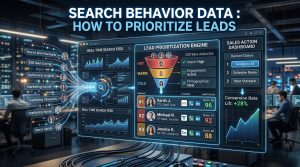
Intent-Based Scoring for Accurate Sales Focus

A practical framework for turning behavioral intent signals into transparent lead priorities, better sales timing, stronger qualification, and more relevant buyer conversations.
Lead generation creates volume, but volume alone does not create revenue. Sales teams can have thousands of contacts in a CRM and still struggle to identify which conversations deserve attention first. The real challenge is separating meaningful buying signals from routine engagement, curiosity, research, and outdated activity.
Intent-Based Scoring provides a structured way to solve that problem. Instead of treating every download, page visit, or form submission as equally valuable, marketers can evaluate what a prospect is researching, how recently they became active, how deeply they are investigating a problem, and whether their behavior aligns with a realistic buying journey.
The concept becomes particularly powerful when organizations combine behavioral information with customer fit. A highly active researcher may look exciting but still be outside the company’s ideal market. Another prospect may show fewer visible interactions but match the target profile exceptionally well and suddenly begin researching a critical solution area. Intent-Based Scoring helps create a more balanced view.
Modern buyers also behave differently from the linear funnels used in many legacy marketing models. Prospects may consume educational content for months, pause, return when a business problem becomes urgent, compare providers, ask technical questions, and only then speak with sales. A scoring system that recognizes these shifts can help teams respond with better timing.
This guide explains how Intent-Based Scoring works, how to build a practical model, which signals matter most, how to align scoring with sales operations, where automation and AI can help, and how to measure whether the framework is actually improving revenue performance.
What Is Intent-Based Scoring?
Intent-Based Scoring is a lead or account prioritization method that assigns greater importance to behavioral signals associated with active research, evaluation, or potential purchasing activity. Rather than relying only on demographics or one-off conversions, the model considers multiple indicators and their context.
Intent-Based Scoring can include signals such as search behavior, content consumption, product-page visits, comparison activity, competitor research, return visits, webinar participation, pricing-page engagement, and other actions that may indicate increasing interest.
The important distinction is that intent is not the same thing as certainty. A person can research pricing without purchasing, download a comparison guide without becoming a customer, or repeatedly visit a product page because they are conducting professional research.
For that reason, Intent-Based Scoring should be designed around evidence rather than assumptions. A signal becomes more useful when it supports a broader pattern involving relevance, recency, frequency, and customer fit.
Intent Signals Versus Fit Signals
Fit answers a simple question: “Could this organization or person realistically become a valuable customer?”
Intent asks a different question: “Is there evidence that they are currently researching a problem or solution related to what we sell?”
Intent-Based Scoring becomes more reliable when those two dimensions work together. A lead can have strong fit but weak current intent, or strong intent but poor fit. Neither condition alone should automatically determine sales priority.
A useful framework may therefore maintain two separate scores before combining them into an operational priority.
| Dimension | Examples | Primary Purpose |
|---|---|---|
| Fit | Industry, company size, role, region | Measures customer relevance |
| Intent | Research activity, comparisons, pricing engagement | Measures behavioral interest |
| Recency | Activity in recent days or weeks | Measures current relevance |
| Momentum | Rising or declining activity | Measures trajectory |
| Engagement | Content and website interactions | Adds behavioral context |
This structure prevents an intent-heavy model from accidentally promoting large numbers of poorly matched prospects.
Why Intent-Based Scoring Matters for Sales Teams
Sales capacity is finite. Representatives have limited hours for research, prospecting, meetings, follow-up, and account management. Without prioritization, they often spend disproportionate time working through lists rather than pursuing the conversations with the most useful context.
Intent-Based Scoring can reduce that friction by organizing leads according to observable evidence.
Imagine a sales representative receives two hundred marketing-qualified leads. Twenty have recently shown strong research behavior around the company’s solution category. Another sixty engaged with general educational content weeks ago. The remaining leads completed older campaigns without meaningful recent activity.
A useful scoring model does not need to claim that all twenty will buy. It simply helps the representative decide where to investigate first.
The psychological advantage is equally important. Sales professionals are more likely to personalize outreach when they understand why a contact has become relevant. A generic “high priority” label creates little insight. A contextual explanation such as “recent evaluation activity across several solution topics” gives the representative a starting point for a more relevant conversation.
Intent-Based Scoring can also reduce premature outreach. Sending aggressive sales messaging to someone who has only consumed introductory educational content may create resistance. A lower priority score can keep that person in a nurturing journey until stronger evidence emerges.
This makes prioritization a timing mechanism rather than simply a ranking exercise.
For organizations building broader intent programs, understanding how Intent Data Identifies can help clarify the difference between general interest and signals associated with stronger buying readiness.
The Core Principles of Intent-Based Scoring
A reliable scoring framework usually follows several principles that make the system easier to interpret and maintain.
Relevance Comes First
Intent-Based Scoring should reward behavior connected to a meaningful business problem. A thousand interactions around unrelated subjects should not outweigh a smaller number of highly relevant interactions.
Topic relevance can be measured at different levels. Some behaviors are directly connected to a product category, while others indicate adjacent problems. Creating topic groups helps distinguish the two.
Recency Changes the Meaning of a Signal
A signal becomes less useful as it ages. Someone who visited a solution page yesterday is in a different context from someone who did the same thing eight months ago.
Intent-Based Scoring should therefore include time decay or a similar mechanism. Recent behavior receives more consideration, while old actions gradually lose influence unless new activity appears.
Momentum Often Matters More Than Volume
A lead with constant low-level engagement may be less urgent than a previously inactive prospect who suddenly becomes highly active.
Intent-Based Scoring can capture momentum by measuring changes in activity over a defined period. Rising frequency, expanding topic depth, or movement from educational content toward commercial content can all contribute to a stronger priority signal.
Sequences Are Stronger Than Isolated Actions
One action rarely provides enough context. Several related actions can reveal a pattern.
A prospect who reads a definition, returns for an advanced guide, searches for comparisons, and then visits implementation documentation has demonstrated a different research journey from someone who only downloads an introductory PDF.
Intent-Based Scoring should therefore consider sequences rather than simply adding arbitrary points to individual activities.
Building an Intent-Based Scoring Model
The first step is defining what the score is supposed to accomplish. A model designed for enterprise sales will look different from one designed for a low-cost self-service product.
Intent-Based Scoring should be connected to a specific business decision. That decision might be whether sales should review an account, whether marketing should accelerate nurture content, whether an existing customer should receive an expansion alert, or whether an opportunity should receive additional attention.
Step 1: Define the Ideal Customer Profile
Document your strongest customer characteristics before introducing behavioral scoring.
Consider:
- Target industries
- Company size
- Typical revenue range
- Geographic markets
- Job functions
- Common business problems
- Buying complexity
- Typical sales-cycle length
This information provides the fit layer against which behavioral signals can be interpreted.
Step 2: Define High-Value Intent Topics
Create a topic taxonomy that separates awareness subjects from solution and evaluation subjects.
For example:
| Topic Category | Example Behavior | Typical Interpretation |
|---|---|---|
| Awareness | “What is lead scoring?” | Early education |
| Problem | “How to improve lead qualification” | Recognized need |
| Solution | “Lead scoring software” | Solution exploration |
| Comparison | “Lead scoring tools compared” | Evaluation |
| Commercial | “Lead scoring platform pricing” | Commercial research |
| Implementation | “CRM lead scoring integration” | Adoption planning |
Intent-Based Scoring becomes easier to manage when these topic groups are explicit.
Step 3: Establish Behavioral Weighting
Not every action deserves the same influence. A product documentation visit may represent a different stage from a general blog visit.
However, marketers should resist exaggerated point values. A single pricing-page visit should not automatically transform an unknown visitor into a sales-ready lead.
A better system considers the interaction alongside the lead’s other evidence.
For example:
Low influence: one general article view.
Moderate influence: several related articles and repeat visits.
Higher influence: comparison activity plus solution-page engagement.
Strong contextual influence: recent commercial research combined with strong customer fit and multiple related signals.
This makes the model more realistic.
The Most Valuable Intent Signals
Intent-Based Scoring depends on selecting signals that genuinely help distinguish meaningful research from ordinary engagement.
Search and Research Behavior
Search behavior can reveal the subjects prospects are actively trying to understand. Specific searches often provide useful context, especially when they become more detailed over time.
A broad informational query may indicate early research. A sequence that progresses toward comparisons, implementation, pricing, security, or vendor alternatives may indicate deeper evaluation.
Search behavior should still be interpreted cautiously because different audiences search in different ways.
Website Engagement
Returning to important pages can reinforce research signals.
Look for patterns such as:
- Repeat visits
- Product-page engagement
- Pricing-page visits
- Comparison-page activity
- Documentation consumption
- Demo-page visits
- Case-study engagement
Intent-Based Scoring can combine these actions with time-based rules so that fresh engagement receives appropriate attention.
Competitor Research
Competitor-related behavior may indicate that the buyer is actively exploring alternatives. Yet competitor research alone does not prove that your business is being considered seriously.
Its strongest value often comes when it appears alongside other evaluation behavior.
Content Depth
Content depth helps distinguish casual consumption from sustained investigation.
A prospect reading one article may simply be learning. Someone consuming several interconnected resources over a short period may be trying to understand a problem in greater detail.
Intent-Based Scoring can categorize content based on the buying stage it supports rather than treating every asset as equivalent.
Account-Level Activity
In B2B settings, behavioral signals can become stronger when multiple contacts at the same organization show related interest.
One employee may research strategy, another may study technical implementation, and another may investigate business outcomes. Together, the signals can create a broader account-level picture.
Intent-Based Scoring Across the Buyer Journey
Intent does not appear suddenly at the final stage. It usually develops through a series of research behaviors.
Awareness Stage
At the awareness stage, prospects are learning what a problem means, why it happens, and whether it deserves attention.
The most useful action is usually education rather than immediate sales pressure.
Intent-Based Scoring can identify these contacts without sending them directly into high-intensity sales sequences.
Problem Recognition Stage
The prospect begins investigating a specific obstacle.
Searches become more practical, content consumption becomes more focused, and the prospect may return to several related resources.
This stage can justify stronger nurturing because the buyer has moved beyond generic education.
Solution Exploration Stage
The prospect starts evaluating possible methods, categories, tools, or approaches.
Intent-Based Scoring can raise priority when the research becomes closely related to the organization’s offering, especially when the lead also fits the target customer profile.
Evaluation Stage
The prospect compares providers, features, prices, integrations, implementation requirements, and expected outcomes.
This stage often provides richer behavioral evidence, but marketers still need to look for corroboration.
Decision Stage
The prospect may investigate onboarding, procurement, security, migration, contracts, or implementation details.
At this stage, Intent-Based Scoring can help sales identify accounts requiring timely review, provided that the broader evidence supports the interpretation.
Designing Transparent Priority Tiers
A useful model should not force salespeople to interpret dozens of hidden scores.
Instead, convert the underlying model into a small number of operational tiers.
| Priority Tier | Typical Evidence | Recommended Treatment |
|---|---|---|
| Priority Review | Strong fit + recent multi-signal activity | Sales review |
| Active Nurture | Relevant fit + growing engagement | Targeted nurture |
| Research | Early or moderate engagement | Educational journey |
| Monitor | Weak, old, or poorly matched signals | Low-touch follow-up |
Intent-Based Scoring can determine how leads move between these categories, while the tiers make the resulting decisions easier for sales and marketing to understand.
A lead should not jump to the highest tier simply because one event occurred. Instead, movement should usually require a combination of factors.
For example, an account could move from “Research” to “Active Nurture” after repeated topic engagement. It might move from “Active Nurture” to “Priority Review” when recent commercial research appears alongside strong fit and broader account activity.
This creates a more stable system.
Preventing Score Inflation
One of the biggest problems in behavioral scoring is inflation. If every action adds points indefinitely, highly active users eventually appear important even when their research is unrelated to purchasing.
Intent-Based Scoring needs mechanisms that prevent meaningless activity from accumulating forever.
Use Time Decay
Older signals should gradually lose influence.
Set Frequency Caps
Repeated views of the same page should not create unlimited points.
Group Similar Actions
Ten visits to related educational pages may be one meaningful pattern rather than ten separate high-value events.
Separate Engagement From Intent
High engagement does not automatically mean high purchase intent. An industry enthusiast may consume large amounts of content without becoming a customer.
Recalculate Regularly
The score should be dynamic. New behavior should change the current picture while old activity becomes less influential.
This creates a system that reflects current buyer context instead of historical activity volume.
Combining Intent-Based Scoring With CRM Data
Intent signals become much more actionable when linked with customer records.
A CRM can provide information such as previous opportunities, account ownership, customer status, industry, job role, deal history, and existing relationships.
Intent-Based Scoring can then help answer questions that static CRM information cannot.
For example:
“Is this known account researching the category again?”
“Has this previous opportunity returned after a period of inactivity?”
“Is an existing customer researching a product they do not currently use?”
“Are multiple contacts from one target account becoming active?”
These questions turn behavioral data into operational intelligence.
Sales teams can also use historical outcomes to refine the model. If certain intent patterns repeatedly preceded qualified opportunities, those patterns may deserve more attention. If another signal produced large numbers of false positives, its importance may need to be reduced.
This feedback loop is critical because every company has a different buying journey.
Using Multiple Intent Data Sources
No single source can reliably represent an entire buyer journey. Website activity provides one perspective. Search research can provide another. Third-party activity may add category-level context. CRM data contributes relationship history.
Organizations evaluating these combinations can also review resources covering Top Intent Data Sources to understand how different signal types can complement one another.
The objective should not be collecting the maximum amount of data. More data can create more noise.
A better approach asks whether each source improves a real business decision.
For example, if one external signal repeatedly produces poorly matched accounts, it may add little value regardless of how sophisticated the vendor’s technology appears.
Intent-Based Scoring works best when every source has a defined purpose, known limitations, and measurable contribution to pipeline quality.
Account-Level Intent for B2B Sales
B2B purchasing often involves committees rather than isolated individuals. This makes account-level interpretation especially valuable.
Imagine an organization where one employee researches strategic benefits, another explores technical compatibility, and another investigates pricing. Looking at each contact separately may underestimate the significance of the combined pattern.
Intent-Based Scoring can aggregate relevant activity at the account level while preserving the distinction between individual contact behaviors.
A useful account model might track:
Breadth: How many relevant contacts are active?
Depth: How advanced are the topics being researched?
Recency: How recently did activity occur?
Momentum: Is account engagement rising?
Fit: Does the organization match the ideal customer profile?
Engagement: Is the account interacting with owned content or product resources?
This account-based view can help sales teams understand why a previously quiet organization deserves another review.
Using Intent-Based Scoring for Sales and Marketing Alignment
Scoring models often fail because marketing and sales define “qualified” differently.
Marketing may interpret engagement as an opportunity to nurture, while sales may expect evidence of an immediate conversation.
Intent-Based Scoring becomes far more effective when both departments agree on what different thresholds actually mean.
Create a shared definition for each operational stage.
For example:
Marketing threshold: The lead demonstrates enough relevant activity to receive more targeted content.
Sales-review threshold: The lead combines strong fit with meaningful recent behavior.
Opportunity-support threshold: The account shows evidence that aligns with an active sales conversation.
These thresholds should be validated against actual results rather than chosen simply because they sound reasonable.
Regular reviews between the teams can reveal which signals are helping and which are producing unnecessary alerts.
Personalizing Outreach From Intent Signals
Behavioral data should not be copied directly into sales messages. Instead, it should help representatives understand which business conversation may be relevant.
Suppose a prospect has been investigating implementation challenges. A useful message could focus on reducing deployment friction and explain common integration considerations.
If another account appears to be evaluating alternatives, the sales representative could provide a neutral comparison framework or practical decision checklist.
The principle is simple: use the signal to improve relevance, not to reveal surveillance-like knowledge.
Intent-Based Scoring can help determine what topic deserves attention, while human judgment determines how that topic should enter the conversation.
This also protects the buyer experience. Prospects generally respond better when outreach addresses a recognizable business challenge rather than revealing detailed observations about their private browsing behavior.
Where Automation Fits
Manual scoring becomes difficult as data volume increases. Automation can monitor activity continuously, update scores, classify behaviors, and route alerts.
Intent-Based Scoring can be connected to automated workflows that detect changes in research patterns and trigger internal tasks.
For example:
- A target account shows increasing engagement around a priority topic.
- The system recalculates the account’s current score.
- The account crosses a predefined review threshold.
- A sales task is created with the evidence summarized.
- The representative reviews the context before outreach.
The most valuable part of automation is not the score itself. It is reducing the time between meaningful behavior and informed human action.
Automation can also help prevent operational delays. A lead that becomes relevant at 10:00 AM should not necessarily wait until the next weekly marketing review before someone notices the change.
Tools and automated systems can help organize large quantities of behavioral signals. For example, Smart Bots can demonstrate the broader role of automation in routing and organizing information.
Adding AI to Intent Interpretation
AI can help identify patterns that are difficult to monitor with static rules alone. It can classify topics, summarize behavioral sequences, identify changes, and organize unstructured signals.
Intent-Based Scoring can use AI-assisted interpretation to answer questions such as:
“What changed recently?”
“Which topic is receiving unusual attention?”
“Is the account moving from education toward evaluation?”
“Are multiple contacts showing related behavior?”
“Which new research pattern resembles previously successful opportunities?”
AI should still operate within clearly defined governance. A model can recognize correlation without understanding the full business context.
Human review remains important, especially for high-value accounts or actions that could significantly affect customer relationships.
Another useful layer is sentiment and contextual interpretation. AI Sentiment Analysis illustrates how AI can help analyze broader behavioral or communication signals rather than relying only on numerical activity counts.
The ideal system is therefore not “AI decides which prospects will buy.” It is “AI helps people understand complex behavioral evidence faster.”
Common Mistakes in Intent-Based Scoring
A good framework can still produce poor outcomes when implementation is careless.
Mistake 1: Giving Every Intent Signal Equal Value
A product-comparison action should not necessarily carry the same weight as an introductory article view.
Mistake 2: Ignoring Customer Fit
A non-target company can generate enormous interest and still remain commercially irrelevant.
Mistake 3: Letting Old Signals Survive Forever
Historical activity can create misleadingly high scores.
Mistake 4: Confusing Engagement With Intent
Highly engaged audiences are not automatically ready buyers.
Mistake 5: Overfitting to One Successful Pattern
A pattern that worked in one sales cycle may not generalize across markets, industries, or buyer groups.
Mistake 6: Creating Unexplainable Scores
Sales teams need to understand why an account received attention.
Mistake 7: Automating Outreach Too Early
The first action after a score increase should often be review, not an aggressive sequence.
Intent-Based Scoring should simplify prioritization, not turn marketing into an automated reaction machine.
Privacy and Responsible Intent Modeling
Behavioral scoring requires thoughtful governance because customer interactions can reveal sensitive contextual information about research interests.
Organizations should understand what data they collect, where it comes from, how long it is retained, who can access it, and what legitimate business purpose it serves.
Intent-Based Scoring should also distinguish between information a prospect directly provides and information inferred from observed behavior.
A responsible model minimizes unnecessary collection and focuses on signals that support useful business decisions.
Communication deserves equal attention. Sales representatives generally do not need to disclose the exact details of a prospect’s research activity. The data can be used internally to make a conversation more relevant without making the prospect feel monitored.
Clear internal governance can also improve system quality. When teams know which sources are reliable and which require caution, the scoring model becomes easier to maintain.
Measuring Whether Intent-Based Scoring Works
The real test of Intent-Based Scoring is not how sophisticated the dashboard looks. It is whether prioritized leads produce better business outcomes.
Track metrics such as:
| Metric | What It Reveals |
|---|---|
| Sales acceptance rate | Whether sales trusts the priority model |
| Meeting rate | Whether prioritized contacts engage |
| Opportunity creation | Whether signals correlate with pipeline |
| Conversion rate | Whether lead quality improves |
| Sales-cycle length | Whether timing improves |
| Pipeline value | Whether prioritization affects commercial impact |
| False-positive rate | Whether the model overstates intent |
| False-negative rate | Whether valuable leads are being overlooked |
One particularly useful metric is conversion by priority tier.
Suppose the highest-priority group converts at only slightly higher rates than the nurture group. That may indicate the scoring threshold is too broad or the selected signals are not sufficiently predictive.
Intent-Based Scoring should therefore be continuously compared with actual outcomes.
Use Historical Validation
Review previously won, lost, and disqualified opportunities. Look for patterns in the behavioral data that existed before each outcome.
This can reveal whether the model is identifying meaningful signals or simply rewarding activity.
Run Controlled Tests
Where practical, compare different prioritization approaches. Measure whether changes in score logic affect sales acceptance, opportunity creation, and revenue progression.
Collect Sales Feedback
Sales representatives see context that automated systems may not. Their feedback can reveal when a score was useful, misleading, too early, or too late.
This creates a practical feedback loop for improvement.
A Step-by-Step Implementation Framework
Organizations do not need to launch a complex scoring infrastructure immediately. Start with the smallest model capable of supporting a useful decision.
Phase 1: Define the Business Objective
Decide what the scoring model should improve.
Is the objective faster sales response? Better MQL quality? More effective account-based targeting? Improved customer expansion?
Intent-Based Scoring should have a direct relationship with that goal.
Phase 2: Build the Signal Taxonomy
Separate signals into awareness, problem, solution, evaluation, commercial, and implementation categories.
Document the meaning of each category.
Phase 3: Add Fit Criteria
Define the target industries, roles, company characteristics, and other factors that influence commercial relevance.
Phase 4: Introduce Recency
Apply time-based decay so old behavior does not dominate current context.
Phase 5: Create Priority Thresholds
Build a small number of operational levels that marketing and sales understand.
Phase 6: Connect the CRM
Make the score visible alongside account and contact information.
Phase 7: Add Automation
Automate score updates, alerts, summaries, and internal routing.
Phase 8: Validate Against Outcomes
Compare scored behavior with meetings, opportunities, conversion, and revenue.
Phase 9: Refine
Remove signals that do not provide useful differentiation and strengthen those that repeatedly correlate with meaningful outcomes.
Intent-Based Scoring should become progressively smarter through evidence rather than through increasing complexity.
Advanced Intent-Based Scoring Strategies
Once the foundation is stable, organizations can expand the model.
Topic-Level Scoring
Instead of assigning one general score, maintain scores by topic or problem area.
A prospect could have moderate interest in one category and strong interest in another. That distinction can improve personalization.
Velocity-Based Scoring
Measure how quickly activity changes.
A sudden increase in relevant research can be more useful than a large but stable historical engagement pattern.
Account Consensus Signals
Measure whether multiple stakeholders are showing related interest.
This can be particularly useful for complex B2B purchases.
Opportunity Re-Engagement
Previous opportunities can be monitored for renewed behavioral activity.
An old opportunity that begins researching relevant topics again may deserve review even if there has not yet been a new form submission.
Customer Expansion Signals
Existing customers may generate research around products, features, integrations, or use cases they do not currently use.
Intent-Based Scoring can support expansion workflows by identifying these emerging interests.
Competitive Evaluation Signals
Research around alternatives can be incorporated into the broader context of the account’s buying journey.
The model should not automatically treat competitor interest as negative. Instead, it can recognize that active comparison is part of many legitimate buying processes.
How Psychology Improves Intent Scoring
Behavior is influenced by uncertainty, urgency, perceived risk, social proof, effort, and expected value.
A prospect researching “how to solve X” may be trying to understand the problem. Someone researching “X implementation requirements” may be trying to reduce adoption uncertainty.
Intent-Based Scoring becomes more insightful when these psychological drivers are considered.
For example, repeated searches about pricing can indicate cost uncertainty. Repeated searches about implementation can indicate operational risk. Case-study consumption can indicate a need for social proof. Security-related research can signal risk reduction.
These interpretations should remain hypotheses rather than absolute conclusions.
The role of a good scoring model is to surface context that deserves attention.
Sales teams can then respond to the likely information need rather than forcing the prospect through a generic pitch.
Creating Better Sales Focus
The ultimate purpose of scoring is focus.
A sales representative should be able to open a prioritized account and quickly understand what changed, why it matters, and what evidence supports the priority.
A useful alert might summarize:
Account fit: Strong.
Recent change: Relevant research increased significantly.
Topic: Lead qualification and sales automation.
Engagement: Multiple related resources consumed.
Account breadth: Several contacts active.
Suggested action: Review account context and identify an appropriate business conversation.
Intent-Based Scoring turns scattered activity into a concise decision aid.
This does not eliminate the need for research. It makes research more targeted.
Salespeople still need to understand company priorities, organizational changes, current relationships, decision-makers, and potential pain points. The score simply helps them decide where to invest that effort first.
The Future of Intent-Based Lead Prioritization
As buyers use more digital channels, organizations will have more behavioral information available than ever before. The challenge will increasingly be interpretation rather than collection.
Intent-Based Scoring is likely to evolve from simple point systems toward dynamic models that combine behavior, context, timing, account relationships, and historical outcomes.
Rather than saying “this lead has 82 points,” future systems can provide a more useful explanation:
“This target account has recently increased research around a core problem, multiple stakeholders have become active, and current engagement resembles patterns observed before previous qualified opportunities.”
That type of explanation is easier for a human to assess.
The strongest systems will also become more adaptive. Instead of assuming that all industries, buyer roles, and sales cycles behave identically, models can learn which signals matter in different contexts while maintaining governance and transparency.
The objective remains the same: reduce wasted attention and improve the timing of human decisions.
Final Takeaways
Intent-Based Scoring is most valuable when it connects three things: what the prospect is doing, whether the prospect fits the business, and how those signals are changing over time.
A reliable model should not obsess over individual clicks. It should recognize patterns.
It should not assume every commercial action represents a purchase. It should evaluate context.
It should not replace sales judgment. It should make sales judgment faster and better informed.
It should not reward activity forever. It should account for recency and changing buyer behavior.
And it should not become a black box. Sales and marketing teams should understand why a lead or account received attention.
When these principles are applied consistently, behavioral signals can become a practical operating layer for sales prioritization.
Conclusion
Intent-Based Scoring gives marketing and sales teams a structured way to interpret behavioral signals without treating every interaction as an immediate buying decision. By combining customer fit, research relevance, recency, momentum, engagement depth, and account context, organizations can create clearer priorities and more timely sales workflows. The strongest models remain transparent, continuously validated, and flexible enough to reflect different buyer journeys. Automation can accelerate detection and routing, while human judgment preserves context and relevance. Ultimately, the value of Intent-Based Scoring is not a sophisticated number; it is helping teams recognize meaningful changes, focus limited attention wisely, and create better conversations at the right moment.
Frequently Asked Questions (FAQ)
What is Intent-Based Scoring in marketing?
Intent-Based Scoring is a framework for evaluating behavioral signals that may indicate a prospect is researching a problem, solution, provider, or purchase decision. It can consider search activity, website behavior, content engagement, comparison research, pricing interactions, and other signals. The purpose is to help marketing and sales determine which contacts or accounts deserve more attention. It should not be interpreted as a guarantee that someone will buy. Instead, it provides contextual evidence that can be combined with customer fit, recency, engagement, and CRM information.
How does Intent-Based Scoring improve lead qualification?
Intent-Based Scoring adds behavioral context to traditional qualification. A lead may have an appropriate job title and company profile but show no recent interest in the problem the company solves. Another lead may demonstrate strong research behavior while also matching the ideal customer profile. By considering both dimensions, teams can create more useful priorities. The framework can also help identify leads whose interest is increasing, which may prevent sales teams from relying only on static qualification criteria or old conversion events.
Which signals are most important for Intent-Based Scoring?
The most useful signals depend on the company’s market and buying journey, but common inputs include relevant search behavior, recent website engagement, product-page activity, comparison research, pricing interactions, implementation research, repeat visits, account-level activity, and content depth. No single signal should automatically determine priority. A combination of relevance, recency, momentum, fit, and behavioral depth usually creates a more balanced view. Organizations should validate individual signals against actual sales outcomes before assigning them major influence in the model.
Should a pricing-page visit create a high intent score?
A pricing-page visit can be a meaningful signal, but it should not automatically create a high score. People may view pricing for many reasons, including early research, budgeting exercises, comparisons, or general curiosity. Intent-Based Scoring works better when a pricing interaction appears alongside other evidence such as relevant content consumption, repeat visits, product research, or strong customer fit. The more independent signals support the same interpretation, the more useful the overall priority becomes. Context should matter more than one isolated action.
Can Intent-Based Scoring work for B2B account-based marketing?
Yes. B2B buying decisions often involve several stakeholders, so account-level scoring can add useful context. Different employees may research strategic, technical, financial, or operational aspects of the same solution. When those signals are combined, marketing and sales can recognize broader account interest that would remain hidden when every contact is evaluated independently. Account-based models can consider research breadth, topic depth, recency, activity velocity, company fit, and the number of relevant stakeholders involved in the observed behavior.
How often should an Intent-Based Scoring model be updated?
The model should be monitored continuously and formally reviewed at intervals appropriate to the company’s sales cycle and market. Fast-moving markets may require more frequent reviews because customer behavior and priorities can change quickly. Longer sales cycles may support a slower formal review schedule. The important point is that the model should be compared with real outcomes. Changes in sales acceptance, opportunity creation, conversion, false positives, and false negatives can indicate when scoring rules need adjustment.
What is the difference between intent and engagement?
Engagement describes interaction with a brand, while intent focuses more specifically on signals associated with research toward a problem, solution, or purchasing decision. Someone can be highly engaged without having meaningful purchase intent. For example, an industry enthusiast might read dozens of articles without becoming a customer. Intent-Based Scoring should therefore distinguish general engagement from commercially relevant research. The distinction becomes stronger when behavior is examined together with topic relevance, recency, customer fit, and changes in research depth.
Can AI improve Intent-Based Scoring?
AI can help identify patterns, classify topics, summarize behavioral sequences, and detect changes across large datasets. It can make it easier for marketers to understand why an account’s behavior has changed instead of simply seeing a numerical score. However, AI should not be treated as infallible. Models can identify correlations without understanding every business circumstance. Human review remains valuable for high-impact decisions. A practical approach uses AI to accelerate analysis while keeping scoring rules, governance, and sales decisions transparent.
How can companies reduce false positives in intent scoring?
Companies can reduce false positives by combining behavioral evidence with strong customer-fit criteria, applying time decay, avoiding unlimited point accumulation, and validating signals against historical outcomes. They should also examine why apparently high-intent leads fail to convert. Certain research patterns may reflect education, consulting activity, competitors, students, or unrelated use cases. Intent-Based Scoring should therefore be refined using both successful and unsuccessful outcomes. The goal is not to produce the highest possible scores, but to create better differentiation between genuinely useful priorities and noise.
Does Intent-Based Scoring replace sales judgment?
No. The purpose of Intent-Based Scoring is to support sales judgment by organizing behavioral evidence into a practical priority framework. A score can indicate that an account’s research activity has changed, but it cannot fully explain the organization’s internal politics, budget situation, decision process, strategic priorities, or relationship history. Sales professionals still need to validate context. The strongest operating model uses scoring to decide where human investigation should begin, then allows people to determine the appropriate conversation, timing, and next action.