How Intent Data Identifies Ready-to-Buy Leads
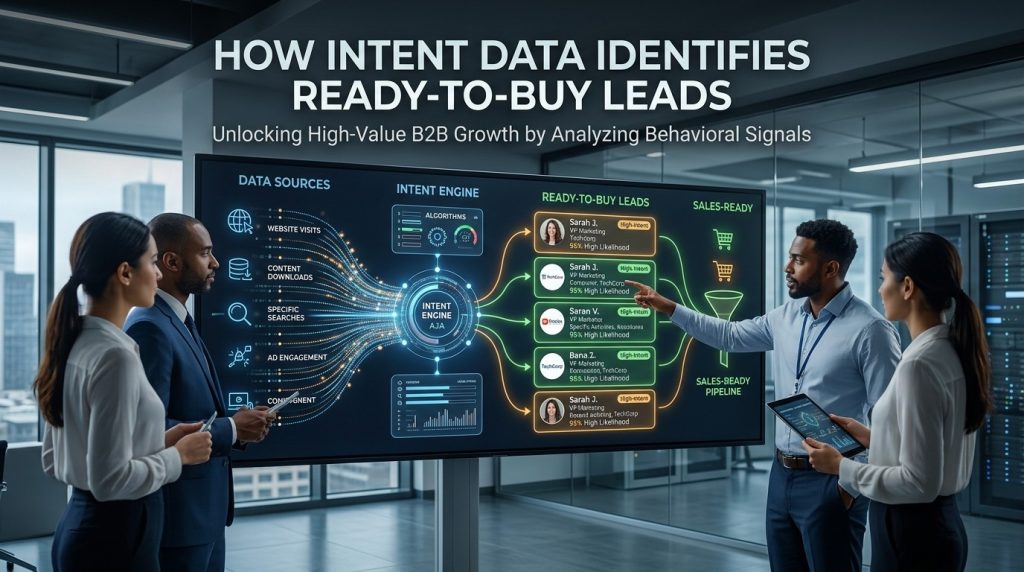
Intent Data Identifies buying signals by combining research behavior, engagement, account fit, timing, and purchase-stage patterns to separate active prospects from ordinary website visitors.
Modern B2B prospecting has a timing problem. A company can perfectly match an ideal customer profile and still have no intention of buying today. At the same time, another company with fewer obvious firmographic similarities may be actively researching solutions, comparing vendors, reviewing pricing, or preparing internal requirements. Intent Data Identifies these behavioral differences by adding a layer of real-world activity to traditional lead qualification.
The challenge is not simply collecting more information. Sales teams already have CRM records, form submissions, website analytics, email engagement, advertising interactions, and third-party research signals. The real challenge is knowing which signals matter, which ones are weak, and when several small actions become a meaningful buying pattern. Intent Data Identifies those patterns when they are evaluated collectively instead of treating every click as an isolated event.
This distinction matters because today’s buyers often complete much of their research before speaking with a sales representative. They may consume comparison articles, technical documentation, case studies, reviews, implementation guides, and pricing information without filling out a form. Intent Data Identifies the hidden movement inside this research journey, helping teams understand when a passive account may be becoming an active opportunity.
What Does “Ready-to-Buy” Actually Mean?
A ready-to-buy lead is not necessarily someone who has already decided which vendor to choose. Instead, the lead is showing enough evidence that a commercial conversation is more relevant now than it was previously. Intent Data Identifies readiness by looking for combinations of activity that suggest problem awareness, solution evaluation, budget consideration, vendor comparison, implementation planning, or decision preparation.
Intent Data Identifies different levels of readiness because buying journeys rarely move in a straight line. A prospect may spend several weeks learning about a problem, become inactive, return with highly specific questions, and then involve several stakeholders. That sequence can be more meaningful than a single high-volume activity spike.
A useful readiness framework includes four stages: awareness, consideration, evaluation, and decision. Awareness signals often indicate curiosity or education. Consideration signals show stronger interest in potential solutions. Evaluation signals indicate comparison and validation. Decision signals commonly involve pricing, procurement, security, implementation, contract, or vendor-specific research.
How Intent Data Identifies Buying Signals
The first principle is simple: Intent Data Identifies behavioral change rather than merely counting activity.
Imagine an account that visits your blog twice in six months. That account is relevant to your industry, but the behavior alone does not justify immediate sales outreach. Now imagine the same account returns several times in two weeks, reads product comparison content, views implementation documentation, visits the pricing page, and downloads a case study. The pattern has changed.
Intent Data Identifies that change by combining frequency, recency, relevance, and depth. The account is no longer simply browsing. It may be researching a business problem seriously enough to explore whether a solution is worth evaluating.
This is why signal quality matters more than signal quantity. Fifty low-value page visits may tell you less than five actions that occur in a coherent sequence. Prospecting systems should therefore focus on behavioral meaning rather than creating large volumes of unqualified “hot lead” alerts.
The Difference Between Interest and Intent
Interest is broad. Intent is more commercially specific.
A person may read an article about customer retention because they are learning about marketing strategy. Another person may search for customer retention software, compare vendors, review integration options, and calculate implementation requirements because they are actively evaluating solutions.
Intent Data Identifies this progression when research becomes increasingly specific.
This difference is especially important for sales teams because premature outreach can create friction. Sending a direct pitch after a single educational interaction may feel irrelevant. Waiting too long when several late-stage signals are appearing can mean missing a valuable window.
Intent Data Identifies the middle ground by helping teams understand whether the behavior represents casual curiosity or a deeper buying process.
The Main Signals That Indicate Buying Readiness

Not all signals deserve equal weight. A strong qualification model considers the type of action, its timing, frequency, commercial meaning, and relationship to the account’s actual business context.
The following signals are commonly useful:
| Signal | Potential Meaning | Typical Strength |
|---|---|---|
| Broad educational content | Early research | Low |
| Repeated topic consumption | Growing problem awareness | Moderate |
| Product category research | Solution exploration | Moderate |
| Vendor comparison | Active evaluation | High |
| Pricing page activity | Commercial investigation | High |
| Technical documentation | Validation or implementation research | High |
| Security or compliance content | Procurement preparation | High |
| Demo request | Explicit commercial interest | Very high |
| Multiple stakeholders researching | Buying-group activity | Very high |
| Procurement or contract content | Decision-stage preparation | Very high |
Intent Data Identifies these actions more effectively when they are evaluated as a sequence. For example, technical documentation by itself may be used by existing customers, engineers, students, or researchers. When the same behavior appears alongside competitor comparisons and pricing activity from a high-fit account, the interpretation becomes much stronger.
Recency: One of the Most Important Variables
Timing often separates useful intent signals from outdated activity.
An account that performed strong research six months ago may no longer be evaluating the category. The project could have been cancelled, delayed, solved internally, or assigned to another vendor. Intent Data Identifies stronger opportunities by giving greater importance to recent activity.
Consider two target accounts. Account A accumulated ten relevant actions over eight months. Account B accumulated six relevant actions during the last ten days. Account A may technically have more activity, but Account B could represent a more immediate prospecting opportunity.
Recency should therefore be included directly in scoring.
A simple model might reduce signal value gradually as time passes. For example, a research action from yesterday could receive full weight, an action from thirty days ago could receive partial weight, and an action from six months ago could contribute very little unless supported by new engagement.
Frequency and Behavioral Momentum
Frequency answers a different question: is the prospect repeatedly returning to the same problem?
Intent Data Identifies momentum when related actions cluster within a defined period.
A single page view can happen accidentally. Several visits across related resources suggest greater interest. Repeated return sessions can also indicate that the prospect is collecting information for internal discussions.
Behavioral momentum becomes especially meaningful when different content formats are involved. An account might first read an educational guide, then a comparison article, then a case study, then technical documentation. Each step adds context.
However, frequency should not be interpreted blindly. Automated traffic, shared corporate networks, content syndication, training programs, and non-buying users can produce false signals. Data quality controls are essential before assigning sales priority.
Account Fit Still Matters
Intent does not replace your ideal customer profile.
Intent Data Identifies a company as active, but activity does not necessarily make the account commercially suitable. A company can show enormous interest in your category while lacking the budget, size, geography, infrastructure, or business model required to become a customer.
This is why account fit should work alongside intent signals.
Useful fit criteria may include annual revenue, employee count, industry, geographic coverage, technology environment, use case, organizational structure, and purchasing capacity.
A simple conceptual formula is:
Priority = Account Fit + Intent Strength + Recency + Engagement Depth
The formula does not need to be mathematically complex. What matters is establishing a consistent process where behavioral activity cannot completely override poor account fit.
First-Party Signals Versus External Signals
First-party activity comes from channels you control. Examples include website visits, product-page engagement, webinar attendance, downloads, form submissions, email activity, and interactions with your content.
External signals may show research outside your own ecosystem. These can reveal market activity that would otherwise remain invisible.
A broader view becomes possible when teams combine several types of Intent Data rather than relying on one behavioral source.
For example, an account may show external research around a software category but display limited activity on your website. That could indicate early-stage market research. If the same account later returns to your site and consumes pricing and implementation content, the picture becomes significantly more commercially relevant.
Teams should assess data providers based on transparency, methodology, coverage, freshness, account matching, compliance, and signal granularity. The best source is not automatically the one with the largest database.
For a deeper breakdown of providers and collection methods, marketers can also review Intent Data Sources when designing a multi-source prospecting framework.
Topic Selection Makes Signals More Useful
Generic topics often produce too much noise.
Suppose a cybersecurity company monitors the broad topic “technology.” That category is far too large to support useful sales prioritization. Monitoring “zero-trust implementation,” “endpoint security migration,” or “SOC modernization” creates a more specific relationship between research activity and commercial relevance.
Intent Data Identifies stronger opportunities when the monitored topics map directly to actual customer problems.
A good topic framework should include:
- Core solution categories
- Important customer pain points
- Competitor names
- Implementation challenges
- Pricing and procurement themes
- Integration requirements
- Regulatory or compliance questions
- Alternative approaches
- Product-specific terminology
The language should reflect how customers search and talk about the problem, not simply how the company describes its own products.
Competitor Research as a Stronger Signal
When an account researches competitors, the buying process may have moved beyond general education.
Intent Data Identifies this shift by recognizing that comparison behavior tends to involve stronger commercial motivation than broad educational research.
For instance, searching “what is CRM software” suggests learning. Searching “CRM migration cost comparison” suggests a more developed need. Searching “Salesforce vs HubSpot implementation” suggests vendor evaluation. None of these statements guarantees a purchase, but each can indicate increasing decision proximity.
Competitor activity should still be interpreted carefully. Competitive research can be performed for market research, consulting work, job-related learning, or other purposes. That is why competitor intent should be combined with account fit and additional behavioral evidence.
Pricing Activity and Commercial Readiness
Pricing behavior is frequently treated as a strong buying signal because cost is usually considered when an organization is moving closer to a purchase decision.
Intent Data Identifies pricing-related activity as more meaningful when it appears within a broader sequence.
For example, a prospect may read an educational article, explore product capabilities, visit comparison pages, and then review pricing. The sequence suggests a different level of maturity than someone who visits pricing directly once.
Pricing behavior also deserves context. Some visitors check pricing because they are simply curious. Others may be preparing an internal budget proposal. The difference cannot be determined from a single event.
Combining pricing activity with job role, company fit, product interest, and recent engagement can produce a more reliable interpretation.
Technical Content Can Reveal Evaluation
Technical resources often attract prospects who are asking, “Can this solution actually work for us?”
Intent Data Identifies technical evaluation when accounts repeatedly interact with implementation guides, API documentation, integration pages, security resources, migration content, or architecture material.
These signals can be particularly meaningful for complex B2B products because technical feasibility often precedes commercial approval.
For example, an enterprise might first review product features, then study integrations, then investigate security requirements, and finally download an implementation guide. That journey indicates growing operational involvement.
Sales and marketing teams should therefore avoid assuming that only pricing pages matter. In complex purchases, technical research can happen immediately before business-case development.
Multi-Stakeholder Activity
B2B buying is often a group decision.
One person researching a category can be useful, but several people from the same company researching related subjects can provide stronger contextual evidence.
Intent Data Identifies buying-group formation when multiple contacts or departments demonstrate relevant behavior around the same account.
Consider a company where a marketing manager researches capabilities, an IT manager investigates integration requirements, and a finance stakeholder reviews pricing information. That pattern tells a richer story than any single signal.
Teams can use this information to coordinate account engagement rather than sending identical messages to every person. Different stakeholders should receive information relevant to their concerns.
Marketing may support the wider buying group with educational material while sales develops relationships with the people responsible for evaluation and decision-making.
Behavioral Sequences Matter More Than Individual Actions
A major advantage of intent-based prospecting is sequence analysis.
Intent Data Identifies readiness more accurately when multiple actions occur in a logical order.
A typical sequence could look like:
Problem research → category research → vendor comparison → case study → technical validation → pricing → demo or sales interaction
The sequence does not have to be identical for every buyer. Different industries and purchasing models create different patterns.
What matters is recognizing progression.
A strong scoring system can therefore assign more points when related actions appear in a plausible buying sequence. This is often more informative than simply adding points for every isolated event.
Creating an Intent Score
Once the signals are defined, companies can create an intent score to help sales teams prioritize.
One example could be:
| Factor | Example Weight |
|---|---|
| Topic relevance | 20% |
| Account fit | 20% |
| Recency | 20% |
| Research depth | 15% |
| Engagement frequency | 10% |
| Buying-group activity | 10% |
| First-party engagement | 5% |
These values are starting points rather than industry standards.
Intent Data Identifies sales-ready leads most effectively when scoring rules are tested against actual pipeline outcomes.
A score should answer a practical question: “Why should this account receive attention now?”
If a salesperson cannot understand how the score was created, adoption may suffer. Transparent scoring is usually easier to trust, explain, audit, and improve.
Example of a Simple Lead-Readiness Model
A SaaS company could classify accounts into four groups.
Cold: Strong account fit but little meaningful activity.
Warming: Relevant research has started, but the behavior remains broad.
Active: Repeated relevant research, recent engagement, and at least one commercial signal.
Ready: Strong account fit plus recent evaluation behavior, deeper research, and evidence of buying-group involvement.
Intent Data Identifies movement between these stages rather than permanently labeling a company.
An account marked “Ready” today could become “Warming” next month if activity disappears. Dynamic classification is more realistic than permanent lead status.
Why False Positives Happen
No behavioral system is perfect.
Intent Data Identifies potential readiness, but false positives occur for many reasons. Employees may research products for educational purposes. Consultants may investigate providers for clients. Students may consume technical resources. Existing customers may browse content for support. Automated systems may generate traffic.
Some companies also conduct internal research without budget approval.
That is why the signal should be considered evidence rather than certainty.
A human reviewer can often spot contextual problems that a scoring model cannot. High-value accounts should receive additional validation before expensive sales resources are allocated.
Human Psychology Behind Buying Signals
Prospecting is partly a data problem and partly a psychology problem.
Buyers normally move through several mental states: recognizing a problem, understanding consequences, exploring solutions, reducing uncertainty, comparing alternatives, justifying investment, and seeking internal approval.
Intent Data Identifies behavioral evidence of these changing mental states.
Educational content may correspond to problem awareness. Comparison content may reflect uncertainty reduction. Case studies may support trust formation. Pricing content may indicate economic evaluation. Security documentation may reflect risk reduction.
Understanding this progression helps marketers and sales teams create better messages.
The objective is not to manipulate the buyer. It is to reduce friction by delivering information that matches the question the buyer is currently trying to answer.
Reducing Cognitive Load Through Better Outreach
Cold outreach often fails because the prospect must do too much mental work.
A generic message says, “We provide excellent marketing solutions. Would you like a demo?”
A context-aware message might focus on a specific business issue associated with the account’s industry and growth stage.
Intent Data Identifies which topics deserve attention so the seller can choose a relevant angle without exposing the prospect’s private behavior.
This matters psychologically because relevance lowers the cognitive effort required to interpret a message. The buyer can quickly decide whether the conversation is related to an active concern.
Useful personalization is therefore less about adding personal details and more about improving contextual accuracy.
AI and Intent Interpretation

AI can help companies process large quantities of behavioral information much faster than manual review.
An AI system can classify topics, summarize recent account activity, group signals by buying stage, detect unusual changes, and prepare account briefs for sales teams.
Intent Data Identifies patterns that can then be organized automatically by AI.
For example, an AI-assisted workflow might receive dozens of account-level events, determine that most belong to a single topic cluster, compare recent activity with historical behavior, and summarize the change for a representative.
Automation can also route high-priority accounts to the correct team.
Systems involving Smart Bots can support repetitive tagging, routing, summarization, and workflow actions around broader customer-data processes.
The Role of Sentiment
Intent describes behavior, while sentiment can provide additional context around attitudes and perceptions.
A prospect may actively research a product category while expressing skepticism about implementation complexity. Another may have strong positive sentiment toward a vendor but still be early in the research process.
Intent Data Identifies behavior, while sentiment analysis can help contextualize how people perceive a category, company, or issue.
Large organizations can use AI Sentiment Analysis to organize large volumes of customer or market feedback into broader emotional and thematic patterns.
Sentiment should remain an additional signal rather than a direct measure of purchase likelihood.
Connecting Intent With CRM History
Current activity becomes more meaningful when viewed against account history.
Intent Data Identifies renewed interest particularly well when a dormant account suddenly becomes active again.
Imagine an account that previously evaluated your solution but closed the project without purchasing. Months later, several stakeholders return to comparison content and implementation resources. That new behavior has historical context.
A CRM can provide previous opportunity stages, objections, competitors, product interests, and sales notes.
Combining historical information with current activity helps teams avoid treating every returning account as a brand-new prospect.
It can also support re-engagement campaigns based on legitimate business context rather than generic follow-up messages.
Intent Data for Account-Based Marketing
Account-based marketing depends heavily on choosing the right accounts and coordinating messaging across stakeholders.
Intent Data Identifies accounts showing increased interest in themes associated with the company’s solution, helping ABM teams decide where to increase attention.
For example, a company could maintain a target list of 1,000 accounts, then monitor which organizations demonstrate increasing activity around specific solution topics. Marketing resources can be concentrated on the accounts showing stronger signals.
This does not mean stopping all activity toward other accounts. It means using behavioral evidence to determine where additional investment may make sense.
The same system can help synchronize content, advertising, sales outreach, event invitations, and executive engagement.
Using Intent in Lead Nurturing
Not every active account is ready for a sales conversation.
Intent Data Identifies early-stage research that can be addressed through nurturing instead of immediate sales outreach.
An account researching broad educational subjects might receive guides and educational resources. If activity becomes more specific, the nurture path can introduce comparison content, customer stories, or practical implementation guidance.
When stronger commercial signals emerge, the account can move into a sales-assisted workflow.
This gradual progression protects the buyer experience while maintaining visibility.
Nurturing should also include frequency controls. A rise in intent does not mean a prospect wants ten emails in one week. Increased relevance should not become increased noise.
Creating Trigger-Based Sales Alerts
A sales alert should explain more than “high intent detected.”
A useful alert might contain:
Account: Company name
Fit: High
Recent change: Activity increased significantly
Topic: CRM migration
Signals: Comparison content, integration guide, pricing
Stakeholders: Marketing and IT roles
Suggested action: Review migration case study and existing account history
Intent Data Identifies the reason for the alert, while the surrounding context helps the salesperson decide whether action is appropriate.
This approach is much more useful than generic alerts because it connects data to a possible next step.
When a High-Intent Alert Should Not Trigger Outreach
Even a strong signal may require caution.
Intent Data Identifies activity, but sales teams should still check for existing customer relationships, open support issues, recent objections, ongoing procurement processes, or other account-level context.
For example, an existing customer may repeatedly visit competitor comparison pages while evaluating alternatives. That behavior deserves a different response from a brand-new prospect.
Likewise, an account in the middle of contract negotiations may generate unusual pricing and procurement activity. Treating that as a fresh cold prospect could create confusion.
Context should always come before automation.
Using Intent Data Without Becoming Intrusive
Behavioral intelligence can improve targeting, but the outward experience should remain respectful.
Prospects generally do not need to know every internal signal that influenced a sales decision.
Instead of saying, “We noticed you read three articles about our competitor last Tuesday,” the salesperson can say, “Many companies evaluating this category are currently comparing implementation complexity and total cost.”
Intent Data Identifies the relevant business topic internally, while the message remains focused on legitimate customer needs.
This distinction is especially important for trust. Personalization becomes uncomfortable when it feels like surveillance.
Good prospecting uses intelligence to improve relevance, not to demonstrate how much the company knows.
Privacy and Responsible Data Use
Companies should understand how their behavioral data is collected, processed, matched, stored, and shared.
Intent Data Identifies potentially valuable buying activity, but organizations still need appropriate governance around privacy, retention, consent, transparency, access controls, and applicable regulations.
Data quality and ethical use are closely connected. If an organization cannot explain where a signal came from or why it is being used, that signal may not belong in a high-stakes qualification workflow.
Teams should define clear responsibilities for data ownership and review.
A responsible framework asks:
- What was collected?
- Why was it collected?
- Is the source reliable?
- Can the identity be matched accurately?
- How long should the information be retained?
- Who can access it?
- What decision will it influence?
Measuring Intent-Based Lead Qualification
A mature system should connect signals to outcomes.
Intent Data Identifies potential buyers, but the business must determine whether those signals actually improve commercial performance.
Track metrics such as:
| Metric | Why It Matters |
|---|---|
| Positive reply rate | Shows outreach relevance |
| Meeting rate | Measures engagement |
| Opportunity creation | Tests commercial value |
| Pipeline per intent tier | Shows signal quality |
| Win rate | Connects signals with closed business |
| Sales-cycle length | Tests timing impact |
| Revenue per account | Measures financial value |
| False-positive rate | Reveals scoring weakness |
The most important comparison is not simply “how many high-intent accounts did we find?” It is “how did high-intent accounts perform compared with similar accounts without those signals?”
This turns intent from a marketing concept into a measurable business process.
Building a Feedback Loop
Scoring systems should evolve.
Intent Data Identifies signals based on rules that may work today but underperform tomorrow. Market conditions change, customer journeys change, and content consumption patterns change.
Sales teams should regularly review which signals appeared before real opportunities.
Suppose competitor research turns out to be highly predictive for one segment but weak for another. The scoring model can be adjusted.
Likewise, if pricing activity produces many false positives, the team might reduce its weight unless other supporting signals appear.
The most effective models become better because they learn from actual business outcomes.
A Practical Workflow for Sales Teams
A straightforward workflow can look like this:
Step 1: Define the ICP
Identify accounts that are commercially relevant.
Step 2: Map buying topics
Document the subjects buyers research at every stage.
Step 3: Collect signals
Bring together first-party, external, CRM, and campaign information where appropriate.
Step 4: Normalize data
Standardize domains, account identities, timestamps, topics, and signal types.
Step 5: Apply scoring
Weight fit, recency, frequency, depth, and engagement.
Step 6: Classify readiness
Separate awareness, warming, active, and ready accounts.
Step 7: Review context
Check CRM history, existing relationships, and possible false positives.
Step 8: Activate outreach
Choose an action appropriate for the buying stage.
Step 9: Measure outcomes
Track meetings, opportunities, pipeline, and revenue.
Step 10: Refine
Update scoring rules based on evidence.
Intent Data Identifies opportunities most effectively when the workflow remains simple enough for salespeople to use every day.
A 30-Day Implementation Plan
Week 1: Define the Framework
Document the ICP, key topics, buying stages, strong signals, weak signals, scoring criteria, and ownership.
The objective is clarity. A simple model that everyone understands is more useful than a sophisticated model nobody trusts.
Week 2: Connect the Data
Bring together CRM information, website behavior, marketing engagement, and available external research signals.
Focus on the data needed to answer specific sales questions.
Week 3: Build and Test Scoring
Create initial thresholds and run historical accounts through the framework.
Look for obvious false positives and missing signals.
Week 4: Launch a Controlled Pilot
Select a limited group of target accounts.
Compare the results of intent-informed outreach against normal prospecting activity. Monitor replies, meetings, opportunity creation, and sales feedback.
Avoid automating everything immediately. Manual validation during the pilot can reveal problems before they become system-wide.
Advanced Pattern: Sudden Intent Spikes
A sudden increase in activity can be especially useful when compared with an account’s normal baseline.
Intent Data Identifies unusual behavior by comparing current activity with historical patterns.
For example, if an account normally shows one or two relevant visits per month but suddenly generates fifteen interactions across several connected topics, the change itself can be informative.
A spike does not automatically mean “buy now.” However, it is a useful reason to investigate.
Sales teams can examine whether the account is hiring for relevant roles, launching a new initiative, expanding internationally, changing technology, or facing a known business trigger.
Behavior becomes more valuable when connected with real-world business context.
Advanced Pattern: Multiple People From One Account
A second powerful pattern is cross-person activity.
Intent Data Identifies stronger buying-group evidence when several people from the same organization investigate related topics within a similar period.
For example:
- Marketing researches campaign automation.
- Operations examines workflow integration.
- IT reviews API documentation.
- Finance views pricing information.
Individually, each action could be ambiguous. Together, they can suggest a coordinated evaluation process.
Sales teams should not automatically contact every individual. Instead, the pattern can inform account strategy and help identify which functions may need different information.
Advanced Pattern : Returning After a Long Gap
Reactivation is another useful signal.
An account that previously went quiet but suddenly returns may have a new project, leadership change, budget cycle, vendor review, or operational problem.
Intent Data Identifies reactivation by detecting meaningful new activity against a previous inactive baseline.
This can be especially useful for old leads that sales teams have already invested in.
Rather than restarting with a generic introduction, representatives can review the previous journey and determine whether the new behavior suggests a changed business context.
Advanced Pattern: Research Depth
Depth measures how far someone goes beyond surface content.
A user reading one blog post has limited behavioral depth. A user reading several articles, visiting product pages, reviewing integrations, downloading a case study, checking security information, and examining pricing demonstrates a much deeper research journey.
Intent Data Identifies this progression by weighting different actions according to their place in the buying journey.
Depth should never be used alone, but it becomes powerful when combined with recency and account fit.
Turning Signals Into Useful Sales Conversations

The end goal is not a score.
It is a better conversation.
Intent Data Identifies what a prospect may be researching, but the salesperson still needs to discover the actual business situation.
A strong opening question might explore current challenges, project timing, process complexity, evaluation criteria, or business goals.
The signal can guide the topic without becoming the topic itself.
For example, research around migration could encourage questions about current system limitations, integration complexity, data volume, and internal resources.
This makes the conversation feel informed while leaving space for the prospect to explain what is actually happening.
What a Mature Intent Program Looks Like
A mature program is not necessarily the one with the most data.
It is the one where teams understand:
- Which accounts matter
- Which signals matter
- Why a signal matters
- When action is appropriate
- Who should act
- What message fits the stage
- How success is measured
Intent Data Identifies the behavioral layer, but operating discipline determines whether that layer creates commercial value.
Organizations that combine reliable signals with transparent scoring, human review, contextual outreach, privacy-aware practices, and continuous measurement can make prospecting substantially more focused.
The technology matters, but process design matters just as much.
Final Checklist for Identifying Ready-to-Buy Leads
Before routing an account to sales, ask:
Fit: Does this account match the ICP?
Recency: Is the activity current?
Frequency: Is the prospect repeatedly engaging?
Depth: Is the research becoming more commercially specific?
Progression: Are signals moving from education toward evaluation?
Stakeholders: Are multiple relevant people involved?
History: Does the CRM provide useful context?
Quality: Is the data source trustworthy?
Privacy: Is the signal being used responsibly?
Action: Is there a logical next step?
Intent Data Identifies ready-to-buy leads most reliably when these questions are considered together instead of relying on a single behavioral event.
Frequently Asked Questions (FAQ)
1. What does Intent Data Identifies mean in lead qualification?
Intent Data Identifies refers to the use of behavioral research and engagement signals to recognize accounts that may be moving closer to a purchase decision. It helps sales teams distinguish active research from general audience interest.
2. Can intent signals guarantee that a lead will buy?
No. Intent signals indicate possible buying activity, not guaranteed purchasing. They are best used as evidence that improves prioritization and timing.
3. Which intent signal is usually the strongest?
There is no universal strongest signal. Recent combinations of evaluation behavior, pricing activity, technical research, competitor comparison, strong account fit, and multi-stakeholder engagement can provide stronger evidence than isolated actions.
4. How does recency affect lead readiness?
Recent behavior is generally more useful for immediate prospecting because buying projects can change quickly. Older activity may still provide context but should usually receive less weight unless new signals appear.
5. Why is account fit important when using intent?
A company can show intense interest in a topic while still being unsuitable because of budget, industry, geography, company size, or other business constraints. Fit prevents behavioral activity from creating large numbers of irrelevant opportunities.
6. Can small businesses use intent-based prospecting?
Yes. Smaller sales teams can benefit because they often have limited time for account research. A simple intent framework can help them focus attention on accounts showing relevant changes in behavior.
7. How can AI improve intent qualification?
AI can organize large signal volumes, identify topic clusters, summarize account activity, detect changes, classify buying stages, and assist routing. Human review is still valuable when signals are ambiguous or high-impact.
8. Should every high-intent account receive a sales email?
Not necessarily. Some signals deserve monitoring, nurturing, account research, or internal review before outreach. The appropriate response depends on readiness, context, relationship history, and the sales process.
9. How often should an intent scoring model be updated?
There is no universal schedule. Teams should review performance regularly and adjust the model when conversion patterns, market behavior, customer journeys, or data quality change.
10. What is the best way to prove that intent-based prospecting works?
Compare downstream outcomes such as reply rates, meetings, opportunities, pipeline, sales-cycle duration, win rates, and revenue across accounts with different intent levels. The strongest proof comes from measurable business outcomes rather than signal volume alone.
Conclusion
Intent Data Identifies ready-to-buy leads by connecting behavioral signals with account fit, timing, research depth, engagement, and buying-stage progression. The strongest results come from analyzing multiple signals rather than trusting isolated actions. Recency, competitor research, pricing activity, technical evaluation, and multi-stakeholder engagement can reveal meaningful changes in purchase readiness. Yet intent should remain evidence, not certainty. By combining reliable data, transparent scoring, thoughtful human review, responsible privacy practices, and continuous measurement, sales and marketing teams can prioritize accounts more intelligently while creating outreach that feels timely, relevant, and genuinely useful.