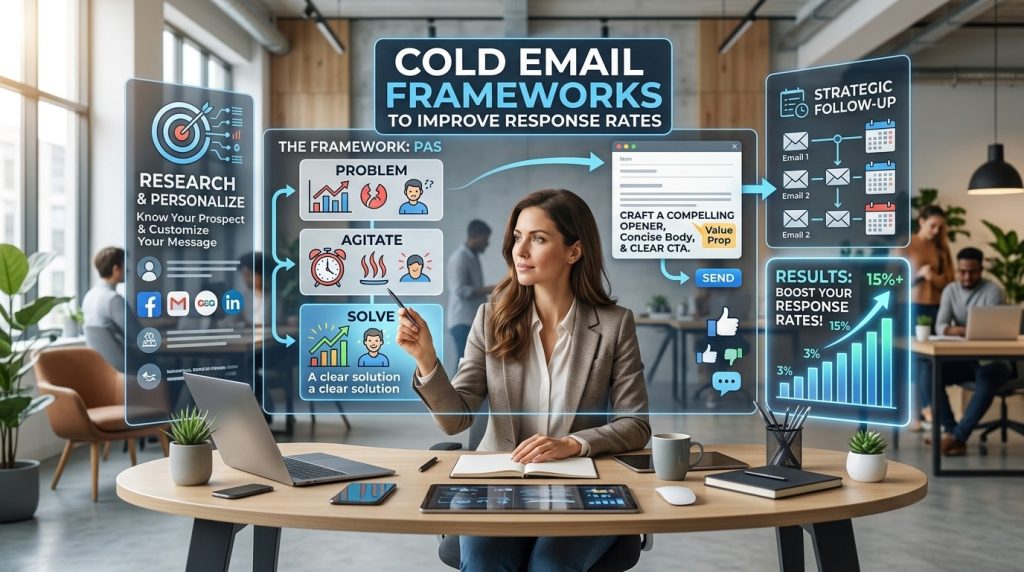
Cold Email Frameworks help teams write messages that feel relevant, respectful, and easy to answer, turning cold outreach into a clearer path toward meaningful conversations.
Cold Email Frameworks matter because inbox attention is scarce and trust is earned quickly. A stranger can only earn a reply when the message feels useful, specific, and easy to act on. The goal is not volume alone; it is creating a message that reduces hesitation. When the first line feels relevant, the reader keeps going. When the structure feels simple, the reader can decide faster.
Cold Email Frameworks also matter because many campaigns fail for avoidable reasons. The offer may be too vague, the audience may be too broad, or the message may sound like a template. In those cases, the sender is not really starting a conversation. The sender is adding noise. Better response rates usually come from better fit, clearer value, and more thoughtful timing.
Cold Email Frameworks become stronger when they reflect the reader’s real world. People reply when the email connects to a current need, a measurable outcome, or a familiar pressure. That is why good outreach is less about clever phrasing and more about disciplined communication. If the message respects attention, it earns more of it.
Why response rates depend on psychology
Cold Email Frameworks improve response rates when they reduce the mental effort required to answer. A reader scans for relevance, safety, and clarity. If the message asks for too much work, the reply disappears. If the benefit is obvious, the reader can move forward without feeling overloaded.
Cold Email Frameworks should therefore be built around ease. People do not want to decode a pitch or guess the next step. They want a short explanation, a reason to care, and a simple action. That is why the best outreach often feels calm, not aggressive. Calm language lowers resistance.
Cold Email Frameworks also work better when they respect uncertainty. Most cold prospects are not ready to buy immediately, but they may be open to a useful conversation. A message that feels human, informed, and low pressure often earns more engagement than one that pushes too hard too early. In practice, trust is the real conversion lever.
The anatomy of a strong cold email
Cold Email Frameworks are more effective when the message has a clear structure. The subject line earns the open, the opening sentence earns attention, the body creates relevance, and the call to action makes the next step easy. Each part has one job. When those jobs are mixed together, the email becomes harder to process.
Cold Email Frameworks should keep the promise simple. A reader should know who the email is for, what problem it addresses, and why the sender reached out now. If any of those parts are missing, the message feels unfinished. Clarity is often more persuasive than excitement because clarity reduces risk.
Cold Email Frameworks should also feel short enough to scan. A long email can work when it is well organized, but a cold prospect rarely gives unlimited attention. Tight writing helps the reader get the point quickly. The more obvious the relevance, the easier the reply.
Audience research and targeting

Cold Email Frameworks improve when the sender knows exactly who should receive them. A list built on vague assumptions wastes attention. A list built on role, industry, pain point, or timing creates a better chance of relevance. The better the target, the easier it is to write a message that feels specific.
Cold Email Frameworks should be based on real signals, not just job titles. Company growth, hiring activity, funding, recent product launches, website changes, or visible pain points can all shape the angle of the email. The more context the sender has, the less generic the outreach becomes. Specific outreach usually sounds more credible.
Cold Email Frameworks also benefit from segmentation. A message for a founder is not the same as a message for an operations manager. One may care about speed; another may care about control. When the audience is segmented clearly, the email can speak to the right incentive instead of guessing.
Subject lines that earn opens
Cold Email Frameworks depend heavily on the subject line because the subject line determines whether the message is opened at all. The best subject lines are often simple, direct, and relevant to the person receiving them. They avoid hype and do not try too hard to sound clever.
Cold Email Frameworks perform better when the subject line hints at value without exaggeration. The reader should feel that the email is worth a glance, not that it is another aggressive sales pitch. Short subject lines often work because they are easy to process. The human brain tends to trust what it can understand quickly.
Cold Email Frameworks also improve when the subject line matches the body. If the subject promises one thing and the email delivers something else, trust drops immediately. That small mismatch can ruin the chance of a reply. Consistency is part of persuasion.
Openings that create relevance fast
Cold Email Frameworks need a first sentence that makes sense immediately. If the opening is generic, the reader may assume the rest of the email is generic too. A good opening often references a recent event, a role-specific challenge, or a clear reason the outreach matters.
Cold Email Frameworks should avoid long introductions about the sender. In cold outreach, the reader cares first about themselves. That means the opening should connect to the recipient before it talks too much about the company. Relevance comes first; self-description comes second.
Cold Email Frameworks become more effective when the opening feels like a human observation rather than a canned script. A sentence that shows understanding of the reader’s situation usually earns more attention than a sentence that lists features. People respond to recognition because recognition feels respectful.
Value propositions that feel real
Cold Email Frameworks work best when the value proposition is concrete. The reader should understand what changes if they reply. Will they save time, reduce cost, improve conversion, increase visibility, or simplify a process? Abstract promises rarely motivate action.
Cold Email Frameworks should also connect the benefit to a known problem. A good value proposition does not just say something is better; it explains why better matters now. That framing helps the reader see the email as relevant rather than promotional. Practical value is easier to believe.
Cold Email Frameworks become stronger when the value is specific enough to be evaluated quickly. Broad claims create doubt. Specific claims create curiosity. The difference between “we help teams grow” and “we help reduce manual follow-up by 30%” is not just wording. It is credibility.
Human-centric writing that gets replies
Cold Email Frameworks improve when they sound like they were written for a person, not for a list. That means plain language, natural rhythm, and a respectful tone. People can usually tell when an email was written to sound automated rather than helpful.
Cold Email Frameworks should be easy to read on mobile. Most recipients scan quickly, so short sentences and clean paragraphs matter. The writing should feel approachable, not crowded. If the message is comfortable to read, it is more likely to be answered.
Cold Email Frameworks also become more persuasive when they use empathy. The reader may already be busy, skeptical, or distracted. Acknowledging that reality makes the message feel more mature. Human-centric writing does not beg for attention; it earns it by being considerate.
Personalization without sounding fake
Cold Email Frameworks are often improved by personalization, but only when the personalization is meaningful. A first name alone is not enough. Real personalization references a relevant company signal, a business priority, or a plausible pain point. That kind of detail makes the message feel prepared.
Cold Email Frameworks should avoid over-personalization that feels creepy. The goal is not to prove how much data was collected. The goal is to show understanding. A thoughtful sentence about the recipient’s role or recent activity usually works better than an exaggerated observation.
Cold Email Frameworks become more effective when personalization supports the main point rather than distracting from it. The message still needs a clear reason to reply. Personalization helps the email feel earned, but the core offer must still be strong.
The role of timing in outreach

Cold Email Frameworks are shaped not only by content but also by timing. A good message sent at the wrong time can still be ignored. Outreach is more effective when it reaches the prospect during a window where the problem feels real and the inbox is not overwhelming.
Cold Email Frameworks improve with an Outreach Engagement Timing mindset. That means thinking about day of week, time of day, business season, and recent events. Timing will never guarantee a reply, but poor timing can easily suppress one. Good timing gives the message a better chance to be seen in a useful context.
Cold Email Frameworks should also consider sequence spacing. Too much follow-up can feel pushy; too little can be forgotten. The right rhythm respects the reader’s time while still staying visible. Timing is a strategic variable, not a minor detail.
A practical workflow for consistency
Cold Email Frameworks perform better when the sending process is organized. A clear Outreach Workflow Process should define audience selection, list hygiene, message drafting, approval, sending, follow-up, and performance review. Without a workflow, the team tends to repeat mistakes or lose track of lessons.
Cold Email Frameworks also benefit from templates that can be adapted rather than copied blindly. A good workflow gives the sender a reliable starting point while still leaving room for customization. That balance helps scale outreach without turning it into spam.
Cold Email Frameworks become easier to improve when the workflow is documented. If the team knows what was sent, to whom, and when, it can test changes more intelligently. Process discipline creates learning, and learning improves response rates over time.
Follow-up that feels respectful
these emails often win or lose in the follow-up sequence. Many replies come after the second or third touch, not the first. That means follow-up is part of the strategy, not an afterthought. The key is to stay relevant and respectful.
these emails should use follow-up to add value, not to repeat the same request. A short reminder, a new angle, or a useful detail can keep the conversation alive without feeling demanding. Repetition alone can create fatigue. New context is more persuasive than pressure.
these emails work best when follow-up stops before annoyance begins. The right number of touches depends on audience and offer, but the principle remains the same: persistence should feel considerate. Good follow-up keeps the door open without pushing too hard.
Deliverability and technical trust
the approach are only useful if they actually reach the inbox. Technical trust matters because even strong writing cannot help if the message lands in spam or promotions folders. Authentication, domain reputation, list quality, and sending behavior all influence deliverability.
the approach should be sent from systems that look consistent and credible. Sudden volume spikes, low-quality lists, or poor formatting can damage trust with inbox providers. The sender may never see that damage directly, but the open rate will reveal it. Deliverability is often invisible until it breaks.
the approach also benefit from clean formatting. Heavy images, too many links, or suspicious language can reduce inbox placement. A simple email that reads like a real human wrote it usually performs better than a flashy one. Technical trust supports human trust.
Testing and optimization
the review process improve through testing, not guesswork. The sender should compare subject lines, opening sentences, calls to action, and sequence timing to see what actually moves response rates. Small tests can reveal surprising patterns. Sometimes one word or one format change makes a measurable difference.
the review process should track opens, replies, positive replies, meetings booked, and qualified outcomes. A high open rate means the subject line works, but it does not prove the message is strong. A reply rate is more meaningful, and a positive reply rate is even better. Optimization should focus on business value.
the review process also improve when the team learns from negative signals. Silence is information. If a segment never responds, the problem may be targeting rather than wording. Testing helps uncover where the friction really is so the team can fix the right thing.
Common mistakes that reduce replies
Cold Email Frameworks often fail because the message is too broad. A generic pitch tells the reader that the sender did not invest enough effort. Another common mistake is making the email about the sender instead of the reader. Cold outreach works better when the prospect feels understood.
Cold Email Frameworks also suffer when the call to action is too heavy. Asking for too much too soon creates resistance. A low-friction next step, such as a short conversation or simple reply, usually performs better. The easier the action, the more likely it is to happen.
Cold Email Frameworks can also be damaged by over-editing. Some Ethical Spy Skills become so polished that they lose warmth. The best messages often sound clear, direct, and human. Polished is good; sterile is not. The reader should feel like a person is inviting a conversation, not forcing a funnel.
A simple framework for repeatable results

Cold Email Frameworks become easier to manage when the team uses a repeatable structure. A useful framework starts with list quality, then message relevance, then timing, then follow-up, then review. Each stage supports the next one. If one stage is weak, the overall result drops.
Cold Email Frameworks work best when the sender asks five questions before sending: Is this the right person? Is the problem relevant? Is the message easy to scan? Is the next step simple? Is the timing sensible? Those questions keep the process practical and honest.
Cold Email Frameworks should ultimately help people start better conversations. The goal is not to trick someone into replying. The goal is to reach the right person with a useful message at the right time. That mindset is what makes outreach sustainable.
A practical reply-rate playbook
A useful reply-rate playbook starts with one simple rule: make every email easier to skim than the last. That means the first line should be readable in seconds, the value should be obvious, and the next step should never feel like homework. If the recipient has to work hard to understand the message, the message has already lost momentum. A stronger approach is to remove friction at every stage, from list building to follow-up.
The second rule is to keep learning from every send. One campaign may reveal that a short opener works better than a long one, while another may show that a plain subject line beats a clever one. Those lessons matter because cold outreach is rarely improved by assumptions. It improves when the team observes behavior and adjusts the process without ego. The most effective teams treat each send as a small experiment.
The third rule is to respect the person on the other side of the inbox. A fast reply is good, but a thoughtful reply is better. When the message is clear, relevant, and low pressure, the conversation is more likely to continue in a useful direction. That is how outreach becomes durable instead of noisy.
The final advantage comes from consistency across the whole process. If the list is clean, the promise is relevant, the follow-up is measured, and the writing feels human, results usually improve gradually and then compound. Small gains in each step often create a noticeable jump in total replies.
Conclusion
Cold Email Frameworks are most effective when they combine relevance, clarity, timing, and restraint. A good message respects the reader’s attention, speaks to a real need, and makes the next step simple. That combination usually performs better than clever wording or aggressive selling. The strongest outreach feels human because it is built around the reader’s perspective instead of the sender’s impatience. When teams focus on fit, structure, and consistency, response rates become more predictable and more useful over time. The result is not just more replies, but better conversations that move closer to real business opportunity.
Frequently Asked Questions (FAQ)
1. What are the best Cold Email Frameworks?
The best frameworks are the ones that focus on targeting, relevance, clear value, respectful timing, and simple follow-up. A framework should make the message easier to understand and easier to respond to.
2. How long should a cold email be?
Short enough to scan quickly is usually best. A cold email should get to the point fast, explain why it matters, and make the reply easy.
3. Do subject lines really matter that much?
Yes. The subject line often decides whether the message gets opened at all, so it has a big influence on overall performance.
4. Is personalization always necessary?
Meaningful personalization helps, but it should be relevant and natural. A name alone is not enough.
5. How many follow-ups should I send?
It depends on audience and offer, but follow-up should be persistent without becoming annoying. Each touch should add something useful.
6. What hurts deliverability the most?
Poor list quality, suspicious formatting, weak domain reputation, and spam-like sending behavior can all reduce inbox placement.
7. Why do people ignore cold emails?
They often ignore messages that feel generic, irrelevant, too long, or too pushy.
8. How can I improve reply rates quickly?
Focus on list quality, stronger subject lines, clearer openings, and a lower-friction call to action.
9. Should I use templates?
Templates help with structure, but the best results usually come from adapting them to the audience and context.
10. What is the main goal of outreach?
The main goal is to start a useful conversation with the right person, not to force an immediate sale.