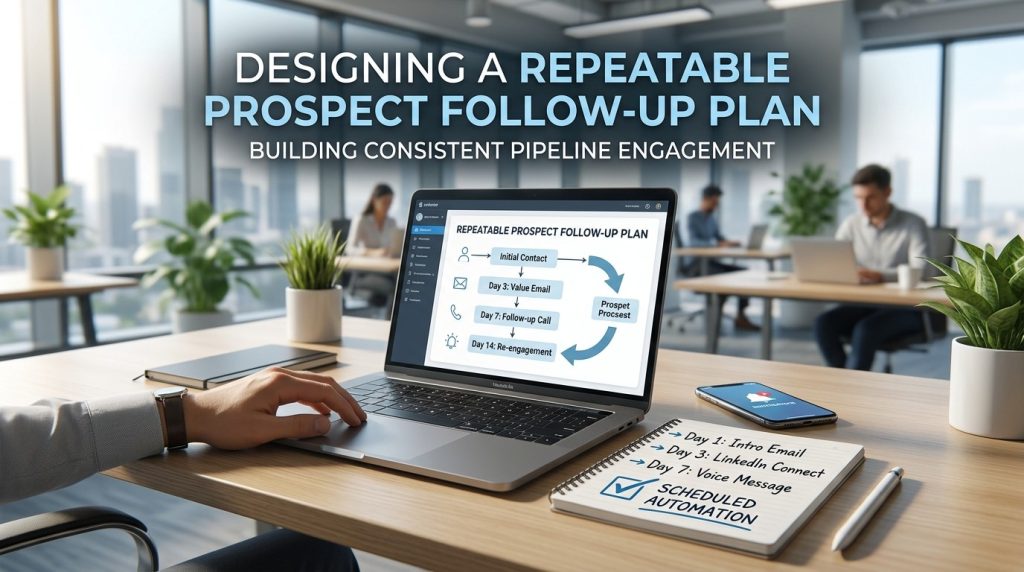
A Repeatable Prospect Follow-Up system turns scattered replies into steady momentum, helps teams stay timely without sounding robotic, and keeps every prospect conversation organized around trust, relevance, and next steps.
A dependable Repeatable Prospect Follow-Up system does more than keep salespeople organized. It lowers buyer frustration, improves response quality, and gives every prospect a sense that your team knows what it is doing. In crowded markets, that reliability becomes a quiet advantage that compounds over time. It also helps teams avoid messy handoffs, lost context, and unnecessary repetition.
The Psychology of Follow-Up
Designing a Repeatable Prospect Follow-Up plan starts with one simple idea: prospects rarely disappear because they are uninterested forever; they drift when the next step feels unclear. A reliable system gives every lead a predictable path, so no one is left guessing what happens after the first reply, the first call, or the first meeting. This also gives managers a cleaner way to review performance and coach the team with evidence.
In modern outreach, Repeatable Prospect Follow-Up is not about sending more messages. It is about sending the right message at the right moment, with enough structure to guide the buyer and enough flexibility to respect their pace. That balance makes your outreach feel thoughtful instead of aggressive, which improves trust and response quality. That consistency helps buyers feel that they are being guided rather than chased.
Teams that work with SaaS Referral Programs often see that referrals and follow-ups share the same psychology: people respond when the message feels relevant, timely, and easy to act on. A referral intro may open the door, but a disciplined follow-up process is what keeps the conversation moving forward without pressure. A predictable rhythm also makes referrals easier to convert because the context stays fresh.
When companies manage Professional B2B Referral Deals, the stakes are usually higher, the buying committee is wider, and the delay between interest and decision is longer. That is why a Repeatable Prospect Follow-Up framework matters so much. It protects the relationship by making each touchpoint useful, respectful, and easy to understand. It also protects trust by avoiding the awkward feeling that often comes from overly persistent outreach.
A Practical Outreach Workflow Process gives your team a repeatable map from first contact to closed opportunity. The best workflows define who reaches out, when they reach out, what they say, and how they measure progress. Without that clarity, even good reps waste time reinventing the process from scratch every day. Teams benefit because every activity has a clear purpose and a measurable outcome attached to it.
Clear Outreach Engagement Timing Rules reduce the guesswork that causes bad follow-up habits. Some prospects want a same-day response, while others prefer a quieter cadence over several days. A disciplined Repeatable Prospect Follow-Up plan respects those differences and uses timing as a trust signal instead of a pressure tactic. That structure helps prospects know what to expect, which lowers resistance and confusion.
Building the Outreach Structure

The foundation of Repeatable Prospect Follow-Up is segmentation. Not every prospect deserves the same cadence, because not every prospect is in the same stage. Someone who requested a demo needs a different follow-up sequence than someone who downloaded a guide, and both need a different tone than a referral introduction from a partner. Segmentation also keeps messaging aligned with urgency, interest level, and decision complexity.
Another reason Repeatable Prospect Follow-Up works is that it lowers internal chaos. When sales teams improvise every message, managers cannot coach consistently and marketers cannot improve the sequence. A fixed structure creates visibility, which makes performance easier to diagnose and easier to scale across people, territories, and product lines. It also makes it easier to spot which stage of the funnel is actually leaking.
Your first goal is to define what counts as a meaningful touch. An email, a voicemail, a LinkedIn note, a calendar invite, and a personalized resource all serve different purposes. A good Repeatable Prospect Follow-Up plan assigns each touch a role so the sequence feels like a conversation rather than a random pile of reminders. Clear touch definitions create accountability and prevent one message from trying to do every job at once.
In the earliest stage, curiosity is fragile, so your tone should be helpful rather than eager. That is why Repeatable Prospect Follow-Up should begin with simple confirmation, a useful detail, or a context-rich follow-up that gives the prospect a reason to continue the discussion. The first impression after the first response matters more than teams think. That small improvement often changes whether the prospect sees the note as useful or disposable.
Prospects often answer only when the message seems to belong to their situation. A Repeatable Prospect Follow-Up system uses the prospect’s role, industry, trigger event, and pain point to shape each note. The more context you include, the less effort the buyer has to spend translating your intent into their own business reality. Context-rich notes are easier to trust because they sound grounded in real business needs.
Good follow-up also respects cognitive load. Busy buyers skim, delay, and forget. A well-built Repeatable Prospect Follow-Up sequence reduces friction by making the next action obvious: reply, book, review, forward, or confirm. That kind of clarity helps people move from passive interest to active engagement without feeling overwhelmed. It also creates a stronger bridge between curiosity and a real business conversation.
Timing, Cadence, and Buyer Readiness
The cadence should feel deliberate, not frantic. A strong Repeatable Prospect Follow-Up plan often starts quickly, then stretches out as the relationship matures. Early speed matters because attention is fresh, but later patience matters because real buying decisions take time, approval, and comparison against competing priorities. That pacing prevents fatigue and gives the buyer room to think without losing the thread.
One practical way to think about Repeatable Prospect Follow-Up is in layers. The first layer is the immediate response, the second is the value-building check-in, the third is the objection-handling message, and the fourth is the reactivation note. Each layer has a purpose, and each one deserves its own tone. Each layer should feel like a next step, not a reset button that repeats the same ask.
Relevance improves when you attach a concrete asset to the follow-up. That might be a case study, a comparison sheet, a short video, a relevant article, or a simple answer to a question the prospect already raised. A Repeatable Prospect Follow-Up plan should never send a message without a reason for the recipient to care. Useful assets reduce pressure because they make the follow-up feel like support instead of a demand.
Personalization does not mean writing a novel every time. It means showing that the note was created for a real person with a real context. The best Repeatable Prospect Follow-Up systems use light personalization consistently, because a short relevant sentence often beats a long generic paragraph that feels mass-produced. Specificity helps the buyer feel understood, which is often the first step toward a real reply.
Speed matters after a form fill, demo request, or inbound reply. A quick first response improves the odds of a conversation because the prospect’s attention is still warm. A disciplined Repeatable Prospect Follow-Up framework treats that early window as valuable inventory, not something to be handled later when the team gets around to it. That window is valuable because a delayed response is much harder to recover than a quick one.
Not every prospect will respond on the first try, and that is normal. The goal of Repeatable Prospect Follow-Up is not to force an immediate yes; it is to create enough structured contact that a delayed yes becomes possible. Many deals look quiet before they look active, and consistency is what bridges that gap. Patience often wins because complex buying behavior is rarely linear, even when the opportunity looks simple.
To keep the sequence human, vary the angle of each message. One note can reference a challenge, another can share a proof point, another can ask a low-friction question, and another can offer to close the loop. Repeatable Prospect Follow-Up works best when each touch feels like a new step instead of a copy-paste resend. Varied angles keep attention alive and make the sequence feel more like a conversation than a machine.
Sales teams often fail when they confuse persistence with repetition. Persistence means adding value over time; repetition means saying the same thing again and again. A mature Repeatable Prospect Follow-Up system avoids that trap by planning what each touch should accomplish before the sequence starts. Planning the purpose of each touch prevents the sequence from collapsing into noise.
Great timing is a form of respect. When you space messages in a way that matches buyer behavior, prospects feel less hunted and more guided. That is why Repeatable Prospect Follow-Up should be built around expected decision rhythms, not internal quota pressure or random calendar availability. Timing should match the buyer’s mental energy, not only the seller’s enthusiasm.
Your subject lines and opening lines matter because they shape the emotional reaction before the body is read. A Repeatable Prospect Follow-Up message should feel recognizable, specific, and relevant within seconds. If the prospect senses that the note is about them, the likelihood of engagement rises immediately. Recognition in the subject line can be enough to make the message feel worth opening.
In high-consideration sales, silence does not always mean rejection. It can mean internal discussion, budget review, legal review, or simple overload. A patient Repeatable Prospect Follow-Up approach acknowledges that reality and uses follow-up as a gentle way to stay present without forcing an answer too soon. That patience also allows the process to stay professional even when the deal moves slowly.
The best sequences also define exit rules. If a prospect has clearly said no, moved to another vendor, or become inactive for a long period, your Repeatable Prospect Follow-Up plan should route them into nurture instead of endless direct outreach. Respecting disengagement protects both brand trust and team energy. Clear exit rules keep the pipeline healthier and help the team spend attention where it matters most.
Continuous Improvement and Real-World Adaptation

A Repeatable Prospect Follow-Up system becomes truly effective when it evolves with real-world feedback. No sequence works perfectly from the start, and that is completely normal. What matters is how often you review performance and adjust based on what prospects actually respond to. Over time, patterns begin to appear—certain subject lines get more replies, specific timing windows perform better, and particular messages move conversations forward faster.
It is also important to listen to qualitative signals, not just numbers. Pay attention to how prospects reply, what questions they ask, and where they hesitate. These small details reveal gaps in your messaging or timing. A strong system uses these insights to refine tone, structure, and sequencing.
As your market changes, your follow-up approach should adapt too. A flexible Repeatable Prospect Follow-Up process ensures your outreach stays relevant, human, and effective without losing consistency.
Messaging That Feels Human
Automation can help, but only when it supports the strategy rather than replacing it. A strong Repeatable Prospect Follow-Up system uses tools to schedule reminders, track responses, and surface next steps, while the actual messaging remains thoughtful, contextual, and easy for a human to trust. It also reduces the risk of creating deliverability problems from repeated low-quality sends.
Templates are useful because they reduce blank-page anxiety, but they should not turn into rigid scripts. The most effective Repeatable Prospect Follow-Up templates leave room for customization, especially in the first line, the proof point, and the call to action. That balance keeps the team efficient and the message believable. Templates work best when they give reps a starting point, not a script to hide behind.
Managers should coach the logic behind the sequence, not only the wording. When reps understand why a message exists, they make better judgment calls in live conversations. A Repeatable Prospect Follow-Up plan becomes stronger when the team can explain the purpose of each touch in plain language. Coaching on purpose improves judgment and keeps the follow-up style consistent across the team.
Prospect follow-up also benefits from shared language across departments. Marketing, sales, and customer success should understand the same buyer stages, because inconsistent definitions create confusing handoffs. A cross-functional Repeatable Prospect Follow-Up process prevents the common problem of one team promising speed while another team delivers delay. Shared language prevents handoff friction and makes the customer experience feel more coherent.
Metrics should reveal behavior, not just volume. Open rates, reply rates, meetings booked, time to first reply, and conversion by sequence all help you judge whether Repeatable Prospect Follow-Up is working. The point is to improve decisions, not to chase numbers that look impressive but say little about pipeline quality. Better metrics help leaders see whether the sequence is creating interest or only activity.
Once you know which messages work, you can refine the sequence by persona, segment, and buying stage. That is where Repeatable Prospect Follow-Up becomes a growth system rather than a script. Better sequences do not happen by accident; they happen because someone studies the data and makes careful adjustments. Iteration turns a basic process into a high-performing system that improves month after month.
If a message gets ignored, resist the urge to panic. Ignored does not always mean rejected, and a calm Repeatable Prospect Follow-Up plan gives the buyer space to return when timing improves. Follow-up works best when it preserves dignity on both sides of the conversation. Graceful silence can be more persuasive than another push when the buyer is not ready.
Decision-makers often respond to messages that reduce uncertainty. Share a concise next step, a small proof point, or a useful comparison that helps them think more clearly. A good Repeatable Prospect Follow-Up system acts like a guide, making the path forward feel manageable instead of complicated. Removing uncertainty can often move a deal more than adding extra detail.
Teams should also watch for over-following. Too many touches can train prospects to ignore you or resent the brand. A disciplined Repeatable Prospect Follow-Up framework uses intention, not volume, so each message earns its place and the relationship stays intact. Moderation helps the brand stay credible, especially in markets where trust is hard to earn.
The strongest outreach habits often come from rehearsal. When reps practice follow-up language before real interactions, they sound calmer, clearer, and more confident. That preparation supports Repeatable Prospect Follow-Up because it reduces nervous improvisation and keeps the tone steady even under pressure. Rehearsal builds confidence and helps the rep sound calm when the conversation gets difficult.
Follow-up should answer the question behind the objection. If the buyer says they are busy, that may mean they do not see enough urgency. If they say they need approval, they may need a sharper business case. A smart Repeatable Prospect Follow-Up sequence responds to the reason under the reason. Listening for the reason behind the objection makes the next response more useful.
One useful design choice is to map the journey from first touch to qualified conversation. Mark the decision points, likely delays, and expected objections. Then shape each Repeatable Prospect Follow-Up step around what the buyer is most likely thinking at that moment, not just what the rep wants to say next. A clear map turns follow-up into an operational asset instead of a personality trait.
With a repeatable structure in place, the process becomes easier to train and easier to audit. New team members can ramp faster, experienced reps can compare notes, and managers can spot weak points earlier. That is the real advantage of Repeatable Prospect Follow-Up: it turns a subjective skill into a dependable system. When the system is teachable, it becomes easier to scale without losing quality.
Maintaining a Long-Term System

Practical implementation also means giving the team a shared rulebook. That rulebook should define the first response window, the minimum number of touches, the handoff point to nurture, the approved channels, and the tone that matches your brand. When the rules are visible, reps spend less energy debating process and more energy improving conversations. It also becomes easier to onboard new hires, because they can study a clear pattern instead of learning by trial and error. Over time, a simple operating standard protects quality, keeps reporting accurate, and makes leadership decisions less subjective. Small refinements become easier too, because everyone is working from the same baseline. That is what turns outreach from a series of individual habits into a dependable commercial system. In practice, that clarity protects pipeline health, improves manager coaching, and helps prospects feel that every message is intentional, not improvised and easier to improve later.
Conclusion
A strong Repeatable Prospect Follow-Up strategy is not built on pressure; it is built on rhythm, relevance, and respect. When every message has a purpose, every delay has a rule, and every follow-up feels useful, prospects are more likely to keep engaging. The best teams do not chase attention randomly. They create a calm, dependable path that helps buyers move from curiosity to confidence without feeling rushed, confused, or forgotten. The result is a calmer pipeline, better buyer experience, and a process that stays usable as volume grows. That steadiness also makes follow-up easier to coach, automate, and improve over time.
Frequently Asked Questions (FAQ)
What is a repeatable follow-up plan?
A Repeatable Prospect Follow-Up plan is a structured sequence that tells your team when to contact a prospect, what to say, and when to stop. It replaces guesswork with consistency, which helps both the rep and the buyer stay aligned. It makes the process easier to teach and easier to trust.
How many follow-ups should I send?
There is no universal number, but a Repeatable Prospect Follow-Up system usually includes several touches spaced across the buying cycle. The goal is to stay relevant long enough for the prospect to respond, without becoming repetitive or intrusive. It keeps the buyer experience consistent across the whole funnel.
Why do prospects stop replying?
Prospects often go quiet because priorities shift, internal approvals slow things down, or the next step is unclear. A Repeatable Prospect Follow-Up approach helps you re-enter the conversation with value instead of pressure, which makes replies more likely. It supports more thoughtful pacing without guesswork.
Should I use email only?
No. A strong Repeatable Prospect Follow-Up model often mixes email, calls, social touchpoints, and helpful resources. Different channels serve different moments, and using more than one can improve visibility without relying on a single method. It helps teams balance automation with real human judgment.
How does timing affect response rates?
Timing shapes whether your message feels helpful or annoying. A Repeatable Prospect Follow-Up strategy uses timing guidelines to align messages with buyer behavior, so each touch arrives when it has the best chance of being noticed. It gives every touch a clearer role in the sequence.
Can automation replace manual follow-up?
Automation can support a Repeatable Prospect Follow-Up process, but it cannot replace judgment, empathy, or context. The best results come when software handles reminders and sequencing while humans handle nuance, personalization, and relationship building. It can reduce wasted effort and improve response quality.
What metrics matter most?
Reply rate, meeting rate, speed to first response, and conversion by stage are all useful indicators in a Repeatable Prospect Follow-Up framework. These numbers show whether your sequence creates real movement or only surface-level activity. It makes reporting easier because the stages are defined.
How do I keep messages from sounding robotic?
Use specific context, vary the angle, and write like a person speaking to another person. A Repeatable Prospect Follow-Up system feels human when every message has a reason to exist and a tone that fits the prospect’s stage. It keeps the writing style more natural and less mechanical.
What happens when a lead is not ready?
Move them into nurture rather than forcing the conversation. A Repeatable Prospect Follow-Up plan works best when it respects readiness and lets the prospect re-engage later without losing the relationship or the brand impression. It respects readiness instead of forcing premature decisions.
Is this useful for small teams too?
Yes. A Repeatable Prospect Follow-Up structure is especially useful for small teams because it reduces chaos and saves time. When everyone follows the same rhythm, fewer opportunities slip through the cracks and coaching becomes much easier. It gives small teams a reliable process they can repeat.