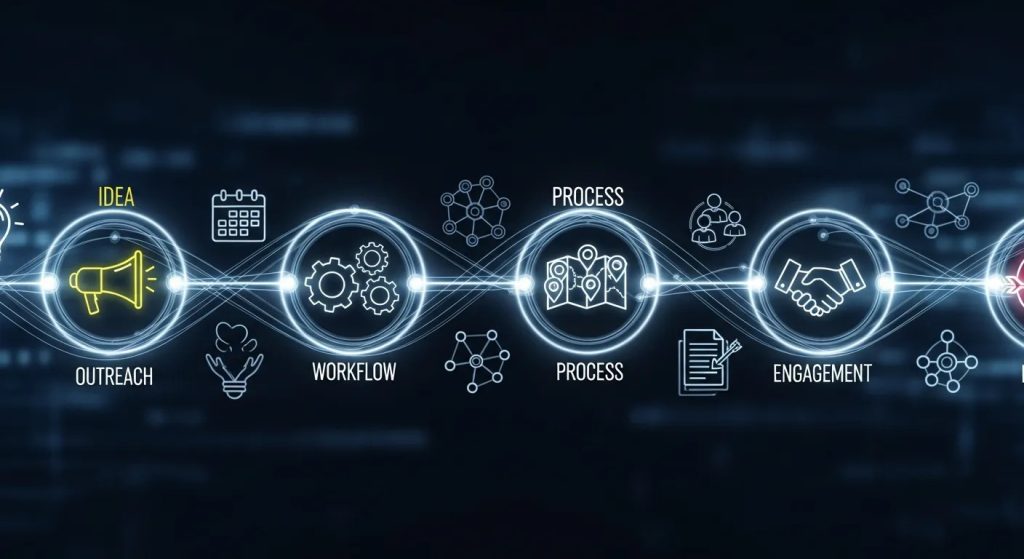
Learn how to Map Practical Outreach Workflow Process with clarity, consistent messaging, and measurable steps that turn scattered outreach into a predictable, human-centered system.
To Map Practical Outreach Workflow Process, you first need to understand why most outreach breaks down. Teams often start with enthusiasm, then lose momentum because messages are inconsistent, handoffs are unclear, and no one owns the next step. A workflow gives the team a shared route from prospect discovery to follow-up, so effort is not wasted. That is the practical way to Map Practical Outreach Workflow Process without losing momentum.
To Map Practical Outreach Workflow Process, the goal is not to add bureaucracy. The goal is to reduce confusion. When the path is clear, reps know what to do, managers know what to inspect, and prospects receive a more relevant experience. That consistency builds trust, and trust is what makes outreach feel useful instead of intrusive. That is the practical way to Map Practical Outreach Workflow Process without losing momentum.
A strong outreach workflow also protects quality. Without a workflow, the loudest tasks win. With a workflow, the right tasks happen in the right order. That is where the difference between random activity and a High Converting Outreach Strategy becomes visible. The former creates motion; the latter creates progress. That is the practical way to Map Practical Outreach Workflow Process without losing momentum.
Start by defining the real outcome
Before you Map Practical Outreach Workflow Process, define what success means. Do you want more replies, booked meetings, better qualified opportunities, or faster pipeline creation? Each outcome changes the workflow. A reply-focused motion looks different from a meeting-focused motion, and both differ from a conversion-focused motion. That is the practical way to Map Practical Outreach Workflow Process without losing momentum.
To Map Practical Outreach Workflow Process, you need a target that is measurable and tied to revenue. This keeps the workflow honest. If the team cannot see the result, they will default to vanity metrics. Open rates matter, but they do not close deals. Meetings matter more, but only if the meetings become opportunities. Pipeline quality matters most because it shows whether the workflow is helping the business move forward. That is the practical way to Map Practical Outreach Workflow Process without losing momentum.
A useful way to think about it is to define one primary outcome and two supporting outcomes. For example, the primary outcome may be booked demos, while the supporting outcomes are qualified replies and positive first calls. That balance helps the team stay focused when the process gets busy. That is the practical way to Map Practical Outreach Workflow Process without losing momentum.
Map the buyer journey before the sales journey

One of the most common mistakes is to build outreach around internal convenience rather than buyer behavior. To Map Practical Outreach Workflow Process, start with the buyer’s journey. Ask when awareness begins, when curiosity grows, when comparison starts, and when a decision becomes realistic. That is the practical way to Map Practical Outreach Workflow Process without losing momentum.
The buyer journey tells you what the prospect is thinking. The sales journey tells you what your team is doing. To Map Practical Outreach Workflow Process, those two paths must line up. If the prospect is still learning about the problem, sending a hard close message too early will create resistance. If the prospect is already comparing vendors, a soft educational message may feel too vague. That is the practical way to Map Practical Outreach Workflow Process without losing momentum.
This is where Right Messages for Prospect Stages become essential. Prospects need different messages depending on whether they are problem-aware, solution-aware, vendor-aware, or ready to decide. The workflow should make those stage changes visible so the right message reaches the right person at the right time.
Identify the stage markers
To Map Practical Outreach Workflow Process, build stage markers that are easy for the team to recognize. A prospect who just downloaded a guide is not the same as one who asked for pricing. Someone who replied with a question about fit is different from someone who requested a demo. Each action shows a different level of intent.
These markers should be written into the workflow. If the team agrees on the signs, they can act faster and with more confidence. That is how the workflow becomes practical. It does not rely on guesswork. It relies on observable behavior.
Segment your audience clearly
You cannot Map Practical Outreach Workflow Process well if every prospect is treated the same. Segmentation is the part of the system that gives outreach its relevance. Segment by role, company size, use case, pain point, industry, engagement level, and buying stage.
To Map Practical Outreach Workflow Process, you need fewer generic messages and more useful distinctions. A founder wants different proof than an operations manager. A mid-market buyer wants different context than an enterprise buyer. A warm inbound lead needs a different message from a cold outbound prospect. Segmentation makes those differences actionable. That is the practical way to Map Practical Outreach Workflow Process without losing momentum.
Behavioral Lead Scoring Drives Better Closings because it helps teams see which prospects are actively leaning in and which ones are still passive. Once scoring is in place, your segments become smarter. The workflow can then route high-intent prospects into faster follow-up while slower-moving leads continue through a nurture path.
Build segment logic that the team can actually use
To Map Practical Outreach Workflow Process, keep the segmentation rules simple enough to use every day. If the rules are too complex, reps will ignore them. Start with the three to five segments that most affect conversion. Add more only when the process proves stable.
A simple framework often works best: hot intent, warm intent, cold intent, current customer, and dormant contact. Those categories are easy to understand and easy to act on. The purpose is not perfection. The purpose is consistent action.
Define every handoff in writing
To Map Practical Outreach Workflow Process, you need to know who owns each stage. Many workflows fail because they assume people will “just know” what to do next. They will not. Every handoff should be visible, documented, and easy to follow. That is the practical way to Map Practical Outreach Workflow Process without losing momentum.
For example, marketing may identify the lead, sales development may qualify the contact, account executives may run discovery, and customer success may handle expansion signals. If the handoffs are unclear, response times slow down and prospects feel ignored. That is how momentum dies.
Write the handoffs as if a new team member will need to follow them tomorrow. This is not only helpful for training. It also exposes friction. If no one can describe the handoff in one sentence, the workflow is probably too vague. That is the practical way to Map Practical Outreach Workflow Process without losing momentum.
Choose the message logic before writing the copy
A lot of teams start with copy. The better approach is to first Map Practical Outreach Workflow Process around message logic. Copy comes later. Message logic defines why the message exists, what stage it serves, what action it should inspire, and what concern it should address.
To Map Practical Outreach Workflow Process, every message should answer one question in the prospect’s mind. Early-stage messages usually answer “Why should I care?” Mid-stage messages usually answer “Why now?” Late-stage messages usually answer “Why you?” If the copy does not answer the right question, it will sound attractive but fail to move the prospect.
This is where sequence planning matters. A prospect may receive an introduction, a value message, a proof point, a follow-up, and a call-to-action over time. Each step should build on the last one. That progression is far more effective than sending disconnected emails. That is the practical way to Map Practical Outreach Workflow Process without losing momentum.
Match tone to trust level
To Map Practical Outreach Workflow Process, keep the tone aligned with trust. Cold prospects need clarity and brevity. Warm prospects can handle more detail. Highly engaged prospects need relevance and a clear next step. Tone is not decoration. Tone is part of conversion psychology.
If a prospect has only barely recognized the problem, a hard sales tone can feel aggressive. If they have already shown strong buying intent, a vague educational note can feel evasive. Workflow mapping should prevent those mismatches.
Build outreach assets for each stage
To Map Practical Outreach Workflow Process, create a library of assets that supports the workflow. These may include first-touch emails, follow-up emails, LinkedIn messages, call scripts, objection-handling notes, proof-point snippets, case studies, and handoff templates.
The idea is to reduce decision fatigue. Reps should not have to invent the wheel every morning. If the workflow contains ready-to-use assets, execution becomes faster and more consistent. That consistency raises quality and makes results easier to compare. That is the practical way to Map Practical Outreach Workflow Process without losing momentum.
A good asset library also helps managers coach more effectively. Instead of asking whether a message “sounds good,” they can ask whether the asset matches the stage, the target, and the desired action. That is a much more useful conversation.
Build triggers that move prospects automatically
To Map Practical Outreach Workflow Process, the workflow must contain triggers. Triggers are events that tell the team when to move a prospect forward or pause outreach. A prospect who opens multiple emails, visits a pricing page, books a call, or requests a resource should not stay in the same sequence as a disengaged contact.
Triggers reduce wasted effort. They also improve relevance. A person who shows stronger intent deserves stronger follow-up. A person who stops engaging may need a different message or a slower cadence. The workflow becomes practical when it reacts to behavior instead of relying on fixed assumptions.
This is where automation can help without making the experience robotic. Use automation to detect signal changes, but keep the human judgment in the follow-up. The best systems combine data with empathy. That is the practical way to Map Practical Outreach Workflow Process without losing momentum.
Use behavior to time the next move
To Map Practical Outreach Workflow Process, timing is often more important than word choice. A strong message delivered too early can lose its effect. A modest message delivered at the right moment can create a response.
This is why teams should review trigger timing carefully. If a prospect has just replied, do not wait three days to answer. If someone has shown repeated interest, do not leave them in a generic drip sequence. A well-timed response feels attentive and professional.
Prioritize follow-up rules
To Map Practical Outreach Workflow Process, define what happens after every type of response. A reply is not enough. The workflow should specify whether the next step is a call, a personal note, a qualification check, a meeting request, or a re-engagement message.
Many teams lose deals after the first positive signal because they do not have a clear follow-up standard. A prospect may say “send more info,” and the rep sends a brochure without a plan. That is not follow-up. That is delay. A good workflow turns a reply into progress. That is the practical way to Map Practical Outreach Workflow Process without losing momentum.
A strong rule is to decide the next step before sending the first message. When you know the likely next move, you can shape the message to support it. That improves clarity and reduces hesitation.
Use scoring to separate interest from noise

To Map Practical Outreach Workflow Process, scoring helps the team avoid guessing. Not every click means buying intent, and not every silence means disinterest. A smart score combines engagement signals, role fit, company fit, and behavior over time.
Behavioral Lead Scoring Drives Better Closings because it aligns outreach effort with buyer readiness. If someone has visited your site repeatedly, engaged with a key email, and fits the target profile, they deserve faster, more personalized attention. If someone has low fit and low engagement, they may be better suited for nurture.
Scoring makes the workflow feel fair. It also helps managers coach the team around evidence instead of intuition. The rep can say, “This lead scored high because of repeated high-intent behavior,” which is much stronger than “I think this lead is good.”
Coordinate outreach across channels
To Map Practical Outreach Workflow Process, do not treat email, calls, and social touchpoints as separate universes. The prospect experiences them as one relationship. The workflow should therefore coordinate those touchpoints so the message stays consistent.
For example, an email may introduce the value proposition, a call may deepen the conversation, and a social message may reinforce familiarity. If each channel says something different, trust drops. If each channel supports the same core story, recognition grows.
A strong multi-channel outreach plan usually mixes channels intelligently rather than pushing one channel too hard. The workflow should define when to add a call, when to send a follow-up email, and when to use social proof. Coordination is what makes the sequence feel professional instead of noisy. That is the practical way to Map Practical Outreach Workflow Process without losing momentum.
Make personalization systematic
To Map Practical Outreach Workflow Process, personalization should be specific but repeatable. The goal is not to write a brand-new message for every prospect. The goal is to personalize the right parts of the workflow so the prospect feels understood.
You can personalize by role, company event, recent behavior, industry trend, pain point, or product usage. The more the message reflects real context, the more likely it is to be read. But personalization must support the workflow rather than interrupt it.
That is why templates matter. A good template gives structure while leaving room for tailored details. The team saves time, and the prospect gets a message that feels relevant. This is where efficiency and empathy can coexist.
Keep the personalization honest
To Map Practical Outreach Workflow Process, avoid fake personalization. Mentioning a company name is not enough. The message should connect to a real pain point, a relevant trigger, or a useful observation. Otherwise, the prospect will recognize the script immediately.
Honest personalization builds credibility. It shows that the sender paid attention. And attention is one of the most persuasive signals in outreach.
Build an internal QA process
To Map Practical Outreach Workflow Process, quality control cannot be left to memory. The workflow should include a review step for copy, timing, segmentation, and handoff accuracy. Even experienced teams make mistakes when the process is moving quickly.
A QA process can be simple. Check whether the prospect is in the right segment, whether the message matches the stage, whether the CTA is appropriate, and whether the next step is clearly defined. That small review prevents avoidable errors.
This is especially valuable for teams with multiple reps. Without QA, one person’s strong approach can coexist with another’s weak one, which makes performance hard to compare. A consistent workflow gives the team a common standard. That is the practical way to Map Practical Outreach Workflow Process without losing momentum.
Connect workflow mapping to customer intelligence
To Map Practical Outreach Workflow Process, outreach should not live apart from customer insight. The more the team understands what customers care about, the better the workflow becomes. Interview notes, support conversations, product adoption patterns, and win-loss data all improve message design.
This is where referral signals can be useful too. B2B SaaS Referral Programs show that happy customers are willing to advocate when value is clear. That same value should shape your outreach. If customers consistently praise a specific result, the workflow should highlight that result earlier and more often.
The smartest workflows turn customer language into outreach language. That way, the prospect hears proof in familiar terms rather than generic marketing claims.
Review, refine, and simplify
To Map Practical Outreach Workflow Process, the workflow must stay alive. A map that never changes becomes outdated quickly. Review performance weekly or monthly, depending on volume. Look at response rates, meeting rates, qualification rates, and closed revenue.
When you review, look for friction. Are prospects dropping after the second touch? Is one segment consistently outperforming the others? Are certain messages creating better replies? The answers tell you what to refine and what to remove.
Simplification is often the hidden growth lever. Many workflows become overloaded with extra steps that do not improve outcomes. The best process is usually the one that does less but does it more consistently. That is the practical way to Map Practical Outreach Workflow Process without losing momentum.
A practical workflow example
To Map Practical Outreach Workflow Process, imagine a simple three-stage process. Stage one identifies the prospect and scores their fit. Stage two sends the right message based on stage and behavior. Stage three routes the response to the right owner with a clear next action.
In that model, the workflow begins with segmentation, moves into stage-based messaging, and ends with follow-up and qualification. Each step has a clear owner and a clear purpose. There is no confusion about where the lead is, what happens next, or why the message was sent.
This type of structure is easy to train, easy to inspect, and easy to improve. That is why practical workflows outperform chaotic outreach. They convert intent into action without making the process feel mechanical.
Operational habits that keep the system healthy
To Map Practical Outreach Workflow Process, the team needs habits as much as templates. Those habits include daily review of new leads, weekly review of performance, regular message refreshes, and ongoing coaching for reps. The workflow is only as strong as the discipline behind it.
Good habits also reduce burnout. When people know what to do, when to do it, and why it matters, they feel less pressure to improvise under stress. That confidence improves quality. It also helps new team members ramp faster.
The long-term result is a cleaner pipeline and a stronger buyer experience. That is the real value of workflow mapping: fewer missed opportunities, better messages, and more useful conversations.
Final alignment between strategy and execution

To Map Practical Outreach Workflow Process, remember that the best plans stay close to reality. A workflow should reflect how your team actually works, not how a slide deck says they should work. It should be practical enough for daily use and flexible enough to evolve.
When the process is mapped well, the team spends less time guessing and more time engaging. That creates better throughput, better consistency, and better outcomes. In the end, the workflow is not just a sequence of tasks. It is a way to turn buyer understanding into revenue-generating action.
Conclusion
To Map Practical Outreach Workflow Process, start with the outcome, map the buyer journey, segment with discipline, and define every handoff before you write more copy. A practical workflow does more than organize outreach; it creates a repeatable path from attention to response to revenue. When messaging matches prospect stage, triggers react to behavior, and follow-up rules are clear, the team moves faster with less waste. Add scoring, QA, and regular review, and the process becomes easier to scale. The result is a cleaner pipeline, stronger conversations, and a more reliable system for growth that keeps improving as your market and customers evolve.
Frequently Asked Questions (FAQ)
1) What does it mean to map an outreach workflow?
It means documenting every step from prospect identification to follow-up so the team knows what happens, who owns it, and when the next action should occur.
2) Why is workflow mapping important in sales?
It reduces confusion, improves consistency, and helps the team send better messages at the right time to the right prospects.
3) How do I start mapping the process?
Begin with the business outcome, then map the buyer journey, segment the audience, define handoffs, and build message logic for each stage.
4) What role does scoring play in the workflow?
Scoring helps prioritize prospects based on fit and behavior so the team can focus on the leads most likely to convert.
5) How many stages should the workflow include?
Start with a few clear stages that your team can actually use every day. Add complexity only when the simpler version is already working.
6) Should the workflow be fully automated?
No. Automation should support timing and consistency, but human judgment is still needed for relevance, tone, and follow-up quality.
7) How often should the workflow be reviewed?
Review it regularly, ideally weekly or monthly, depending on volume and team size. Use performance data to refine weak spots.
8) What makes outreach messages more effective?
Messages work better when they match the prospect stage, address a real pain point, and lead to a clear next step.
9) Can this workflow support multiple channels?
Yes. Email, calls, and social outreach should work together as one coordinated sequence, not as separate efforts.
10) What is the biggest mistake teams make?
They focus on sending messages before they define the workflow, which leads to inconsistent outreach and weak results.