Multi-Channel Sequencing for Maximum Reach
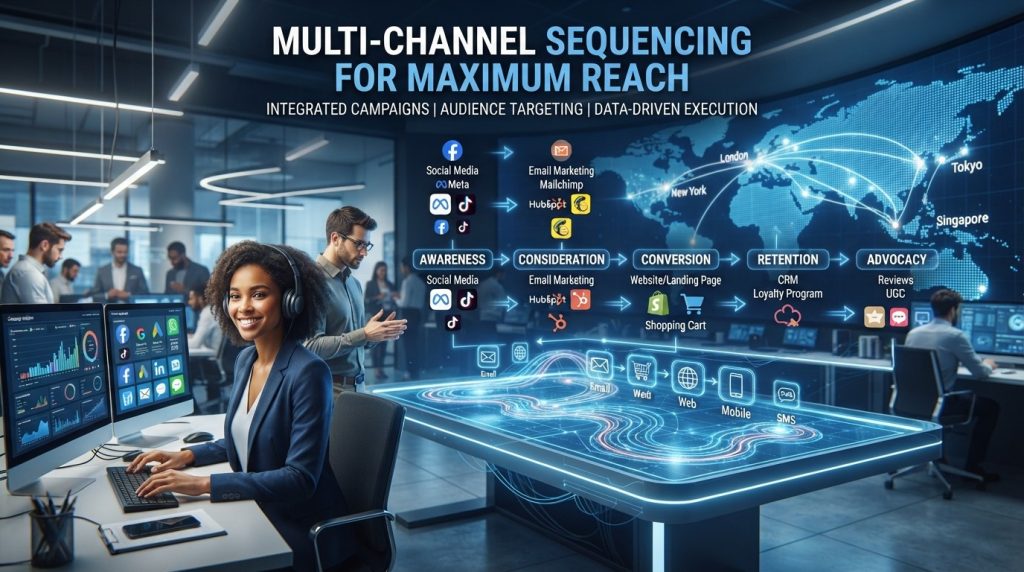
A coordinated sequence across email, LinkedIn, phone, social platforms, and retargeting can increase visibility, relevance, response quality, and sales momentum without overwhelming prospects.
Modern buyers rarely make important decisions after seeing one message on one platform. They may notice a company through LinkedIn, read an email later, visit the website from a search result, watch a short video, receive a follow-up call, and finally respond after several carefully timed interactions.
That behavioral reality makes Multi-Channel Sequencing an important approach for businesses that want consistent reach without depending entirely on one communication channel. Instead of sending the same message everywhere, teams coordinate multiple channels according to buyer behavior, intent, timing, and stage in the decision process.
Effective Multi-Channel Sequencing is not simply a matter of using more platforms. More channels can actually create more noise when the timing, messaging, and audience logic are poorly coordinated. The objective is to create a connected buyer journey where every touchpoint adds context instead of repeating the previous message.
This approach becomes especially valuable in B2B outreach, where prospects are busy, research independently, compare vendors, and often delay action even when a solution is relevant. A prospect who ignores an email today may notice a LinkedIn message tomorrow, engage with a useful insight next week, and become responsive when a well-timed phone conversation addresses a current business problem.
The strategic advantage of Multi-Channel Sequencing comes from combining reach with relevance. Each channel has a different psychological role, and the best sequences use those differences rather than treating every channel as interchangeable.
What Is Multi-Channel Sequencing?
Multi-Channel Sequencing is the structured process of coordinating communication across several marketing or sales channels according to a defined sequence, timing model, audience segment, and objective.
Instead of asking, “How many messages should we send?” marketers should ask, “What should the prospect experience at each stage?”
A basic sequence may look like this:
| Stage | Channel | Primary Objective |
|---|---|---|
| 1 | Establish relevance | |
| 2 | Build familiarity | |
| 3 | Website/content | Provide evidence |
| 4 | Phone | Start conversation |
| 5 | Retargeting | Maintain visibility |
| 6 | Address objections | |
| 7 | Phone/meeting | Create commitment |
Multi-Channel Sequencing works because the channels perform different jobs. Email can explain. LinkedIn can create familiarity. Phone can create immediacy. Content can reduce uncertainty. Retargeting can preserve memory. Social proof can reduce perceived risk.
A strong sequence therefore feels less like repeated advertising and more like a continuous conversation.
Why Single-Channel Outreach Often Stops Working
Single-channel outreach depends heavily on one environment and one moment of attention. That creates several problems.
The first is visibility. A prospect may not open the email, may not check a platform message, or may miss a phone call because of workload. A single missed interaction can therefore stop the entire communication process.
The second problem is familiarity. People are generally more comfortable engaging with brands they recognize. One isolated message often provides too little exposure to create meaningful recognition.
The third issue is context. Different channels support different forms of communication. A 700-word explanation may work in an email but fail as a LinkedIn message. A complex product proposition may need a phone conversation after the prospect has already seen supporting information.
Multi-Channel Sequencing addresses these limitations by creating multiple opportunities for recognition and response.
However, the purpose is not frequency for its own sake. The sequence must become more useful as it progresses.
The Psychology Behind Multi-Channel Sequencing
Human attention is selective. Buyers do not process every message they encounter, and they rarely evaluate every supplier with equal depth.
Multi-Channel Sequencing becomes powerful when it works with several psychological principles.
Familiarity Reduces Resistance
Repeated exposure to a consistent brand can increase recognition. A prospect may initially ignore an unfamiliar company, but repeated exposure through different relevant contexts can make later communication feel less intrusive.
The important factor is consistency. If your email says one thing, your LinkedIn message says something unrelated, and your salesperson presents a completely different proposition, familiarity can turn into confusion.
Context Creates Meaning
A message can feel irrelevant when presented without context.
For example, a prospect may ignore a generic sales email. Later, they might interact with a post explaining a problem they are currently experiencing. A subsequent outreach message can then reference that problem and feel significantly more relevant.
This is one reason Multi-Channel Sequencing should connect messages rather than treat them as independent campaigns.
Micro-Commitments Build Momentum
Large decisions create psychological resistance. Small actions are easier.
A prospect may not agree to a sales meeting immediately, but they might click a benchmark report, watch a short demonstration, reply with a question, or accept a connection request.
A good sequence encourages these micro-commitments before asking for a larger commitment.
Timing Changes Perceived Relevance
The same message can produce very different results depending on when it arrives.
A seasonal business, for example, may have completely different priorities before, during, and after a major buying period. This is where AI Seasonal Marketing can help teams identify changes in audience interest and align campaigns more closely with timing.
Multi-Channel Sequencing should therefore be built around buyer context, not just calendar intervals.
The Core Architecture of an Effective Sequence
A high-performing sequence usually includes five components: audience definition, channel selection, message hierarchy, timing, and measurement.
Define the Audience First
Before choosing channels, establish exactly who the sequence is designed for.
Identify:
- Industry
- Company size
- Role
- Geographic market
- Business model
- Current challenges
- Buying authority
- Existing relationship
- Intent level
- Expected customer value
A sequence for enterprise executives should not look identical to a sequence for small-business owners.
Multi-Channel Sequencing becomes more effective when the audience has a shared reason to care about the message.
Establish One Primary Outcome
Every sequence should have a clear business objective.
Possible outcomes include:
- Booking a meeting
- Generating qualified leads
- Activating dormant prospects
- Increasing demo requests
- Promoting a high-value product
- Re-engaging previous customers
- Driving registrations
- Moving prospects into a sales conversation
One sequence can support multiple metrics, but the primary objective must remain clear.
Assign a Job to Every Channel
Do not add channels merely because they are available.
Ask what each platform contributes.
Email can provide detail and continuity. LinkedIn can support professional recognition. Phone can create direct dialogue. Search can capture active demand. Retargeting can reinforce memory. Content can address education needs.
This division of responsibility helps Multi-Channel Sequencing become structured rather than chaotic.
Choosing the Right Channel Mix
There is no universally perfect combination of channels. The correct mix depends on your market, product complexity, customer preferences, transaction value, and sales cycle.
For many B2B campaigns, an effective combination could include email, LinkedIn, phone, content, and retargeting.
For consumer products, social media, email, paid media, SMS, and shopping channels may be more appropriate.
Match Channels to Buyer Behavior
Channel selection should be based on where your audience naturally spends attention.
If your target customers actively use LinkedIn for professional research, it deserves a greater role.
If customers frequently compare products through Google, search and informational content should carry more weight.
If purchases happen after demonstrations or consultations, phone and video calls may become critical later in the sequence.
The Best Channel Mix for Sales Outreach is therefore not determined by the number of channels used. It is determined by whether the selected channels match actual buyer behavior.
Multi-Channel Sequencing works best when channel selection follows evidence instead of assumptions.
Email: The Context Channel
Email remains useful because it gives marketers room to explain a problem, establish credibility, present evidence, and create a logical next step.
The first email should normally focus on relevance rather than promotion.
A weak opening says:
“We offer industry-leading solutions for businesses like yours.”
A stronger approach identifies a specific problem:
“Teams expanding into three or more markets often struggle to maintain consistent lead follow-up across channels.”
The second message can add insight. The third can introduce evidence. A later message can address a common objection.
This creates progression.
Email Sequencing Principles
Keep each email focused on one core idea.
Use short paragraphs.
Make the first lines meaningful because readers often scan before deciding whether to continue.
Avoid repeating the same subject line and proposition.
Create a logical relationship between messages.
Measure replies, positive responses, meetings, and revenue rather than only opens or clicks.
Multi-Channel Sequencing becomes especially strong when email provides the narrative foundation that other channels reinforce.
LinkedIn: The Familiarity Channel
LinkedIn works differently from email because prospects may encounter your content or profile before receiving a direct message.
That creates an opportunity to build familiarity before making a direct request.
A sequence might begin with profile engagement, continue with a connection request, and later move toward a short conversational message.
Avoid immediately copying a long sales pitch into LinkedIn.
Instead, use the platform to establish professional relevance.
A useful LinkedIn interaction could reference a market trend, operational issue, new technology, benchmark, or business development challenge.
The purpose is not to manufacture familiarity. It is to earn recognition through useful participation.
When integrated into Multi-Channel Sequencing, LinkedIn can make later email or phone outreach feel less disconnected.
Phone: The Human Interaction Channel
Phone outreach remains valuable when the objective requires dialogue, clarification, urgency, or qualification.
However, calling without context can create resistance.
A prospect who has already received a relevant email and interacted with your LinkedIn content may perceive a call differently from a prospect who has never heard of your company.
This is why sequencing matters.
The phone conversation can become the point where previous digital interactions are converted into a real business discussion.
The Role of the First Call
The first call should not necessarily attempt to close the entire deal.
Its job may be to:
- Confirm relevance
- Understand the current situation
- Identify urgency
- Discover constraints
- Validate the problem
- Establish the next appropriate step
Multi-Channel Sequencing can make these calls more productive because the salesperson enters the conversation with greater context.
Content: The Trust Channel
Content can support prospects who are interested but not yet ready to speak with sales.
Useful assets include:
- Research reports
- Case studies
- Comparison guides
- Industry benchmarks
- Calculators
- Educational articles
- Product demonstrations
- Implementation guides
- Expert interviews
The content should correspond to the prospect’s stage.
Early-stage prospects need education. Mid-stage prospects need evaluation evidence. Late-stage prospects need confidence, risk reduction, and implementation clarity.
Multi-Channel Sequencing can connect these content assets to specific communication moments.
Retargeting: The Memory Channel
Retargeting can keep your company visible after a prospect has interacted with your website or content.
This matters because people often research solutions over several sessions.
A prospect might read an article today, compare suppliers tomorrow, speak with a colleague next week, and return to the market several weeks later.
Strategic retargeting can reinforce the central value proposition without requiring another direct sales message.
However, retargeting should not become repetitive. Frequency controls, audience exclusions, and creative rotation are essential.
Building the Sequence Step by Step
A practical Multi-Channel Sequencing framework can be designed around the buyer journey.
Step 1: Identify the Trigger
Start with a meaningful trigger.
Examples include:
- New company funding
- Hiring activity
- Product launch
- Market expansion
- Technology adoption
- Leadership change
- Seasonal demand
- Website engagement
- Content download
- Search behavior
A trigger gives outreach a reason.
Step 2: Create the Message
The message should connect the trigger to a specific business problem.
Avoid making the prospect do the work of figuring out why your communication matters.
A strong proposition usually follows this structure:
Trigger → Problem → Business impact → Useful insight → Next step
Step 3: Select Channels
Determine which channels are suitable for the audience and objective.
For a complex B2B sale, email + LinkedIn + phone may work well.
For a digital product, email + paid media + content + retargeting may be stronger.
For high-value consulting, content + LinkedIn + email + phone + webinars may produce better engagement.
Step 4: Establish Timing
Timing should account for urgency and expected decision speed.
A typical sequence could run across two to four weeks, but the intervals should be tested.
The important principle is progression.
Every interaction should either increase understanding, increase trust, reveal intent, or move the prospect toward a useful action.
Example of a B2B Multi-Channel Sequence
Consider a software company targeting operations leaders.
Day 1: Send a personalized email focused on a measurable operational issue.
Day 2: View or engage with the prospect’s professional content where appropriate.
Day 4: Send a LinkedIn connection request with a simple contextual note.
Day 6: Share a short benchmark or educational asset.
Day 8: Make a phone call referencing the business problem.
Day 11: Send a case study addressing a common objection.
Day 15: Follow up with a concise email asking whether the issue is currently a priority.
Day 21: Provide a final useful resource and pause aggressive outreach.
This is very different from sending eight identical sales emails.
Multi-Channel Sequencing creates a progression where each contact has a distinct role.
Personalization Without Creating Operational Chaos
Personalization can increase relevance, but excessive manual customization can make campaigns impossible to scale.
The solution is structured personalization.
Use variables that genuinely influence the message:
- Company
- Industry
- Role
- Trigger
- Business problem
- Geography
- Existing relationship
- Recent activity
Avoid fake personalization such as mentioning a random company fact that has nothing to do with the proposition.
The prospect should immediately understand why the information is relevant.
Personalization Tiers
A useful system has three levels.
Tier one is basic personalization using role, company, and industry.
Tier two adds a trigger such as a new launch, hiring initiative, technology change, or expansion.
Tier three uses behavioral signals such as content engagement, product interaction, or previous conversations.
Multi-Channel Sequencing becomes more scalable when automation handles predictable tasks while humans handle high-value personalization.
AI and Automation in Multi-Channel Sequencing
Artificial intelligence can support sequencing through data analysis, content assistance, prioritization, intent detection, timing recommendations, and automated workflow management.
The objective should be augmentation rather than removing human judgment.
AI can identify patterns across thousands of prospects much faster than manual teams.
For example, AI can help segment prospects based on:
- Engagement level
- Industry signals
- Previous interaction
- Content interests
- Website activity
- Buying-stage indicators
- Seasonal behavior
Generative AI can also support creative experimentation. Teams working with paid and seasonal campaigns can use Generative AI for Seasonal Ads to develop multiple creative concepts, message angles, and variants for testing.
The human team still needs to verify accuracy, brand consistency, audience appropriateness, and strategic relevance.
Seasonal Timing and Multi-Channel Campaigns
Seasonality can dramatically change buyer priorities.
A retailer before a major shopping period has different needs from the same retailer after the season ends.
Similarly, travel, education, healthcare, finance, technology, and consumer goods can all experience shifts in demand throughout the year.
Multi-Channel Sequencing can incorporate these shifts by changing message timing, offers, creative, audience definitions, and channel emphasis.
During high-demand periods, brands may increase visibility and reduce friction.
Before peak demand, they may focus on education and planning.
After peak periods, they may emphasize retention, replenishment, reviews, or next-cycle preparation.
This approach makes outreach feel timely rather than artificially scheduled.
Creating Message Continuity Across Channels
One of the most common failures in multi-channel campaigns is inconsistent messaging.
Imagine this sequence:
The email promotes cost reduction.
The LinkedIn message promotes productivity.
The advertisement emphasizes premium features.
The phone salesperson focuses on speed.
The prospect receives four different reasons to care.
That fragmentation weakens positioning.
A stronger approach creates one strategic narrative.
For example:
Core problem: fragmented lead follow-up.
Email: explain the cost of fragmented follow-up.
LinkedIn: publish research on response delays.
Content: show how response gaps affect revenue.
Phone: ask how the prospect currently manages follow-up.
Retargeting: demonstrate the workflow.
Each channel delivers a different expression of the same central problem.
That is the foundation of effective Multi-Channel Sequencing.
Coordinating Email, LinkedIn, and Phone
B2B organizations often operate these channels separately, creating duplicate outreach and poor customer experiences.
The solution is to connect activity records and establish clear handoff rules.
For example:
Email reply received → stop automated email sequence.
Positive LinkedIn response → notify salesperson.
Meeting booked → suppress prospecting ads.
Phone conversation completed → personalize the next email.
Unsubscribe → remove prospect from promotional sequence.
This coordination is particularly important when teams need to Sync Email LinkedIn and Phone for B2B so that prospects do not receive conflicting messages from different systems.
Multi-Channel Sequencing requires operational discipline, not only creative messaging.
How Many Touchpoints Are Enough?
There is no universally correct number.
More touchpoints can increase opportunities for engagement, but excessive contact can damage trust.
The right number depends on:
- Audience expectations
- Relationship strength
- Offer value
- Sales cycle
- Trigger strength
- Message quality
- Channel tolerance
- Engagement behavior
A prospect who repeatedly interacts with your content may justify more communication than someone who has shown zero engagement.
Behavior should influence the sequence.
High engagement can accelerate conversation.
Low engagement can reduce frequency.
Negative feedback should trigger immediate suppression.
Multi-Channel Sequencing should therefore be adaptive rather than rigid.
The Difference Between Persistence and Pressure
Persistence means continuing to provide relevant opportunities to engage.
Pressure means repeatedly demanding action without adding value.
That distinction is critical.
A good follow-up gives the prospect a reason to pay attention.
A poor follow-up simply asks again.
For example, instead of:
“Just following up on my previous email.”
Try:
“I found a benchmark showing how companies in your sector are reducing response delays. Sharing it here because it relates directly to the issue I mentioned.”
The second message creates additional value.
This principle protects the relationship while maintaining momentum.
Measuring Multi-Channel Sequencing Performance
Measurement should go beyond individual channel metrics.
A campaign may have low email response but still generate excellent revenue because LinkedIn and phone interactions compensate.
Important metrics include:
| Metric | What It Reveals |
|---|---|
| Reach | How many relevant prospects were exposed |
| Engagement | Whether people interacted |
| Positive reply rate | Message relevance |
| Meeting rate | Sales effectiveness |
| Qualified opportunity rate | Lead quality |
| Conversion rate | Buyer progression |
| Pipeline generated | Commercial impact |
| Revenue influenced | Financial value |
| Cost per opportunity | Efficiency |
| Time to conversion | Sequence effectiveness |
Attribution is challenging because several channels may influence the same decision.
Instead of asking only, “Which channel won?” evaluate how the complete journey performed.
Testing Multi-Channel Sequences
Testing should focus on variables that can materially affect results.
Test:
- Sequence length
- Time between touches
- Opening message
- Call timing
- LinkedIn timing
- Offer type
- Content asset
- CTA
- Personalization level
- Audience segment
- Channel order
Do not change everything at once.
A structured experiment isolates one major variable while keeping the rest relatively stable.
Test the Order of Channels
Channel order can significantly affect response.
Sequence A:
Email → LinkedIn → Phone
Sequence B:
LinkedIn → Email → Phone
Sequence C:
Phone → Email → LinkedIn
The best order may differ by audience.
Multi-Channel Sequencing is ultimately a behavioral system, so real response data should determine the final structure.
Common Mistakes to Avoid
Using Every Available Channel
More platforms do not automatically create more reach.
Poorly coordinated channels can create fatigue, duplication, and wasted resources.
Sending Identical Messages Everywhere
A LinkedIn message should not read like a copied email.
A phone conversation should not sound like a robotic automation script.
Adapt the format while preserving the central narrative.
Ignoring Buyer Intent
Someone downloading an introductory guide should not necessarily enter the same sequence as a prospect requesting pricing.
Intent should influence urgency and communication style.
Continuing After Negative Signals
Unsubscribe requests, explicit rejection, repeated inactivity, and complaints should affect future outreach.
Respect improves long-term brand perception.
Measuring Only Opens and Clicks
Engagement metrics can look impressive without producing business results.
Always connect campaign activity to qualified opportunities and revenue where possible.
Deliverability and Reputation Considerations
Multi-channel campaigns still require strong email hygiene.
Maintain clean contact databases.
Remove invalid addresses.
Respect opt-out requests.
Avoid excessive sending volume.
Monitor domain reputation.
Use relevant subject lines.
Do not rely on deceptive personalization.
A sophisticated sequence cannot compensate for poor communication fundamentals.
Building a Human-Centered Sequence
Technology should support human psychology instead of replacing it.
Ask what the prospect may be thinking after every interaction.
After the first email:
“Why should I care?”
After the LinkedIn interaction:
“Is this company credible?”
After the content interaction:
“Does this solve my problem?”
Before the call:
“Will this conversation waste my time?”
After the proposal:
“Can I trust this supplier?”
A strong Multi-Channel Sequencing strategy anticipates these questions and answers them progressively.
Multi-Channel Sequencing for Different Buyer Stages
Not every prospect belongs in the same workflow.
Awareness Stage
Focus on education, market problems, and useful insights.
The objective is recognition, not immediate conversion.
Consideration Stage
Introduce comparisons, proof, case studies, demonstrations, and detailed explanations.
The prospect is now evaluating alternatives.
Decision Stage
Reduce risk.
Highlight implementation, support, expected outcomes, commercial clarity, and evidence.
Retention Stage
The sequence changes after purchase.
Use email, customer communities, support communication, product education, and account management to reinforce value.
Multi-Channel Sequencing therefore applies beyond acquisition. It can support the entire customer lifecycle.
Using Data to Improve Timing
Timing should increasingly respond to behavior.
For example, if a prospect:
- Visits pricing repeatedly
- Watches most of a product demo
- Downloads a comparison guide
- Replies to an email
- Engages with multiple posts
then the prospect may deserve faster human follow-up.
Conversely, if engagement drops over time, frequency should be reduced or the audience should be moved into a slower nurturing track.
Behavior-based sequencing is more efficient than assuming every prospect progresses at the same speed.
Creating a Sequence Governance System
Large teams need rules.
Document:
Who owns each stage.
Which channel is used.
What triggers advancement.
What pauses the sequence.
What causes removal.
How responses are categorized.
How sales receives notifications.
What data is synchronized.
What compliance rules apply.
Without governance, automation can create embarrassing situations such as automated follow-ups continuing after a prospect has already signed a contract.
Operational rules make Multi-Channel Sequencing safer and more scalable.
A Practical Sequence Template
Here is a flexible framework that businesses can adapt.
Touch 1 — Context
Introduce a relevant problem connected to the prospect’s environment.
Touch 2 — Recognition
Use social engagement or LinkedIn to increase familiarity.
Touch 3 — Education
Share a useful insight, benchmark, or resource.
Touch 4 — Conversation
Use phone or personalized direct communication to explore relevance.
Touch 5 — Proof
Provide a case study, result, or evidence.
Touch 6 — Objection Handling
Answer a common concern.
Touch 7 — Decision Prompt
Ask whether solving the problem is currently a priority.
Touch 8 — Nurture
If timing is not right, shift the prospect into an appropriate long-term program.
This framework can be shortened or expanded based on customer behavior.
How Multi-Channel Sequencing Improves Reach Without Increasing Noise
Reach is valuable only when the audience notices the message.
A single channel can create blind spots.
Multiple coordinated channels increase the probability of exposure, but effective sequencing ensures the exposure remains relevant.
The formula is simple:
More relevant opportunities to notice + better timing + consistent narrative = stronger reach.
This does not mean contacting prospects constantly.
It means meeting them in the environments where they already pay attention.
Multi-Channel Sequencing creates this distributed visibility while maintaining strategic consistency.
Advanced Personalization Through Intent Signals
Advanced teams can build sequences around intent categories rather than basic demographics.
A prospect showing research intent might receive educational material.
A prospect showing comparison intent might receive case studies.
A prospect displaying commercial intent might receive a sales conversation.
A returning customer may receive expansion messaging instead.
Intent-based personalization creates a more psychologically appropriate journey.
It also prevents marketing and sales teams from forcing every prospect through the same funnel.
Integrating Multi-Channel Sequencing With CRM Systems
The CRM should act as the operational source of truth.
Important fields can include:
- Current sequence
- Last touch
- Last response
- Engagement score
- Intent level
- Lead stage
- Assigned owner
- Next action
- Suppression status
Automation should update these fields as prospects move through the journey.
For example, a positive email response could automatically pause automated outreach and create a salesperson task.
This reduces duplication and improves customer experience.
How to Scale Without Losing Quality
Scaling is often where campaigns become impersonal.
The answer is not more automation everywhere.
Automate repetitive operations:
- Scheduling
- Data movement
- Suppression
- Notifications
- Basic segmentation
- Reporting
- Content distribution
Keep humans responsible for:
- Complex personalization
- High-value accounts
- Strategic objections
- Negotiation
- Sensitive communications
- Relationship building
The best Multi-Channel Sequencing systems combine machine efficiency with human judgment.
The Future of Multi-Channel Sequencing
As AI-driven discovery and automated buying environments continue evolving, buyers may interact with brands through increasingly fragmented journeys.
A customer might discover a product through an AI answer, validate it through reviews, encounter an advertisement, visit a website, receive an email, and speak with a salesperson.
That means future marketers will need stronger coordination across paid, owned, earned, social, conversational, and sales channels.
The important shift is from campaign thinking toward journey orchestration.
Instead of building isolated campaigns, organizations will increasingly build adaptive systems that respond to signals.
The winning brands will not simply communicate more often.
They will communicate more intelligently.
Multi-Channel Sequencing Checklist
Before launching a campaign, verify that:
The audience is clearly defined.
The primary outcome is measurable.
Each channel has a specific job.
The message remains consistent.
The timing reflects buyer behavior.
Personalization is meaningful.
Negative signals pause communication.
CRM records remain synchronized.
Sales and marketing understand ownership.
Attribution measures business impact.
Creative and messaging are tested.
The sequence contains an exit or nurture path.
This checklist helps turn Multi-Channel Sequencing from a collection of tactics into a repeatable operating system.
Final Strategic Perspective
The strongest outreach campaigns do not feel like a campaign to the recipient.
They feel like a sequence of relevant interactions that gradually increase familiarity, trust, understanding, and confidence.
That is the real value of Multi-Channel Sequencing.
It creates continuity across channels while respecting the fact that buyers do not behave in perfectly linear ways.
Some prospects respond immediately.
Some need repeated exposure.
Some need education.
Some need proof.
Some need a human conversation.
The sequence should accommodate all of these behaviors.
When strategy, psychology, data, timing, technology, and human communication work together, Multi-Channel Sequencing can turn fragmented outreach into a connected buyer experience.
Conclusion
Multi-Channel Sequencing helps businesses create a connected buyer journey across email, LinkedIn, phone, content, advertising, and other relevant channels. Its greatest advantage is not simply greater reach, but better timing, stronger familiarity, clearer messaging, and more relevant interactions. Successful sequences assign a specific role to every channel, adapt to buyer behavior, and measure commercial outcomes rather than vanity metrics. When organizations combine automation with human judgment, coordinate data across systems, respect buyer signals, and continuously test timing and messaging, Multi-Channel Sequencing becomes a scalable framework for generating attention, building trust, creating conversations, and improving long-term sales performance.
Frequently Asked Questions (FAQ)
What is Multi-Channel Sequencing?
Multi-Channel Sequencing is the coordinated use of multiple communication channels in a planned order to guide prospects through awareness, engagement, evaluation, and conversion.
Why is Multi-Channel Sequencing important for B2B marketing?
It helps B2B teams reach prospects across the environments they already use while creating repeated but varied opportunities to build familiarity, trust, and engagement.
How many channels should a sequence include?
There is no universal number. The best sequence uses only the channels that match audience behavior, sales complexity, customer preferences, and campaign objectives.
Is email still important in multi-channel outreach?
Yes. Email can provide context, education, evidence, and follow-up while other channels reinforce familiarity and create additional opportunities for engagement.
Should LinkedIn and phone outreach be combined?
They can be highly complementary. LinkedIn can support professional recognition, while phone outreach can create direct conversation when the prospect is sufficiently qualified or engaged.
How does AI improve Multi-Channel Sequencing?
AI can help with segmentation, behavioral analysis, content variation, timing recommendations, lead prioritization, intent detection, reporting, and workflow automation.
How often should prospects be contacted?
Frequency should depend on audience expectations, engagement, urgency, product value, and buyer behavior. Highly engaged prospects may justify faster follow-up, while inactive prospects should usually receive less frequent communication.
What is the biggest mistake in Multi-Channel Sequencing?
The biggest mistake is treating every channel as a separate campaign. Without consistent positioning and coordinated timing, prospects may receive repetitive or contradictory messages.
How should sequence performance be measured?
Measure positive responses, qualified meetings, opportunities, pipeline, revenue, conversion rate, cost per opportunity, and time to conversion rather than relying only on opens, impressions, or clicks.
Can Multi-Channel Sequencing be automated?
Yes. CRM and marketing automation platforms can manage scheduling, segmentation, suppression, notifications, tracking, and reporting. High-value personalization and relationship management should still involve human judgment.