B2B Outreach Workflow Steps for Automated Sales Pipelines
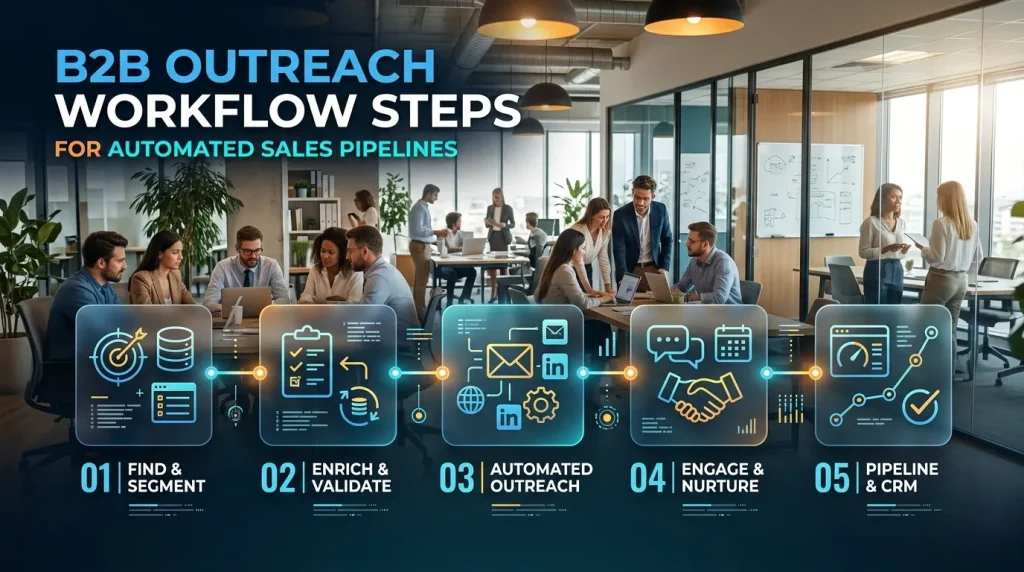
A structured B2B Outreach Workflow combines ideal customer research, verified data, relevant messaging, coordinated follow-ups, automation, and performance reviews to build predictable sales pipelines without sacrificing buyer trust.
Generating leads is not the same as generating sales opportunities. Many B2B companies invest considerable time in finding prospects, collecting business contacts, sending emails, and arranging meetings, yet their sales pipelines remain inconsistent. Some prospects never respond, others lose interest after the first conversation, and qualified opportunities sometimes disappear because nobody follows up at the right moment.
The problem is not always the quality of the product or the size of the target market. Often, the missing element is a repeatable process that connects prospect research, communication, engagement tracking, and sales management.
A well-designed B2B Outreach Workflow addresses this problem by organizing every stage of prospect engagement into a coordinated system. Instead of depending on disconnected spreadsheets, manually scheduled emails, and individual sales representatives remembering every task, businesses can establish structured procedures that guide prospects from initial discovery to meaningful sales conversations.
Automation makes this process more manageable. CRM platforms, sales engagement tools, email sequencing systems, and lead enrichment solutions can coordinate repetitive activities while allowing sales professionals to focus on conversations that require human judgment.
However, automation alone does not create a successful sales pipeline. Poor prospect data, generic messaging, excessive follow-ups, and irrelevant offers can damage a company’s reputation faster when automated at scale.
The goal is to develop a B2B Outreach Workflow that balances operational efficiency with personal relevance. Every interaction should have a clear purpose, every prospect should receive communication appropriate to their situation, and every sales activity should contribute to a measurable business objective.
This guide explores the complete process, including audience research, lead qualification, CRM organization, outreach sequencing, personalization, automation triggers, multichannel engagement, performance measurement, and continuous optimization.
Understanding the B2B Outreach Workflow
A B2B Outreach Workflow is a structured sequence of activities used to identify business prospects, qualify potential buyers, initiate contact, manage engagement, and move suitable opportunities toward a sales conversation or commercial relationship.
It connects marketing and sales activities through defined processes.
For example, imagine a software company selling project management solutions to medium-sized businesses. Its sales team identifies organizations experiencing collaboration problems, researches relevant decision-makers, collects verified business contact information, and organizes prospects into CRM segments.
The team then creates targeted messages explaining how the software addresses specific operational challenges.
When a prospect responds, the workflow automatically updates the CRM record, pauses unnecessary follow-ups, and assigns the conversation to the appropriate sales representative.
This is fundamentally different from sending the same email to thousands of addresses.
A properly designed B2B Outreach Workflow ensures that every prospect receives communication based on their business characteristics, engagement history, and potential interest.
Why Manual Outreach Becomes Difficult to Manage
Manual outreach may work when a business has a small prospect list and only a few active sales conversations.
However, complexity increases as the company expands.
Sales representatives may need to manage hundreds of prospects, remember follow-up dates, update contact information, record conversations, and coordinate with marketing teams.
Without a consistent process, several problems appear:
-
Prospects receive duplicate messages from different representatives.
-
Follow-ups are missed because activities are recorded inconsistently.
-
Sales teams spend excessive time performing administrative tasks.
-
Managers struggle to identify which campaigns generate qualified opportunities.
-
Marketing and sales departments work with disconnected information.
-
Valuable prospects receive generic communication that ignores their needs.
A documented B2B Outreach Workflow reduces these operational gaps by creating a shared structure for prospect engagement.
The Relationship Between Outreach and Pipeline Growth
An automated sales pipeline should not be judged by the total number of messages sent.
Its purpose is to generate qualified conversations and move suitable prospects through a buying journey.
Consider the following stages:
| Pipeline stage | Main objective | Expected activity |
|---|---|---|
| Prospect discovery | Identify relevant companies | Account research |
| Contact identification | Find relevant decision-makers | Contact research |
| Qualification | Evaluate potential fit | Scoring and segmentation |
| Initial outreach | Introduce a relevant business solution | Personalized email or call |
| Engagement | Develop interest | Follow-ups and conversations |
| Sales qualification | Confirm business requirements | Discovery meeting |
| Opportunity management | Evaluate commercial potential | Sales discussions |
| Conversion | Reach a purchasing decision | Proposal and negotiation |
Each stage should have defined entry and exit conditions.
A prospect should not automatically become a sales opportunity simply because they opened an email or clicked a link.
This distinction helps a B2B Outreach Workflow maintain accurate pipeline information and prevents sales teams from confusing superficial engagement with genuine buying intent.
Step 1: Define Your Ideal Customer Profile Before Finding Leads
The first stage of an effective outreach system is identifying which businesses are most likely to benefit from the product or service.
Many sales teams make the mistake of starting with a large contact database rather than defining their actual market.
A list containing thousands of businesses is not necessarily valuable if most organizations lack the budget, operational needs, or authority required to purchase.
A B2B Outreach Workflow should begin with a clear ideal customer profile, commonly known as an ICP.
Identify the Characteristics of Your Ideal Companies
An ICP describes the type of organization that represents a strong potential customer.
Depending on the business, relevant characteristics may include:
-
Industry and business category.
-
Company size.
-
Annual revenue range.
-
Geographic location.
-
Number of employees.
-
Technology infrastructure.
-
Business model.
-
Operational complexity.
-
Existing challenges.
-
Purchasing capacity.
For example, a company selling enterprise cybersecurity software might prioritize financial institutions, healthcare organizations, and technology companies with complex security requirements.
A business offering affordable accounting automation might instead focus on growing service businesses and small professional firms.
An effective B2B Outreach Workflow uses these characteristics to narrow the prospect pool before expensive sales activities begin.
Define the Buying Committee
B2B purchasing decisions frequently involve multiple individuals.
The person experiencing a problem may not control the budget, while the person approving the purchase may not understand every technical detail.
A successful sales process must recognize these different responsibilities.
| Buyer role | Primary concern | Suitable outreach angle |
|---|---|---|
| CEO or founder | Business growth and strategic value | Revenue, efficiency, and competitive advantage |
| Marketing director | Campaign performance | Acquisition, engagement, and conversion |
| Sales manager | Pipeline performance | Productivity and opportunity generation |
| IT director | Technical compatibility | Security, integrations, and infrastructure |
| Finance manager | Financial impact | Costs, ROI, and budget efficiency |
| Operations manager | Process efficiency | Time savings and operational improvements |
The exact buying committee varies by organization and purchasing complexity.
Understanding these roles allows a B2B Outreach Workflow to deliver information that matches the recipient’s responsibilities.
Research Problems Instead of Only Collecting Company Details
An ICP becomes more useful when it explains why potential customers might need the solution.
A company may fit the required industry and employee count but still have no immediate reason to purchase.
Look for business signals such as:
-
Recent expansion.
-
New market entry.
-
Changes in leadership.
-
Recruitment for relevant positions.
-
Product launches.
-
Publicly discussed operational challenges.
-
Changes in technology infrastructure.
These signals can provide context for more relevant outreach.
For detailed segmentation, businesses can use Target Audience Profiling to connect demographic, firmographic, behavioral, and business information with their prospecting strategy.
The purpose is not to collect as much information as possible. It is to identify information that helps sales teams understand prospect suitability.
Step 2: Build a Reliable Prospect Database
Once the ideal customer profile is established, the next stage is developing a structured prospect database.
An outreach campaign is only as dependable as the information supporting it.
Incorrect email addresses, outdated job titles, duplicated records, and irrelevant contacts create unnecessary friction.
A B2B Outreach Workflow should therefore include a defined data collection and verification process.
Identify the Right Data Sources
Businesses can obtain prospect information from several sources, depending on their market and the applicable data protection requirements.
Common sources include:
-
Company websites.
-
Professional networking platforms.
-
Public business directories.
-
Industry association websites.
-
Trade publications.
-
Business event directories.
-
CRM databases.
-
Permission-based lead generation activities.
-
Reputable B2B data providers.
Each source has different strengths and limitations.
Company websites may provide accurate leadership information, while business databases can help identify organizations matching specific firmographic criteria.
A B2B Outreach Workflow should record where prospect information originated so teams can evaluate data quality and maintain appropriate governance.
Collect Information That Supports Personalization
Avoid collecting dozens of fields simply because a data provider makes them available.
Instead, identify the fields needed for qualification and communication.
A practical prospect record might include:
| Data field | Purpose |
|---|---|
| Company name | Account identification |
| Website | Business research |
| Industry | Market segmentation |
| Employee range | Company qualification |
| Country | Geographic relevance |
| Contact name | Personalized communication |
| Job title | Role identification |
| Business email | Contact channel |
| LinkedIn profile | Professional context |
| Business challenge | Message relevance |
| Lead source | Data provenance |
| Verification date | Data freshness |
| CRM owner | Sales responsibility |
| Outreach status | Campaign management |
This information allows the B2B Outreach Workflow to organize contacts according to business relevance.
Verify Email Addresses and Remove Invalid Records
Email verification helps identify addresses that may be invalid, outdated, or unsuitable for outreach.
Common issues include:
-
Incorrect domain names.
-
Typographical errors.
-
Closed business accounts.
-
Invalid mailboxes.
-
Temporary email addresses.
-
Duplicate contact records.
-
Catch-all domains that cannot be reliably validated.
Verification tools can reduce preventable delivery problems, but no tool can guarantee that every address will remain valid indefinitely.
Maintain a regular data-cleaning routine rather than treating verification as a one-time activity.
For a B2B Outreach Workflow, data quality should be monitored throughout the campaign lifecycle.
Establish Data Ownership and Update Rules
A prospect database needs clear maintenance responsibilities.
For example, decide who can create records, modify contact information, merge duplicates, update lead status, and remove unsuitable records.
Without ownership rules, sales representatives may create conflicting information or work from outdated records.
A structured database should also preserve important historical details.
If a prospect changes companies, the previous communication history should not accidentally become associated with an unrelated person.
These controls make the B2B Outreach Workflow more reliable as the sales team grows.
Step 3: Segment Prospects Based on Their Potential Value
Segmentation divides a prospect database into meaningful groups.
Instead of treating every contact equally, sales teams can organize prospects according to factors such as business size, industry, role, urgency, and potential purchasing requirements.
This is important because different prospects need different communication.
Use Firmographic Segmentation
Firmographic information helps sales teams understand organizational characteristics.
For example, a software company may segment prospects into:
-
Startups with fewer than 20 employees.
-
Growing businesses with 20–100 employees.
-
Established companies with 100–500 employees.
-
Enterprise organizations with more than 500 employees.
Each segment may have different decision-making structures and buying requirements.
A startup might prioritize affordability and simplicity, while an enterprise organization may require advanced security, integrations, and procurement approval.
A B2B Outreach Workflow should therefore avoid using identical messaging across segments with significantly different needs.
Apply Behavioral and Intent-Based Segmentation
Behavioral segmentation considers meaningful interactions with a business.
Possible signals include:
-
Downloading a product guide.
-
Requesting a demonstration.
-
Attending an industry webinar.
-
Subscribing to educational updates.
-
Revisiting product documentation.
-
Responding to a previous sales conversation.
These activities can provide additional context, although they should not be interpreted as definitive buying intent.
For example, downloading an educational guide does not automatically indicate readiness to purchase.
The B2B Outreach Workflow should distinguish between curiosity, research activity, and explicit commercial interest.
Create Practical Lead Categories
A simple lead classification system can make sales operations easier.
| Category | Typical characteristics | Recommended action |
|---|---|---|
| High priority | Strong ICP fit and clear business need | Personalized sales engagement |
| Medium priority | Relevant company but uncertain timing | Educational follow-up |
| Early stage | General interest without buying signals | Relevant information and nurturing |
| Poor fit | Outside target customer criteria | Exclude or reconsider |
| Existing opportunity | Active commercial discussion | Sales representative ownership |
The classification rules should be documented so different representatives evaluate prospects consistently.
This helps a B2B Outreach Workflow allocate attention according to potential business value rather than database size.
Step 4: Establish Lead Scoring and Qualification Rules
Lead scoring helps businesses prioritize prospects based on defined characteristics and interactions.
A scoring model can combine company suitability, buyer role, business needs, and engagement signals.
However, scoring should support human evaluation rather than replace it.
Build a Fit-Based Scoring Model
Start by assigning points to characteristics that indicate strong customer fit.
For example:
| Qualification factor | Illustrative score |
|---|---|
| Target industry | +20 |
| Suitable company size | +15 |
| Relevant decision-making role | +20 |
| Identified business challenge | +20 |
| Appropriate geographic market | +10 |
| Existing product requirement | +15 |
These values are examples, not universal industry benchmarks.
A B2B Outreach Workflow can use them to develop an initial prioritization model and adjust the scoring based on actual sales outcomes.
Separate Fit From Engagement
A common mistake is combining every signal into one score without understanding what it represents.
A person might interact with several marketing emails but work for a company that has no realistic purchasing potential.
Another prospect might show little online engagement but represent an excellent target account with an immediate business requirement.
Use separate scoring dimensions:
Fit score: How closely does the prospect match the ideal customer profile?
Intent score: How strongly does the prospect demonstrate a relevant buying need?
Engagement score: How has the prospect interacted with the company?
This separation helps the B2B Outreach Workflow prioritize opportunities more intelligently.
Define Qualification Thresholds
Once scoring is established, create clear rules for what happens next.
For example:
-
Low fit: exclude from active outreach.
-
Moderate fit: continue research or educational engagement.
-
High fit: assign to an appropriate sales sequence.
-
High fit plus explicit interest: prioritize direct human follow-up.
The exact thresholds should be tested against actual outcomes.
Do not assume that a prospect is ready for a sales meeting simply because a mathematical score crosses a predetermined boundary.
Step 5: Select the Right CRM and Sales Automation Tools
A CRM acts as the central information system for a sales pipeline.
It stores prospect details, communication history, ownership information, tasks, opportunities, and customer relationships.
For businesses managing structured outreach, a CRM provides visibility that disconnected spreadsheets cannot easily maintain.
Evaluate CRM Platforms Based on Operational Needs
Different businesses require different levels of functionality.
Some need a simple database and task management system. Others require complex automation, account-based selling, reporting, sales forecasting, and integrations.
Consider these requirements:
| CRM capability | Business benefit |
|---|---|
| Contact management | Centralized prospect information |
| Account management | Company-level visibility |
| Lead assignment | Clear sales responsibility |
| Email integration | Communication tracking |
| Workflow automation | Reduced repetitive administration |
| Lead scoring | Better prioritization |
| Reporting | Pipeline visibility |
| Task management | Consistent follow-up |
| Integration support | Connected business operations |
| Permission controls | Appropriate data access |
A B2B Outreach Workflow should use tools that match actual sales complexity.
Avoid purchasing an expensive platform simply because it includes more features.
Connect Your CRM With Sales Engagement Software
Sales engagement platforms help coordinate communication sequences and representative activities.
These systems can schedule emails, create call tasks, organize follow-ups, track engagement, and manage contact progression.
Salesforce describes sales cadences as structured series of outreach activities, such as emails and calls, that guide representatives through a defined engagement process.
Developer+1
A B2B Outreach Workflow can use similar sequencing principles regardless of which platform a company chooses.
The important consideration is that automation should support the sales process rather than create unnecessary communication.
Integrate Relevant Business Systems
The CRM may need to connect with:
-
Email services.
-
Calendar applications.
-
Marketing automation platforms.
-
Website forms.
-
Customer support tools.
-
Data enrichment services.
-
Reporting and analytics systems.
-
Proposal and document management applications.
These integrations reduce manual data movement.
For example, when an authorized prospect requests a consultation through a website, the CRM can create a contact record, assign an owner, and schedule an appropriate follow-up task.
The B2B Outreach Workflow becomes easier to manage when important events update the relevant systems automatically.
However, integrations should be tested carefully to prevent duplicate records, incorrect field mapping, and unintended data sharing.
Step 6: Design a Multi-Touch Outreach Sequence
A single message rarely provides enough context to establish a B2B relationship.
Prospects may be busy, researching alternatives, or waiting for an internal decision.
A sequence of well-planned interactions creates multiple opportunities for communication.
However, more messages do not automatically produce better outcomes.
Determine the Purpose of Each Touchpoint
Every interaction should serve a specific purpose.
A practical sequence might contain the following stages:
| Touchpoint | Communication objective | Example approach |
|---|---|---|
| Initial email | Establish relevance | Introduce a specific business problem |
| First follow-up | Add context | Explain a useful insight |
| Second follow-up | Provide evidence | Share a relevant case example |
| Professional network interaction | Build familiarity | Engage with relevant public content |
| Phone call | Start a direct conversation | Discuss the business challenge |
| Final follow-up | Close the communication loop | Offer a clear next step |
This is an example framework rather than a mandatory schedule.
The B2B Outreach Workflow should adapt according to industry norms, prospect preferences, and the seriousness of the buying process.
Avoid Making Every Message a Sales Pitch
A prospect does not need to receive the same sales argument repeatedly.
Different interactions can provide different forms of value.
For example:
-
The first message can identify a relevant challenge.
-
The second can explain a practical solution.
-
The third can provide a useful comparison.
-
A later interaction can ask whether the problem is currently a priority.
This approach makes the communication feel more considered.
A strong B2B Outreach Workflow provides a reason for every follow-up rather than sending reminders simply because a sequence requires another touchpoint.
Use Appropriate Engagement Timing
Timing matters because people have different work patterns, responsibilities, and communication preferences.
An executive might respond differently to a message than an operational manager.
Industry, geographic location, business hours, and the context of the previous interaction can all influence the appropriate next action.
Developing Outreach Engagement Timing Rules can help sales teams organize follow-ups according to prospect behavior and practical scheduling considerations.
The objective is to create a helpful communication rhythm without overwhelming recipients.
A B2B Outreach Workflow should also pause or change when a prospect replies, unsubscribes, requests no further communication, or enters an active sales conversation.
Step 7: Personalize Outreach Messages at Scale
Personalization is one of the most important factors influencing how prospects perceive a sales message.
However, replacing a contact’s first name in an email template does not make the communication meaningfully personalized.
Effective personalization connects the message to something relevant about the recipient’s business, responsibilities, or challenges.
Personalize Around Business Problems
Begin with the problem rather than the product.
For example, a company selling sales automation software might contact a business experiencing rapid sales team expansion.
Instead of immediately listing software features, the message could discuss the difficulty of maintaining consistent follow-ups as the team grows.
This gives the recipient a reason to consider the conversation.
A B2B Outreach Workflow should use research to identify appropriate communication angles for different prospect segments.
Use Relevant Personalization Variables
Useful personalization information may include:
-
Company name.
-
Industry.
-
Job responsibility.
-
Relevant business expansion.
-
Publicly announced product launches.
-
Business challenges.
-
Geographic market.
-
Relevant company initiatives.
-
Previous conversations.
-
Existing customer relationships.
Each field should be verified before use.
Incorrect personalization can be worse than no personalization because it signals that the sender did not conduct proper research.
Build Message Templates With Flexible Sections
Templates improve consistency, but they should not make every communication identical.
A practical structure includes:
Opening: Establish a relevant reason for contacting the recipient.
Context: Describe the business challenge or opportunity.
Value: Explain how the proposed solution may help.
Evidence: Provide a relevant example where appropriate.
Call to action: Suggest one simple next step.
The B2B Outreach Workflow can populate verified information automatically while allowing sales representatives to review important messages.
Keep the Language Natural and Specific
Avoid exaggerated claims, generic compliments, and unnecessary corporate language.
A message that says a company is revolutionizing the industry provides little information.
A message explaining how a solution reduces manual reporting work or improves account visibility is more concrete.
Specificity makes the business value easier to understand.
The strongest outreach messages communicate why the conversation may be worth the recipient’s time.
Step 8: Automate Workflow Triggers and Sales Activities
Automation allows a sales system to respond to defined events without requiring representatives to perform every administrative step manually.
However, automation should be based on clear conditions.
A poorly designed B2B Outreach Workflow may continue sending irrelevant emails, assign prospects to the wrong representatives, or create duplicate activities.
The solution is to map triggers, conditions, and actions before activating automation.
Understand the Three Main Automation Components
Most workflow automation follows three basic elements.
Trigger: The event that begins an automation.
Condition: The rule that determines whether the automation should continue.
Action: The activity performed when the conditions are satisfied.
For example:
-
Trigger: A qualified prospect is added to the CRM.
-
Condition: The prospect matches the target industry and has a verified business contact.
-
Action: Assign the prospect to the appropriate sales representative and create an outreach task.
This structure makes a B2B Outreach Workflow predictable and easier to troubleshoot.
Automate Lead Assignment
Lead assignment distributes prospects to the appropriate representatives.
Possible assignment conditions include:
-
Geographic territory.
-
Industry specialization.
-
Company size.
-
Product category.
-
Existing account ownership.
-
Representative availability.
For example, an enterprise prospect from the United Kingdom may be assigned to an enterprise sales representative responsible for that region.
A smaller business may enter a different process.
The assignment logic should prevent one prospect from being allocated to multiple representatives without a clear reason.
Automate Follow-Up Tasks
When a prospect enters an approved outreach sequence, the system can create relevant reminders and tasks.
If there is no response within a defined interval, the next appropriate activity may be scheduled.
If the prospect replies, the system should stop or pause the automated sequence and notify the assigned representative.
A B2B Outreach Workflow needs these suppression rules because continued automation after a response can create an embarrassing customer experience.
Automate Pipeline Status Updates
CRM records should reflect meaningful changes in prospect status.
For example:
| Prospect event | Suggested CRM response |
|---|---|
| New qualified contact | Add to prospect pipeline |
| Initial outreach sent | Record first touchpoint |
| Positive reply received | Pause sequence and notify owner |
| Meeting booked | Create sales opportunity when qualification rules are met |
| Prospect disqualifies themselves | Update status and stop active outreach |
| Unsubscribe request | Suppress further marketing communication |
| Deal closed | Move to the appropriate customer stage |
The B2B Outreach Workflow should preserve the difference between communication activity and genuine sales progression.
Use Human Approval for Sensitive Actions
Not every activity should be automated without review.
High-value accounts, complex proposals, pricing decisions, sensitive customer information, and unusual buying situations may require human judgment.
For these situations, automation can prepare information and create tasks while leaving the final decision to a sales professional.
This hybrid model improves efficiency without removing accountability.
Step 9: Coordinate Email, Phone, and Other Outreach Channels
B2B buyers do not necessarily engage through one communication channel.
Some prefer email, while others respond better to professional networking conversations, scheduled calls, events, or referrals.
A coordinated approach can make the buying journey more consistent.
Develop a Channel Strategy Based on Prospect Preferences
Different channels have different purposes.
| Channel | Suitable use |
|---|---|
| Business email | Detailed introductions and supporting information |
| Phone | Direct discussion and qualification |
| Professional networking platforms | Professional context and relationship building |
| Industry events | In-person networking and conversations |
| Webinars | Educational engagement |
| Referrals | Introductions through established relationships |
| Company website | Research and additional information |
A business should not assume that every channel is suitable for every prospect.
A B2B Outreach Workflow should reflect the recipient’s communication preferences and the applicable platform rules.
Prevent Repetitive Cross-Channel Communication
One common problem occurs when different teams operate independently.
For example, a marketing platform may send a promotional email while a sales representative sends a cold message and another representative makes a phone call on the same day.
From the prospect’s perspective, the company appears disorganized.
Create a shared activity record so teams understand recent interactions.
Use suppression rules to prevent unnecessary overlap.
This is where a structured Omnichannel Referral Funnel can complement the broader customer journey by helping businesses coordinate interactions across multiple channels.
The objective is to create continuity, not simply increase the number of touchpoints.
Connect Outreach With Referral Opportunities
Not every valuable B2B opportunity begins with cold prospecting.
Existing customers, professional partners, and satisfied users may introduce businesses to relevant decision-makers.
A referral program can complement outbound activity by creating additional paths into qualified accounts.
However, introductions should be managed transparently, with appropriate permission and context.
A B2B Outreach Workflow can include referral-originated prospects as a separate source so the sales team understands how these relationships developed.
Step 10: Build Sales Handoffs and Lead Nurturing Rules
The transition from automated outreach to human sales engagement is an important part of pipeline management.
An interested prospect should not have to repeat the same information to multiple representatives.
The CRM should provide enough context for a smooth handoff.
Define When a Prospect Should Reach Sales
A positive email response does not always mean a person is ready to purchase.
They may simply be asking for additional information.
Before assigning a prospect as a qualified opportunity, establish relevant criteria.
These may include:
-
Confirmed business need.
-
Suitable company fit.
-
Relevant decision-maker involvement.
-
Feasible budget or purchasing process.
-
Expected implementation timeline.
-
Willingness to discuss a solution.
A B2B Outreach Workflow should distinguish between an interested contact and a commercially qualified opportunity.
Prepare a Complete Handoff Record
When a sales representative receives a qualified prospect, the record should explain what has happened.
Include the original communication, the prospect’s stated challenge, relevant company information, previous interactions, and any promised next steps.
The representative should understand why the prospect is being transferred.
This avoids restarting the conversation and improves the buying experience.
Develop a Nurturing Process for Prospects Who Are Not Ready
Not every qualified prospect is ready to make an immediate decision.
Some are evaluating alternatives, waiting for budget approval, or planning a future implementation.
Instead of repeatedly asking for a meeting, provide relevant educational information where permitted.
Possible resources include:
-
Implementation guides.
-
Product comparisons.
-
Industry research.
-
Case studies.
-
Technical documentation.
-
Cost evaluation resources.
A B2B Outreach Workflow should include a clear re-engagement policy based on relevance, permission, and the prospect’s communication preferences.
Nurturing should not become a reason to ignore unsubscribe requests or repeatedly contact people who have declined further communication.
Step 11: Protect Deliverability, Data Quality, and Outreach Compliance
Automation can increase the number of messages a company sends, but higher volume does not guarantee better communication outcomes.
Sending too many irrelevant messages can damage domain reputation, reduce deliverability, and create negative perceptions of the business.
A reliable B2B Outreach Workflow requires infrastructure and governance alongside sales strategy.
Configure Email Authentication Properly
Email authentication helps receiving systems verify that messages are authorized to come from a sending domain.
Three important technologies are:
-
SPF: Identifies authorized email-sending sources.
-
DKIM: Adds a cryptographic signature that helps verify message authenticity.
-
DMARC: Defines how receiving systems should handle messages that fail authentication checks and supports reporting.
Google’s current sender guidelines require all senders to Gmail accounts to use SPF or DKIM authentication, while senders exceeding 5,000 messages per day to personal Gmail accounts must meet additional requirements, including SPF, DKIM, and DMARC. Google also outlines alignment, spam-rate, and unsubscribe requirements for applicable bulk and marketing senders.
Gmail Help+1
Businesses should check the current requirements of their email providers and destination markets rather than assuming one configuration covers every situation.
A B2B Outreach Workflow should be supported by properly authenticated domains and monitored delivery performance.
Protect Sending Reputation
Sending reputation can be influenced by recipient engagement, complaints, invalid addresses, authentication problems, and message relevance.
Practical safeguards include:
-
Maintain accurate contact records.
-
Remove invalid addresses.
-
Honor unsubscribe requests.
-
Avoid deceptive subject lines.
-
Monitor bounce and complaint patterns.
-
Keep sending practices consistent.
-
Avoid sudden, unexplained volume increases.
-
Monitor domain authentication.
The purpose is not to find a way around spam filters.
It is to send relevant messages to appropriate recipients through trustworthy infrastructure.
Understand Applicable Privacy and Marketing Rules
B2B outreach requirements vary by country, recipient type, communication channel, and legal basis.
A business operating internationally should not assume that a publicly available business email address gives unlimited permission to use it for every marketing purpose.
Review the applicable privacy, direct marketing, electronic communications, and data retention requirements before designing automated campaigns.
Maintain records of data sources, suppression requests, consent where required, and relevant communication preferences.
A B2B Outreach Workflow should make compliance rules part of its automation logic rather than relying entirely on individual representatives to remember them.
Step 12: Measure Pipeline Performance and Optimize the Process
A structured outreach system should generate measurable information.
Without tracking, managers cannot determine whether poor results originate from audience selection, data quality, messaging, timing, deliverability, or sales execution.
A B2B Outreach Workflow should therefore include a reporting framework from the beginning.
Track the Most Important Outreach KPIs
Different metrics describe different parts of the sales process.
| KPI | What it measures | Why it matters |
|---|---|---|
| Delivery rate | Successful message delivery | Infrastructure and data quality |
| Bounce rate | Messages that could not be delivered | Contact accuracy |
| Positive reply rate | Relevant interested responses | Message-market alignment |
| Meeting booking rate | Prospects accepting meetings | Outreach effectiveness |
| Qualified lead rate | Contacts meeting defined criteria | Lead quality |
| Opportunity creation rate | Qualified opportunities generated | Pipeline contribution |
| Conversion rate | Prospects progressing to customers | Sales effectiveness |
| Sales cycle length | Time required to close opportunities | Process efficiency |
| Cost per qualified opportunity | Acquisition efficiency | Commercial sustainability |
Do not rely on email open rates as the primary measure of interest. Privacy features and automated email activity can make open tracking unreliable.
Instead, prioritize actual replies, qualified conversations, meetings, and pipeline outcomes.
Identify Where Prospects Leave the Pipeline
Imagine that a campaign generates many positive responses but very few meetings.
The problem may involve the meeting request, scheduling process, or qualification approach.
If meetings are booked but opportunities rarely progress, the issue may lie in the audience definition or discovery process.
Use stage-by-stage analysis.
A B2B Outreach Workflow becomes easier to improve when managers identify the exact point where performance declines.
Run Controlled Experiments
Do not change every campaign variable simultaneously.
Test one major element at a time where practical.
For example:
-
Compare two opening approaches.
-
Test different value propositions.
-
Evaluate alternative audience segments.
-
Compare relevant follow-up structures.
-
Examine different meeting calls to action.
Use sufficiently meaningful sample sizes and compare similar prospect groups.
A B2B Outreach Workflow should improve through evidence rather than assumptions about which message sounds more persuasive.
Connect Sales Reporting With Business Revenue
Ultimately, the value of an outreach system depends on the business outcomes it supports.
Monitor whether qualified opportunities become customers, how much revenue they generate, and how long the acquisition process takes.
A campaign that generates fewer leads but higher-value customers may be more effective than one producing large quantities of low-quality contacts.
Include customer retention and expansion opportunities where relevant.
This broader view helps businesses evaluate the actual contribution of outreach to revenue growth.
Step 13: Common B2B Outreach Workflow Mistakes to Avoid
Even well-equipped sales teams can create inefficient systems when automation is implemented without a clear strategy.
The following mistakes deserve particular attention.
Automating Before Understanding the Sales Process
Buying software before defining the process often creates unnecessary complexity.
Start by mapping the existing sales journey.
Identify the information required at each stage, the people responsible, the qualification rules, and the actions that should happen after important events.
Then select automation features that support these requirements.
Sending Generic Messages to Large Audiences
Generic messaging ignores industry differences, company needs, and buyer responsibilities.
A finance director and an IT manager are unlikely to respond to identical value propositions.
Develop relevant message variations based on meaningful prospect segments.
Treating Every Interaction as Buying Intent
A website visit, email click, or social interaction does not automatically indicate readiness to purchase.
Use multiple signals and human qualification before moving prospects into more advanced sales stages.
Failing to Stop Automated Communication
Automation should recognize important events.
If someone replies, unsubscribes, books a meeting, or becomes an active opportunity, the system should update the communication process.
Continuing an automated sequence after a relevant response can create unnecessary friction.
Ignoring CRM Data Maintenance
Automation amplifies both good and bad data.
If CRM records are inaccurate, automated assignments, personalization, and reporting may become unreliable.
Review data regularly and assign clear ownership responsibilities.
Measuring Activity Instead of Outcomes
The number of emails sent, tasks created, or contacts uploaded does not demonstrate pipeline success.
Focus on qualified conversations, opportunity creation, revenue, and customer value.
Step 14: A Practical 30-Day Implementation Plan
A business does not need to automate its entire sales department immediately.
A phased implementation helps teams test their processes, discover problems, and expand gradually.
The following framework provides a practical starting point.
Week One: Research and Process Planning
The first week focuses on defining the foundation.
Identify your ideal customer profile, buying committee, primary business problems, qualification criteria, and target markets.
Review existing sales activities to understand where prospects are lost or follow-ups are missed.
Document the stages your outreach process should contain.
A B2B Outreach Workflow should have clearly defined objectives before any automation is activated.
Deliverables:
-
Ideal customer profile.
-
Prospect qualification criteria.
-
Buyer role definitions.
-
Initial target segments.
-
Sales pipeline map.
Week Two: Data and CRM Preparation
The second week focuses on building the operational foundation.
Select the CRM, establish required fields, identify reliable data sources, and define record ownership.
Create procedures for contact verification, duplicate removal, lead assignment, and suppression management.
Configure basic email authentication and test the relevant integrations.
Deliverables:
-
Structured prospect database.
-
CRM field configuration.
-
Contact verification process.
-
Lead ownership rules.
-
Email infrastructure checks.
Week Three: Message Development and Automation
Develop outreach templates for the priority segments.
Create suitable follow-up sequences, define automation triggers, and establish rules for replies, meetings, disqualification, and unsubscribe requests.
Test the complete B2B Outreach Workflow using internal or authorized test records before starting a live campaign.
Check whether messages stop when expected and whether CRM records update correctly.
Deliverables:
-
Initial outreach templates.
-
Follow-up sequence.
-
Automation rules.
-
Sales notification system.
-
Test results.
Week Four: Launch, Measure, and Improve
Begin with a controlled campaign targeting a clearly defined prospect segment.
Monitor delivery, response quality, booked meetings, lead qualification, and opportunity progression.
Gather feedback from sales representatives about message relevance and the usability of the CRM process.
Adjust the sequence based on observed results.
Deliverables:
-
Initial campaign performance report.
-
Lead quality analysis.
-
Automation improvement list.
-
Updated outreach templates.
-
Next-month optimization priorities.
Building a Scalable Outreach System for Long-Term Sales Growth
A mature outreach system should support more than one campaign.
As the company grows, it may need separate processes for enterprise accounts, small businesses, different industries, inbound leads, referral opportunities, and existing customers.
The architecture should allow these processes to operate consistently without forcing every prospect into the same communication path.
Create Separate Workflows for Different Buyer Segments
A small business may require a short, straightforward sales process.
An enterprise account may involve technical evaluation, multiple stakeholders, compliance reviews, procurement, and lengthy negotiations.
A single sequence cannot effectively represent both journeys.
Create separate pathways with different qualification rules and sales responsibilities.
Introduce Account-Based Outreach Where Appropriate
Account-based outreach focuses on selected organizations rather than treating every individual contact as an independent opportunity.
Sales teams research the organization, identify multiple relevant stakeholders, and coordinate communication around a shared business objective.
This approach can be particularly useful for high-value enterprise sales.
The B2B Outreach Workflow should connect contacts to their parent accounts so communication history and opportunity ownership remain visible.
Build Internal Knowledge-Sharing Practices
Sales representatives often discover valuable insights through conversations.
These may include common objections, purchasing barriers, product requirements, and competitive concerns.
Record relevant information in the CRM and make approved knowledge available to the team.
Companies that use internal collaboration platforms can organize sales insights, successful messaging approaches, and campaign feedback through an appropriately managed Slack Channel Referral Engine.
This can improve information sharing between sales, marketing, and customer-facing teams without turning every internal discussion into another administrative process.
Keep Improving the Customer Experience
A scalable system should become more relevant as the business learns about its audience.
Use prospect feedback to refine messaging, qualification questions, product positioning, and follow-up processes.
Review the full buyer journey periodically rather than focusing only on the initial contact.
A well-managed B2B Outreach Workflow should make it easier for prospects to understand the business value, access relevant information, and communicate with the right people.
The ultimate objective is not to automate every conversation. It is to remove unnecessary operational friction so sales professionals can spend more time building valuable business relationships.
Conclusion
An effective B2B sales pipeline requires more than prospect lists and automated emails. It depends on accurate data, clear qualification rules, relevant messaging, coordinated follow-ups, and measurable processes. By connecting CRM systems with carefully designed automation, businesses can improve consistency without sacrificing buyer trust. Regular performance reviews also reveal where prospects disengage and which activities create genuine opportunities. Ultimately, a successful B2B Outreach Workflow combines technology with human judgment. When every stage has a clear purpose, sales teams can manage prospects more efficiently, build stronger relationships, and create a more predictable foundation for sustainable revenue growth.
Frequently Asked Questions (FAQ)
What is a B2B Outreach Workflow?
A B2B Outreach Workflow is a structured process for identifying business prospects, qualifying contacts, initiating communication, managing follow-ups, and moving suitable opportunities through a sales pipeline. It combines defined sales activities with CRM systems and automation to improve consistency, visibility, and operational efficiency.
What are the main steps in a B2B outreach process?
The main steps include defining an ideal customer profile, researching companies, collecting and verifying prospect data, segmenting contacts, qualifying leads, creating personalized messages, scheduling follow-ups, managing responses, and measuring performance. These stages help businesses create a repeatable process for generating qualified sales opportunities.
Which tools are needed to automate B2B outreach?
Common tools include a CRM, email sequencing platform, contact verification service, data enrichment solution, sales engagement software, calendar integration, and analytics system. The appropriate combination depends on the business’s team size, sales complexity, budget, and required integrations.
How does CRM automation improve B2B sales pipelines?
CRM automation reduces repetitive administrative work by organizing prospect records, assigning leads, creating follow-up tasks, updating pipeline stages, and notifying representatives about important activities. It also improves information visibility, helping sales teams manage conversations and identify opportunities more consistently.
How many follow-ups should a B2B outreach sequence include?
There is no universal number that works for every market. The appropriate sequence depends on prospect relevance, industry expectations, communication preferences, and campaign objectives. Each follow-up should provide a meaningful reason to continue the conversation. Stop communication when a recipient declines or requests no further contact.
How can businesses personalize automated B2B emails?
Businesses can personalize emails using verified company information, industry characteristics, job responsibilities, relevant business challenges, and previous interactions. Effective personalization explains why the communication matters to the recipient instead of relying only on automated first-name insertion or generic compliments.
What is the difference between lead scoring and lead qualification?
Lead scoring assigns values to prospect characteristics and interactions to help prioritize contacts. Lead qualification evaluates whether a prospect represents a realistic business opportunity based on factors such as company fit, need, purchasing authority, budget, and timeline. Scoring supports prioritization, while qualification establishes commercial suitability.
How can I measure B2B outreach campaign performance?
Monitor delivery rates, bounce rates, positive replies, qualified leads, meeting bookings, opportunity creation, conversion rates, sales cycle length, and revenue. Avoid evaluating performance exclusively through email opens or total messages sent. Focus on whether campaigns generate meaningful sales conversations and profitable customer relationships.
Is automated B2B cold email outreach legal?
The legality depends on the countries involved, recipient type, communication purpose, data source, and applicable privacy and electronic marketing regulations. Businesses should review relevant requirements before collecting contact information or sending automated messages. They should also maintain accurate records, respect opt-out requests, and follow applicable email provider policies.
How long does it take to build an automated B2B sales pipeline?
The implementation time depends on data quality, CRM complexity, integration requirements, team size, and existing sales processes. A simple system can be established through a phased implementation, while larger enterprise pipelines may require more extensive planning, testing, and optimization. Begin with a manageable process and expand after validating its performance.