Cold Messaging Templates : Proven Scripts for Replies
Cold Messaging Templates help businesses start relevant conversations with unfamiliar prospects through personalized communication, clear value propositions, thoughtful follow-ups, and customer-focused messaging.
Reaching potential customers who have never interacted with a business is one of the most challenging parts of outbound marketing. A prospect may have the exact problem a company solves, the budget to purchase its services, and the authority to make a decision. Yet getting that person to respond to an unfamiliar message requires more than simply introducing a product or describing a company’s services.
Most people receive promotional emails, LinkedIn invitations, and business messages regularly. They quickly recognize generic sales language, exaggerated promises, and messages that demand attention without offering anything useful. As a result, even a genuinely valuable offer can be ignored when its introduction feels irrelevant or overly promotional.
Cold Messaging Templates provide a practical foundation for overcoming this communication challenge. They help sales professionals, founders, marketers, agencies, and business development teams structure conversations around customer needs rather than relying on random promotional messages.
However, effective messaging is not about copying the same script and sending it to thousands of people. It involves understanding the target audience, identifying relevant business problems, selecting the right communication channel, and explaining why starting a conversation could be worthwhile.
This guide explores how to create effective outreach messages, understand prospect psychology, personalize scripts, improve reply rates, manage follow-ups, measure campaign performance, and develop a repeatable cold outreach strategy that supports sustainable business growth.
What Are Cold Messaging Templates?
Cold Messaging Templates are pre-structured communication scripts used to contact people or businesses that have not previously established a direct relationship with the sender. They provide a framework for introducing a relevant business offer, demonstrating potential value, and encouraging a response without relying on an existing customer relationship.
These scripts can be used across multiple communication channels, including:
- Cold email campaigns.
- LinkedIn connection messages.
- LinkedIn direct messages.
- Business networking outreach.
- Professional community communication.
- Partnership introduction requests.
- B2B sales conversations.
- Carefully targeted business messages.
The main purpose is to make first contact more relevant, consistent, and easier to manage.
For example, an SEO agency may want to contact business owners whose websites have technical performance problems. Instead of sending a generic message describing every service offered by the agency, the sender can mention a specific observation and offer a useful suggestion.
This creates a more meaningful reason for the prospect to respond.
Why Are Messaging Templates Important?
A structured messaging approach reduces the time required to prepare individual messages while helping maintain consistent communication quality.
Without a defined framework, sales representatives may write lengthy introductions, explain too many services, or forget to communicate a clear next step.
A reusable library of Cold Messaging Templates solves part of this problem by providing a starting structure for different customer situations.
However, templates should never replace research and personalization. They are starting points that need to be adapted to the recipient’s role, industry, business problem, and communication preferences.
What Makes a Cold Message Different From a Regular Business Message?
A regular business message often takes place within an existing relationship. Both parties may understand the context, previous conversations, and reason for communicating.
A cold message begins without that shared background.
The recipient may not recognize the sender, understand the company, or know why the message deserves attention.
This makes the opening particularly important.
The sender must establish relevance quickly, communicate professionally, and make it easy for the recipient to decide whether continuing the conversation is worthwhile.
Understand the Psychology Behind Successful Cold Messaging
People do not respond to business messages simply because they contain a product description or an attractive offer. They respond when the communication feels relevant to something they care about.
Understanding customer psychology helps businesses create more effective Cold Messaging Templates that respect the recipient’s attention and decision-making process.
Relevance Creates Initial Attention
People naturally prioritize information that connects with their responsibilities, goals, and immediate problems.
A business owner concerned about declining website enquiries is more likely to pay attention to a message discussing conversion problems than a generic announcement about digital marketing services.
The sender should therefore identify a relevant reason for contacting the prospect.
A useful opening might mention a recent business development, a specific service requirement, or a professional issue connected with the recipient’s industry.
Curiosity Encourages Conversation
A message does not need to explain every service or provide a complete sales presentation.
Sometimes, a specific observation or useful question creates enough interest for the prospect to respond.
For example:
“Noticed your team recently expanded into a new market. Have you already updated your website strategy to attract customers in that region?”
This question gives the recipient a relevant topic to consider without immediately demanding a purchase.
Effective Cold Messaging Templates use curiosity carefully. They should encourage genuine discussion rather than rely on misleading statements or artificial mystery.
Specificity Builds Credibility
A generic compliment such as “I love what your company is doing” provides little evidence that the sender understands the recipient’s business.
A more specific observation is considerably more meaningful.
For example:
“I noticed your company recently introduced a new subscription service. The product positioning looks interesting, particularly for small business customers.”
Specificity signals that the message was written with an actual recipient in mind.
Low-Pressure Requests Reduce Resistance
Asking an unfamiliar prospect to schedule a 60-minute meeting immediately may create unnecessary pressure.
A smaller request often makes more sense.
Examples include:
- Asking whether a particular challenge is relevant.
- Offering a short resource.
- Asking permission to share an idea.
- Suggesting a brief conversation.
- Requesting confirmation about the appropriate contact.
Cold Messaging Templates should make the next step easy to understand and simple to accept or decline.
Trust Must Develop Before a Sales Conversation
An unfamiliar recipient has limited information about the sender.
They may wonder whether the company is legitimate, whether the claims are accurate, and whether responding will result in repeated sales messages.
A professional introduction, recognizable business identity, useful information, and respectful communication help reduce uncertainty.
The first message should establish a reason to continue talking, not attempt to force an immediate transaction.
Research Your Prospects Before Writing a Message
Personalization begins with research.
However, researching prospects does not mean collecting every available piece of information about a person. The objective is to understand enough about their professional situation to create a relevant business conversation.
A strong approach to Cold Messaging Templates starts with a clearly defined prospect profile.
Identify Your Ideal Customer Profile
An ideal customer profile describes the type of organization most likely to benefit from a company’s product or service.
For B2B outreach, useful characteristics include:
- Industry.
- Company size.
- Geographic market.
- Business maturity.
- Revenue model.
- Existing technology.
- Likely operational challenges.
- Purchasing requirements.
For example, an agency providing advanced SEO services may prioritize growing ecommerce businesses with established websites and significant competition.
A company targeting early-stage startups with limited marketing budgets may require a different offer and communication approach.
Understand the Prospect’s Professional Role
Different decision-makers care about different things.
A chief executive may prioritize revenue growth, operational efficiency, and business strategy.
A marketing manager may focus on lead generation, campaign performance, and customer acquisition.
A technical manager may care about integration requirements, security, and implementation complexity.
Cold Messaging Templates should reflect these differences rather than using identical language for every contact.
Find a Genuine Reason to Reach Out
Useful research sources may include company websites, professional profiles, public announcements, case studies, published articles, and relevant industry updates.
A sender might discover that a company has opened a new location, launched a product, expanded its team, or entered another market.
These observations provide context for the conversation.
Avoid pretending to know private information or using personal details unrelated to the business purpose.
Build a Simple Prospect Research Sheet
| Research element | Information to identify |
|---|---|
| Company | Business name and website |
| Industry | Main market and business category |
| Prospect role | Job title and responsibilities |
| Current development | Relevant public business activity |
| Potential challenge | Problem your service may address |
| Business relevance | Why your offer matters |
| Communication channel | Appropriate professional contact method |
| Personalization angle | Specific reason for reaching out |
This process improves message relevance and helps sales teams avoid sending poorly targeted campaigns.
The Essential Structure of an Effective Cold Message
Although different messages require different approaches, most successful outreach scripts follow a recognizable communication structure.
Understanding this framework makes Cold Messaging Templates easier to write, personalize, and improve.
Start With a Relevant Opening
The opening should establish context without wasting the recipient’s time.
Avoid beginning with a lengthy introduction about the sender’s company history.
Instead, mention something relevant about the recipient or their organization.
Example:
“Hi Alex, I noticed your company has recently expanded its ecommerce operations. Congratulations on the growth.”
This opening creates context and makes the message feel more intentional.
Introduce the Business Problem
After establishing context, connect the conversation with a potential customer challenge.
Example:
“Growing ecommerce teams often find it difficult to maintain search visibility while managing expanding product categories.”
The objective is to describe a recognizable problem without assuming that every prospect experiences it.
Communicate the Value Proposition
Explain how your business can potentially help.
Example:
“We help ecommerce businesses improve technical SEO, organize product information, and build stronger organic search visibility.”
Keep the explanation specific and understandable.
Add Relevant Evidence
Where appropriate, include a short example, relevant achievement, case study, or useful observation.
Avoid adding unsupported statistics or exaggerated claims.
For example:
“We recently helped a retailer identify indexing and internal-linking problems affecting several important product categories.”
Only use claims that can be substantiated.
End With a Simple Call to Action
A strong closing should give the recipient an easy way to respond.
Example:
“Would it be useful if I shared a few opportunities worth reviewing?”
This is more conversational than immediately asking for a long meeting.
A well-structured set of Cold Messaging Templates keeps each component focused while allowing the sender to adapt the message to different prospects.
Cold Email Templates for Different Business Situations
Email remains a useful professional communication channel because it allows recipients to review information and respond when convenient.
However, an effective cold email must communicate value quickly.
The following Cold Messaging Templates demonstrate how different business situations can influence email structure.
Template for First-Time B2B Outreach
Purpose: Introduce your company to a relevant potential customer.
Subject: Idea for improving [specific business area]
Hi [First Name],
I came across [Company Name] while researching businesses in the [Industry] space.
I noticed that your team is focusing on [specific business activity]. Companies working in this area sometimes experience challenges with [relevant problem].
We help [target audience] improve [specific outcome] through [brief description of solution].
Would you be open to a short conversation about whether this could be relevant to your business?
Best regards,
[Your Name]
This structure works when the sender has a clear reason to contact the prospect and can explain the business relevance without making unsupported assumptions.
Template for Offering a Specific Business Improvement
Purpose: Start a conversation around a visible opportunity.
Subject: A possible improvement for [Company Name]
Hi [First Name],
I was reviewing your website and noticed an opportunity related to [specific observation].
Improving this area may help your team [relevant business benefit], depending on your current priorities.
We work with companies facing similar challenges and help them implement practical improvements.
Would you be interested in seeing a few suggestions?
Regards,
[Your Name]
This approach works particularly well for technical agencies, consultants, website specialists, and marketing service providers.
The observation should be genuine and relevant rather than a generic statement sent to every prospect.
Template for a Service Introduction
Purpose: Introduce a clearly defined professional service.
Subject: Support for [business requirement]
Hi [First Name],
I noticed that [Company Name] operates in the [Industry] market.
We help businesses in this space with [specific service], particularly when they need to improve [relevant business outcome].
Our approach focuses on [main differentiator], helping teams address [specific problem].
Would it be helpful if I shared a short overview of how the service works?
Best,
[Your Name]
Template for Reaching a Business Owner
Purpose: Communicate directly with a founder or decision-maker.
Subject: Question about [Company Name]’s growth
Hi [First Name],
I came across [Company Name] and noticed your work in [market or business category].
I’m reaching out because we work with growing businesses that want to improve [specific business area].
One opportunity I often see in this market is [relevant observation].
Would you be interested in discussing whether this could apply to your current growth plans?
Best regards,
[Your Name]
Business owners often receive many supplier messages. Keeping the communication relevant and direct can make it easier to evaluate.
Template for Offering a Free Resource
Purpose: Provide value before requesting a conversation.
Subject: Resource for [relevant business challenge]
Hi [First Name],
I recently put together a resource covering [specific topic].
It explains practical ways businesses can approach [relevant problem] and identify potential improvements.
I thought it might be useful for your team because of your work in [industry or business area].
Would you like me to send it over?
Best,
[Your Name]
A useful resource should contain genuine information rather than function as a disguised sales brochure.
Template for Introducing a Case Study
Purpose: Demonstrate relevant experience.
Subject: Example of solving [specific problem]
Hi [First Name],
I wanted to share a relevant example from a recent project.
We worked with a [business type] that was experiencing [specific challenge]. The project focused on [main solution or activity].
The experience highlighted several practical opportunities for businesses dealing with similar situations.
Would you find a short case study useful?
Regards,
[Your Name]
Use customer permission and accurate information when sharing identifiable results.
Template for Contacting a Marketing Manager
Purpose: Address marketing-specific priorities.
Subject: Improving [marketing objective]
Hi [First Name],
I noticed your team is active in [specific marketing channel or activity].
Many marketing teams working in this area are trying to improve [relevant challenge], particularly when managing [specific requirement].
We help marketing teams with [solution] to support [business objective].
Would it make sense to exchange a few ideas about your current approach?
Best,
[Your Name]
Template for Introducing a Partnership Opportunity
Purpose: Connect with complementary businesses.
Subject: Potential partnership between our teams
Hi [First Name],
I came across your company and noticed that you work with [target customer category].
We support similar businesses through [your service], which may complement some of the work your team delivers.
I thought there could be an opportunity to explore how we might help customers access complementary expertise.
Would you be open to an introductory conversation?
Best regards,
[Your Name]
Partnership messages should focus on a genuine customer benefit rather than requesting access to another company’s client list.
LinkedIn Cold Messaging Templates That Encourage Replies
LinkedIn is particularly useful for professional networking because users can explore company information, professional experience, and shared industry interests before starting a conversation.
However, sending long sales messages immediately after connecting can discourage potential prospects.
The strongest LinkedIn outreach usually begins with a relevant professional reason.
LinkedIn Connection Request
Purpose: Establish an initial professional connection.
Hi [First Name], I came across your profile while exploring professionals working in [Industry]. Your experience with [specific area] caught my attention. I’d be glad to connect and follow your insights.
A connection request should remain natural and concise.
Do not treat acceptance as permission to immediately send a lengthy sales pitch.
Message After Connection Acceptance
Purpose: Start a conversation after connecting.
Hi [First Name],
Thanks for connecting.
I noticed your work in [industry or business area]. I’m involved in helping [target audience] address [specific challenge].
I would be interested to learn more about your current priorities in this area.
Great connecting with you.
This approach creates an opening without assuming that the recipient wants to purchase anything.
LinkedIn Message for a Specific Business Observation
Hi [First Name],
I noticed [specific business observation] at [Company Name].
It made me curious about how your team currently approaches [related business challenge].
We work with companies dealing with similar requirements and help them improve [relevant outcome].
Would you be open to exchanging a few ideas?
LinkedIn Message for a Founder
Hi [First Name],
I enjoyed learning about your work at [Company Name].
We help growing businesses improve [specific business area], particularly when they are preparing for [relevant business stage].
I thought there might be some useful ideas to exchange based on your experience.
Would you be open to connecting further?
LinkedIn Message for a Partnership
Hi [First Name],
I noticed that your company supports [customer category] with [specific service].
We work with a similar audience through [complementary service].
There may be an opportunity for our businesses to exchange relevant expertise when customer needs overlap.
Would you be interested in exploring the possibility?
LinkedIn Message After Engaging With a Post
Hi [First Name],
I found your recent post about [specific topic] interesting, particularly your point about [relevant observation].
We have been exploring similar challenges with businesses in [industry].
I thought it would be useful to connect and exchange perspectives.
This is a natural approach when there is genuine context for the conversation.
Cold Messaging Templates for Different Industries
Different industries involve different buying motivations.
A software buyer may prioritize integration and functionality, while a marketing agency prospect may care about lead quality and campaign performance.
Therefore, message structure should remain adaptable.
Digital Marketing Agencies
Subject: Opportunity to improve organic visibility
Hi [First Name],
I was exploring [Company Name] and noticed your activity in the [Industry] market.
Businesses competing in this space often face challenges with organic visibility, technical website performance, and attracting qualified search traffic.
We help businesses identify these opportunities through technical SEO, content strategy, and search-focused website improvements.
Would you be interested in a brief overview of what we noticed?
Best,
[Your Name]
SaaS Companies
Subject: Supporting [Company Name]’s customer acquisition
Hi [First Name],
I noticed that [Company Name] offers solutions for [customer problem].
We work with SaaS businesses that want to improve [relevant growth area], particularly when managing customer acquisition and conversion challenges.
I thought there might be an opportunity to exchange ideas around your current approach.
Would a short conversation be useful?
Best regards,
[Your Name]
Ecommerce Businesses
Subject: Improving your ecommerce customer journey
Hi [First Name],
I came across your online store and noticed your focus on [product category].
Ecommerce businesses often encounter challenges around product discovery, website experience, and customer conversion.
We help online retailers improve [specific area] through [relevant service].
Would you be open to reviewing a few potential opportunities?
Regards,
[Your Name]
Recruitment Companies
Subject: Supporting recruitment growth
Hi [First Name],
I noticed your work in the recruitment industry.
Growing recruitment businesses often need to balance candidate acquisition, employer relationships, and operational efficiency.
We help businesses improve [specific solution relevant to recruitment].
Would it be useful to discuss whether this could support your current priorities?
Best,
[Your Name]
Professional Consulting Firms
Subject: Exploring complementary expertise
Hi [First Name],
I came across your consultancy and noticed your focus on [specialist area].
We support businesses with [complementary service], which may be relevant to some of the operational challenges your clients encounter.
I thought there might be an opportunity to exchange knowledge and explore a useful partnership.
Would you be open to a short introduction?
Best regards,
[Your Name]
Follow-Up Messages That Recover Missed Opportunities
Many prospects do not respond to the first message.
This does not automatically mean they are uninterested.
They may be busy, reviewing other priorities, or waiting for a more suitable time to evaluate the offer.
A thoughtful follow-up can bring the original message back to attention without creating unnecessary pressure.
First Follow-Up
Purpose: Check whether the original message was relevant.
Hi [First Name],
Just following up on my earlier message about [specific topic].
I thought this might be relevant because of [business observation or potential benefit].
Would it be worth exploring, or is this not currently a priority?
Best,
[Your Name]
Follow-Up With Additional Value
Hi [First Name],
I wanted to share one additional thought regarding [specific problem].
A potential improvement could involve [brief practical suggestion].
I thought this might be useful even if the timing is not right for a conversation.
Would you like me to send over a few more details?
Follow-Up With a Relevant Case Study
Hi [First Name],
I recently reviewed an example involving a business with a similar challenge to the one I mentioned previously.
The project focused on [specific activity] and highlighted some useful lessons around [business outcome].
Would it be helpful if I shared the example?
Best regards,
[Your Name]
Final Follow-Up
Hi [First Name],
I understand this may not be a current priority.
I’ll leave the conversation here for now rather than continue filling your inbox.
Should [specific business challenge] become relevant later, feel free to reach out.
Best wishes,
[Your Name]
A professional final follow-up helps preserve goodwill and respects the recipient’s decision.
Personalize Cold Messages Without Making Them Complicated
Personalization is one of the most important elements of effective outbound communication.
However, personalization does not require writing an entirely different message from the beginning for every prospect.
Businesses can create structured message frameworks and customize the information that matters most.
Use Business-Specific Observations
Mention something relevant about the company.
For example:
- A recently launched product.
- A new service category.
- An expansion into another market.
- A relevant published article.
- A visible website opportunity.
- A public business announcement.
The observation should connect naturally with the reason for contacting the recipient.
Personalize the Problem, Not Just the Greeting
Adding someone’s name to a generic message does not make it meaningfully personalized.
A more valuable approach is connecting the business offer with a relevant problem.
For example, a software company might discuss reporting complexity with a finance manager and workflow automation with an operations manager.
Both messages promote the same solution but address different professional priorities.
Develop Reusable Personalization Fields
A structured framework may include:
| Variable | Purpose |
|---|---|
| First name | Professional greeting |
| Company | Identifies the organization |
| Industry | Establishes market relevance |
| Recent observation | Creates context |
| Business challenge | Connects with customer needs |
| Solution | Explains the potential value |
| Call to action | Encourages a response |
A well-managed collection of Cold Messaging Templates allows these fields to be updated without changing the entire communication structure.
Avoid Artificial Personalization
Do not mention irrelevant personal information simply to make a message appear customized.
Avoid misleading statements about having followed someone’s work for years or pretending that a mutual relationship exists.
Personalization should improve relevance, not manufacture familiarity.
Choose the Right Timing for Cold Outreach
A relevant message can still be overlooked when it arrives at an inconvenient time.
Timing matters because professionals manage meetings, deadlines, internal communication, and competing business priorities.
However, there is no universal delivery time that guarantees replies across every industry and location.
Consider the Prospect’s Working Schedule
A message intended for a decision-maker should account for their working location and normal business hours.
A company targeting international prospects should consider time-zone differences before scheduling outreach.
For example, a message sent during the evening in the recipient’s location may receive attention the following working day.
Match Timing With Customer Context
Some industries have predictable busy periods.
Retail businesses may experience significant seasonal pressure, while accounting firms may have demanding reporting periods.
Cold Messaging Templates should account for these conditions when selecting campaign timing.
Space Follow-Ups Appropriately
Repeated messages sent too close together can create irritation.
A reasonable follow-up schedule might include an initial email, a follow-up after several business days, and another message after a suitable interval.
The exact cadence should depend on message relevance, prospect seniority, industry expectations, and previous engagement.
A more detailed approach to Outreach Engagement Timing Rules can help teams understand how communication frequency and timing influence response opportunities.
Build a Multi-Channel Cold Outreach Strategy
A prospect may be more active on one business platform than another.
Some professionals regularly check email, while others engage more frequently on LinkedIn or through industry communities.
A coordinated approach can help businesses communicate through appropriate channels without repeatedly sending the same message everywhere.
Combine Email and LinkedIn Carefully
Email can provide space for a detailed introduction, while LinkedIn can support professional discovery and relationship development.
A coordinated sequence might involve researching a prospect, sending a relevant connection request, and following up through the appropriate business channel.
Avoid assuming that someone who does not respond on one platform should automatically receive repeated messages elsewhere.
Coordinate Outreach With Other Demand Generation Channels
Outbound communication can work alongside search advertising, content marketing, and remarketing.
For example, a B2B technology company may use outbound email to introduce a service while also attracting interested businesses through paid search.
When paid campaigns support the same offer, advertisers should maintain consistent positioning and carefully manage the audience and intent signals used in those campaigns.
Related resources such as Performance Max Brand Controls provide context on coordinating paid acquisition with brand-related search activity, while Performance Max Search Themes explain how search-intent suggestions contribute to automated advertising.
The purpose is to support a consistent customer acquisition strategy rather than overwhelm the same prospects with disconnected promotional messages.
Build a Repeatable B2B Outreach Workflow
Effective outbound messaging becomes more scalable when supported by an organized operational process.
Without a defined workflow, teams may contact unsuitable prospects, repeat messages unnecessarily, miss follow-ups, or struggle to understand campaign results.
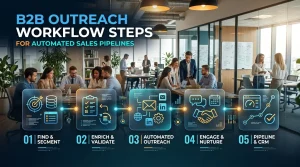
A structured approach to the B2B Outreach Workflow can help connect prospect research, contact management, communication, response handling, and sales pipeline activities.
Define Prospect Qualification Criteria
Before sending outreach, determine whether the contact matches the intended customer profile.
Evaluate company relevance, job responsibilities, business requirements, and potential purchasing authority.
This prevents teams from spending excessive time contacting people who have little connection with the advertised solution.
Organize Messages by Campaign Objective
Different campaign objectives require different messaging approaches.
A campaign introducing a service may focus on the customer’s problem and potential benefits.
A partnership campaign may emphasize complementary expertise and mutual value.
A re-engagement campaign may refer to previous discussions or a new business development.
Use CRM Systems to Manage Responses
A CRM can help teams record contact information, message history, follow-up dates, and opportunity status.
Useful stages include:
- Prospect identified.
- Prospect researched.
- Initial message sent.
- Response received.
- Conversation started.
- Meeting scheduled.
- Opportunity qualified.
- Proposal submitted.
- Customer acquired.
- Opportunity closed.
The workflow should also record opt-outs and negative responses to prevent unwanted future communication.
Handle Different Types of Cold Message Replies
A successful outreach campaign is not simply about receiving replies.
Businesses must understand how to respond appropriately to different types of responses.
A positive reply, an objection, a request for more information, and an unsubscribe message require different communication approaches.
Responding to an Interested Prospect
When a prospect shows interest, acknowledge the response and provide the requested information.
Example:
“Thanks for getting back to me. Based on your interest in [specific area], I can share a short overview of how we approach this challenge and what the process involves.”
Avoid immediately sending a large presentation or demanding a meeting.
Understand what the prospect wants to know first.
Responding to a Pricing Question
Example:
“Thanks for asking. Pricing depends on the scope and requirements involved. If you can share a little more about what you need, I can provide a more relevant estimate.”
This helps avoid giving an unrealistic price without understanding the requirements.
Responding to a Not-Now Message
Example:
“Completely understand. Would it be appropriate to reconnect later, or would you prefer that I leave the conversation here?”
Respect the answer and follow up only when permission or a legitimate basis exists.
Responding to a Not-Interested Message
Example:
“Thanks for letting me know. I appreciate your time and won’t continue with this conversation.”
A respectful response protects professional reputation.
Responding to a Request for More Information
Example:
“Absolutely. Our service focuses on [main solution], helping [target audience] address [specific problem]. I can also share an overview of the process and relevant examples if useful.”
Keep the response focused on the prospect’s actual question.
Measure the Performance of Cold Outreach Campaigns
Campaign evaluation should extend beyond the number of messages sent.
A business may send thousands of emails without generating meaningful opportunities.
The objective is to understand which messages attract relevant replies and contribute to customer acquisition.
Track Important Outreach Metrics
| Metric | What it measures | Business purpose |
|---|---|---|
| Delivery rate | Messages successfully delivered | Monitors delivery quality |
| Bounce rate | Messages that cannot be delivered | Identifies list quality problems |
| Reply rate | Prospects responding | Measures communication engagement |
| Positive reply rate | Interested responses | Measures message relevance |
| Meeting booking rate | Prospects scheduling meetings | Measures interest progression |
| Qualified lead rate | Relevant business opportunities | Measures lead quality |
| Conversion rate | Leads becoming customers | Measures sales effectiveness |
| Customer acquisition cost | Cost of acquiring customers | Evaluates profitability |
Calculate Reply Rate
Reply rate measures the percentage of delivered outreach messages that receive a response.
Formula:
Reply Rate = (Replies Received ÷ Delivered Messages) × 100
Suppose a campaign delivers 500 emails and receives 40 replies.
Reply Rate = (40 ÷ 500) × 100 = 8%.
This is a basic engagement indicator, not proof that the campaign generates profitable customers.
Calculate Positive Reply Rate
Not every response represents purchasing interest.
Some recipients may decline, request removal, or provide a neutral response.
Positive reply rate focuses on responses that indicate interest in discussing the offer.
Formula:
Positive Reply Rate = (Positive Replies ÷ Delivered Messages) × 100
Businesses should define positive replies consistently to make comparisons meaningful.
Measure Meeting Conversion
Meeting conversion measures how successfully outreach creates scheduled business conversations.
Formula:
Meeting Conversion Rate = (Meetings Booked ÷ Delivered Messages) × 100
The result helps identify whether the message and call to action create sufficient interest.
Evaluate Revenue, Not Just Engagement
A campaign producing many inexpensive replies may still generate poor business results if the leads are unsuitable.
Track qualified opportunities, closed deals, customer value, and campaign expenses.
This helps connect communication performance with actual commercial outcomes.
Improve Cold Messaging Through A/B Testing
Testing helps identify which message elements work better with different customer groups.
However, meaningful testing requires a clear hypothesis and consistent measurement.
Test Subject Lines
Compare different subject lines while keeping the main email message reasonably consistent.
For example:
- Improving Website Performance.
- An Idea for Your Marketing Team.
- Question About Your SEO Strategy.
The purpose is to understand which subject line attracts relevant attention without becoming misleading.
Test Different Opening Messages
Some prospects may respond better to company-specific observations, while others may prefer direct explanations of the problem being addressed.
Test these approaches across comparable prospect groups.
Test Calls to Action
Compare a direct meeting request with a smaller request for information.
For example:
“Would you be available for a short discussion?”
versus:
“Would it be useful if I shared a few suggestions?”
Test Follow-Up Messages
Different follow-ups may produce different responses.
Compare value-based messages, short reminders, and permission-based closing messages.
Do not change multiple major variables simultaneously when trying to understand a particular result.
Cold Messaging Templates should evolve through genuine campaign learning rather than random wording changes.
Common Cold Messaging Mistakes That Reduce Replies
Even a well-targeted campaign can underperform when the message creates unnecessary friction.
Sending Generic Messages
A generic introduction provides little reason for someone to respond.
Explain why the recipient’s business is relevant and connect the message with a specific problem.
Writing Excessively Long Emails
A first message should not contain the complete history of the company, every available service, and a full proposal.
Prioritize the most relevant information.
Additional details can be shared when the recipient expresses interest.
Using Misleading Subject Lines
Avoid subject lines that create false urgency or imply an existing relationship.
The subject should represent the actual content of the email.
Adding Multiple Calls to Action
Asking the recipient to book a meeting, read a report, visit a website, and respond to several questions can create confusion.
Choose one primary action.
Following Up Too Aggressively
Repeated messages can damage relationships and create a negative impression.
Use a reasonable cadence and immediately respect opt-out requests.
Failing to Research the Recipient
Incorrect assumptions about a company’s services or the prospect’s responsibilities can undermine credibility.
Research the business before contacting it.
Ignoring Data Quality
Invalid addresses, outdated contact information, and poorly selected prospects can damage campaign performance.
Maintain accurate contact records and remove unsuitable or opted-out contacts.
Measuring Replies Without Qualification
A response is not automatically a sales opportunity.
Measure whether the conversation involves a relevant customer problem and a realistic potential requirement.
Compliance, Privacy, and Responsible Cold Messaging
Businesses should understand that commercial messaging is subject to legal and platform requirements.
Rules vary depending on the recipient’s location, business type, communication channel, and the sender’s relationship with the recipient.
Before running a campaign, review applicable privacy, electronic marketing, and advertising requirements.
Use Appropriate Business Contact Data
Collect contact information through legitimate and appropriate sources.
Avoid using stolen databases, questionable personal information, or contact details collected in ways that violate applicable requirements.
Identify the Sender Clearly
Recipients should be able to understand who is contacting them and which organization the sender represents.
Use accurate sender identities, genuine company information, and non-deceptive subject lines.
Provide an Appropriate Opt-Out Method
Commercial email campaigns should include a clear and functional way for recipients to stop future marketing messages where required.
Maintain suppression lists so that opted-out contacts are not accidentally reintroduced into future campaigns.
Protect Personal Information
Store prospect information securely and give access only to people who need it for legitimate business activities.
Avoid collecting sensitive information that is unnecessary for the outreach objective.
Respect Platform Rules
Professional networking platforms, email providers, and communication tools may impose restrictions on automation, bulk messaging, and account behavior.
Avoid tools or practices that create artificial engagement or violate platform requirements.
Responsible communication protects both campaign effectiveness and business reputation.
Conclusion
Effective cold outreach depends on relevance, timing, personalization, and genuine business value. The strongest messages explain why a conversation matters without overwhelming recipients with promotional language. Research prospects, choose appropriate communication channels, use clear scripts, and follow up respectfully. Measure positive replies, qualified opportunities, and actual customer acquisition rather than message volume alone. Above all, treat every recipient as a professional making an independent decision. A well-managed messaging strategy builds more than replies; it creates opportunities for meaningful conversations, lasting business relationships, and sustainable sales growth.
Frequently Asked Questions (FAQ)
What Are Cold Messaging Templates?
Cold Messaging Templates are reusable scripts designed to introduce a business, service, product, or professional opportunity to people who have not previously communicated with the sender. They help organize outreach around relevant problems, clear value propositions, and simple calls to action.
How Do You Write a Cold Message That Gets Replies?
Research the recipient, mention a relevant business observation, explain a problem your solution addresses, and finish with a simple question. Keep the communication concise, accurate, and focused on the recipient rather than the sender’s company history.
What Is a Good Cold Email Template?
A good cold email template includes a relevant subject, personalized opening, recognizable customer problem, concise value proposition, and one clear call to action. The message should give the recipient a useful reason to respond without creating unnecessary pressure.
How Long Should a Cold Message Be?
A first-contact message should generally contain only the information necessary to explain its relevance and invite a response. For many B2B situations, a short email of approximately 50–150 words can be a practical starting point, although complexity and audience expectations vary.
How Many Follow-Up Messages Should You Send?
There is no universal number that works for every campaign. A small number of carefully spaced, relevant follow-ups may be appropriate, provided that the sender respects the recipient’s preferences, applicable requirements, and opt-out requests.
Are Cold Messaging Templates Effective for B2B Sales?
Yes. Structured scripts can improve consistency, reduce message preparation time, and help sales teams communicate relevant business value. Their effectiveness depends on prospect selection, research, personalization, offer quality, and follow-up practices.
What Is the Difference Between Cold Email and LinkedIn Outreach?
Cold email uses email to introduce a business offer or start a professional conversation. LinkedIn outreach uses professional profiles, connections, and direct messages to establish contact. Both require personalization and respectful communication, but their formats and platform rules differ.
How Do You Measure Cold Messaging Success?
Important metrics include delivery rate, bounce rate, reply rate, positive reply rate, meeting booking rate, qualified lead rate, conversion rate, and customer acquisition cost. Measuring commercial outcomes provides a more useful understanding than counting responses alone.
Why Do Prospects Ignore Cold Messages?
Common reasons include irrelevant offers, generic wording, poor timing, lack of trust, excessive message length, unclear benefits, and inappropriate targeting. Improving relevance and reducing unnecessary friction can make outreach more effective.
Can Cold Messaging Be Automated?
Yes. Businesses can automate appropriate administrative activities such as campaign scheduling, contact organization, follow-up reminders, and CRM updates. However, automation should not replace genuine personalization, accurate information, consent requirements, or respectful communication.