Top Intent Data Sources for Better Targeting
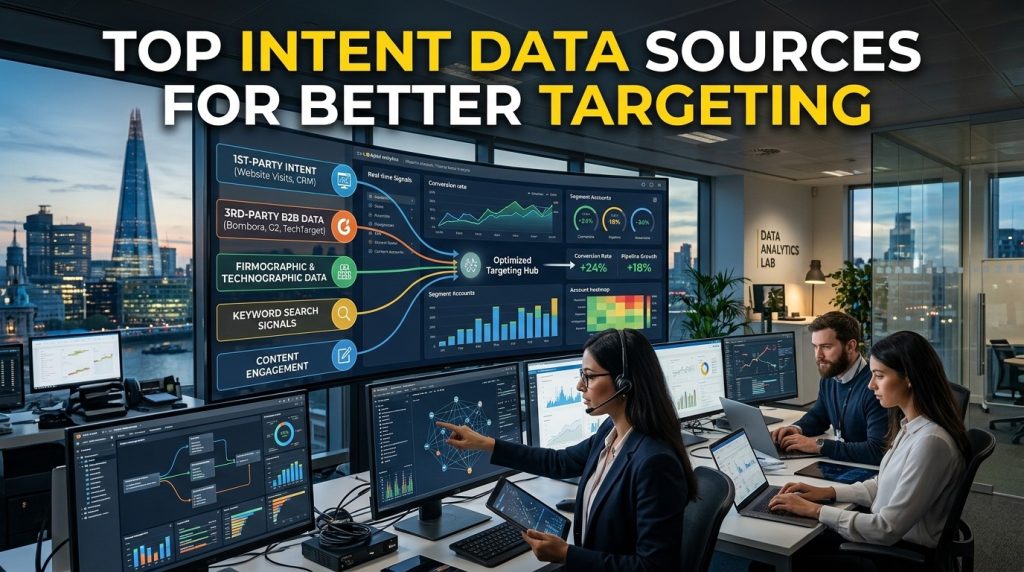
Intent data has become valuable because modern buyers leave signals long before they submit a form. The strongest strategy is not collecting every possible signal, but combining relevant first-party behavior with evaluated external research, review, publisher, community, and engagement data.
High-quality Intent Data Sources help teams recognize changing interest, prioritize accounts, personalize messages, and coordinate sales and marketing actions. Yet no signal proves a purchase will happen. Context, recency, frequency, fit, data quality, privacy, and business outcomes must shape interpretation. When marketers build a signal framework and continuously compare intent against conversions, targeting becomes more timely, focused, measurable, and useful.
The hardest part of modern targeting is not finding more people. It is recognizing which people or accounts have a meaningful reason to pay attention right now.
A huge audience can create impressive reach while producing weak engagement, low-quality leads, and inefficient sales conversations. On the other hand, a smaller audience that is actively researching a relevant problem can be significantly more valuable because the timing is different. This is where Intent Data Sources become important.
Instead of relying exclusively on demographic or firmographic assumptions, marketers can study behavioral evidence that indicates research, consideration, engagement, or potential buying activity. These signals can come from a company’s own website, CRM, email activity, product usage, review platforms, publishers, research networks, social interactions, events, or specialized data providers.
Modern B2B marketing increasingly treats intent as a way of understanding what buyers are researching before they openly identify themselves. 6sense describes Intent Data Sources as digital signals such as content consumed, topics researched, and review-site activity that may indicate a company is actively exploring a solution.
That makes Intent Data Sources more useful when they answer a specific business question instead of simply adding another dashboard metric.
A strong framework should help answer questions such as:
Who is researching the category?
Which accounts are showing increased activity?
What topics are receiving attention?
Is the interest recent or persistent?
Does the account fit the ideal customer profile?
Has the prospect moved from education toward evaluation?
What should marketing, sales, or advertising do next?
The psychological advantage is timing. Buyers rarely wake up one morning and immediately become customers. They notice a problem, investigate possibilities, compare alternatives, gather proof, evaluate risk, and eventually take action.
Intent Data Sources can help marketers see parts of that journey.
The key, however, is not to assume that every signal equals purchase intent. Intent Data Sources produce evidence, not certainty. The strongest programs combine multiple signals, look for meaningful changes in behavior, and validate those signals against actual outcomes.
What Are Intent Data Sources?
Intent Data Sources are the places, platforms, systems, or networks from which behavioral signals are collected and interpreted to identify potential buying interest.
Those sources vary widely in quality, scope, timing, and context.
A page visit on your own website may be highly relevant because the visitor reached your pricing page. A generic article visit on an unrelated publisher may be much weaker. A product review comparison on a trusted software marketplace can provide a different type of evidence. A sales conversation can reveal explicit needs that anonymous browsing cannot.
This means Intent Data Sources should not be treated as interchangeable.
6sense broadly distinguishes first-party, second-party, and third-party intent, while Bombora also describes first-party signals as activity on owned properties and third-party signals as external research activity across the broader web.
For practical use, the three categories can be understood as follows:
| Source type | Where signals come from | Main strength | Main limitation |
|---|---|---|---|
| First-party | Your website, CRM, email, product, events | Direct relevance | Limited to known or observed brand activity |
| Second-party | Review platforms, partner data, shared ecosystems | Strong category context | Coverage depends on platform |
| Third-party | Publisher networks, research networks, external data providers | Broader market visibility | Quality and methodology vary |
This classification is useful because Intent Data Sources can reveal different stages of the buyer journey.
First-party information often tells you that someone has already entered your ecosystem.
Second-party data can show that someone is comparing providers or evaluating a category.
Third-party data can sometimes reveal research before the buyer has discovered or contacted your brand.
That sequence is strategically important.
If a business only watches first-party activity, it may react after the buyer has already entered the funnel. External signals can provide earlier visibility, while direct engagement provides stronger confirmation.
Bombora describes its own third-party model as monitoring research activity across a Data Co-op of publishers, B2B brands, and other providers, while its first-party examples include website engagement, event activity, sales conversations, and product or trial milestones.
The practical lesson is simple: the value of Intent Data Sources comes from what they reveal that your existing measurement system does not.
Why Intent Data Sources Matters for Better Targeting
Traditional targeting often answers, “Who could buy?”
Intent-focused targeting adds another question: “Who appears to be researching or engaging with something related to what we sell?”
That difference can transform campaign prioritization.
Imagine a software company with 10,000 accounts that match its ideal customer profile. Firmographic targeting may tell the company which accounts fit by industry, employee count, geography, or technology environment.
But fit does not mean timing.
Only a portion of those accounts may currently be evaluating a relevant solution. Intent Data Sources can help narrow that broader universe by identifying accounts that are showing behavioral evidence of active research.
This makes targeting more dynamic.
Instead of building one audience and repeatedly showing the same message, marketers can create segments based on engagement intensity, topic interest, recency, or stage. One segment might receive educational content, another comparison content, and another a sales-focused offer.
The psychological reason this works is relevance.
People become more responsive when a message matches what they are already thinking about. The message feels timely rather than intrusive. This does not guarantee conversion, but it can reduce wasted attention.
Gartner research specifically emphasizes the importance of combining multiple intent signals rather than relying on one isolated indicator when trying to identify genuine technology buying activity.
That principle should shape the entire approach to Intent Data Sources.
One article view is weak evidence.
A repeated pattern across relevant topics, product comparisons, website activity, and commercial engagement is more informative.
Likewise, one anonymous research spike may not be enough to justify an aggressive sales motion. When several independent signals point in the same direction, confidence can increase.
The Major Categories of Intent Data Sources
First-party intent data
First-party Intent Data Sources come from properties and systems the business controls. These are often the most directly connected to the brand because the company knows exactly what content, product, offer, or interaction generated the signal.
Examples include website visits, pricing-page views, product-page activity, content downloads, email engagement, demo requests, form submissions, webinar registrations, trial milestones, account activity, and sales conversations. Bombora and 6sense both describe these types of behaviors as examples of first-party intent.
The main advantage is context.
If someone visits your pricing page for three minutes and then checks an integration page, the business understands exactly what they were looking at.
The limitation is visibility.
A company cannot observe every organization that is researching a problem somewhere else on the internet. This is why first-party data is strongest when combined with broader external signals.
The related Value-Based Bidding concept is also useful here because not every first-party action necessarily has the same commercial value. A product view, pricing-page visit, demo request, and completed purchase should not automatically be treated as equivalent signals.
Smart segmentation can therefore transform raw first-party activity into useful targeting intelligence.
Website engagement
Website behavior is among the most accessible Intent Data Sources for almost every business.
Useful signals include:
- Frequency of visits
- Pages viewed
- Pricing-page engagement
- Product comparison activity
- Case-study consumption
- Documentation visits
- Return visits
- High-value conversion paths
The deeper the relationship between the action and the buying decision, the more strategically useful the signal can become.
For example, someone visiting five blog posts may simply be researching a topic. Someone repeatedly visiting pricing, implementation, integrations, and product documentation may display a much more specific pattern.
Still, website behavior should be interpreted carefully. Internal employees, existing customers, competitors, job candidates, and automated traffic can all produce activity.
CRM and marketing automation
CRM systems contain some of the richest first-party Intent Data Sources because they combine behavior with known business context.
Sales representatives may record:
- Business problems
- Budget discussions
- Timelines
- Competitor mentions
- Product interests
- Objections
- Decision-maker roles
- Meeting outcomes
Marketing automation systems add email opens, clicks, content interactions, form completions, webinar participation, and nurture engagement.
When these systems are connected, a marketer can move beyond anonymous “engagement” and understand the broader account journey.
A prospect who downloaded a guide six months ago and suddenly books a demo represents a different situation from someone who downloaded a guide yesterday but has shown no additional engagement.
Recency and sequence matter.
Product usage and trial behavior
For SaaS companies, product telemetry can function as an especially valuable intent layer.
Trial users may:
- Invite colleagues
- Use advanced features
- Reach usage thresholds
- Visit pricing
- Explore integrations
- Compare plans
- Return frequently
These actions can provide more meaningful evidence than general content consumption because they happen closer to actual product evaluation.
The same logic applies beyond SaaS. Ecommerce sites, marketplaces, education platforms, and service businesses can identify behavioral actions that suggest increasing engagement.
Search Behavior and Research Activity

Search behavior is another major category of Intent Data Sources because research often begins with a question.
People may search for:
“How does this work?”
“What alternatives exist?”
“Best software for…”
“Pricing for…”
“Compare A vs B”
“Reviews of…”
“Best agency for…”
These patterns can reveal movement along the research journey.
Informational searches may indicate early education.
Comparison queries may suggest active evaluation.
Pricing queries may represent stronger commercial interest.
Brand and competitor searches can indicate that the person has moved deeper into the decision process.
This is where paid search and organic search can intersect with intent intelligence. The related Smart Bidding framework is relevant because advertising systems can use conversion-focused automation to adjust bids based on expected outcomes, while intent analysis helps marketers understand the kinds of searches entering the funnel.
However, search queries should not be interpreted as absolute proof of buying intent.
An analyst researching a market can search commercial phrases without being a buyer. A student can search product comparisons. A competitor can search a brand name. A journalist can research an industry.
This is why the best Intent Data Sources are evaluated in context.
Search term + company fit + recency + engagement + downstream action is much stronger than search term alone.
Content consumption
Content consumption can also reveal shifts in interest.
Repeated engagement with content around one topic can indicate that the topic has become more important to an account.
Bombora describes its approach as monitoring content consumption and measuring topic-level research behavior over time rather than relying only on isolated keyword spikes.
This distinction matters.
A single article visit is a point.
A pattern is a signal.
A meaningful spike against a historical baseline can be even more useful because it suggests that current activity differs from normal behavior.
Review Platforms as High-Value Intent Data Sources
Software review platforms can be powerful because users often visit them while comparing providers, capabilities, pricing, ratings, and alternatives.
6sense identifies review sites such as G2, TrustRadius, PeerSpot, and Gartner Digital Markets as examples associated with second-party Intent Data Sources.
This makes review platforms interesting for both sales and marketing.
A person casually reading a blog may not yet have decided what solution category they need.
A person comparing multiple providers on a review platform may already have a much clearer evaluation framework.
The mindset has changed from learning to deciding.
What review activity can reveal
Review platforms can provide clues about:
- Category interest
- Competitor evaluation
- Feature priorities
- User concerns
- Pricing sensitivity
- Vendor comparison
- Market expectations
The information becomes even more useful when combined with CRM data.
For example, suppose an account already attended your webinar, visited pricing, and later appears in category comparison activity. Each individual signal is imperfect, but the combined pattern can justify closer attention.
This is where Intent Data Sources become more useful than isolated lead scoring.
The goal is not to assign a magical score. The goal is to understand behavioral context.
Why social proof matters
Review behavior also reveals something psychological: risk reduction.
Buyers often want confirmation that other organizations have succeeded with a solution before making a decision. Reading peer reviews is partly a search for evidence.
That means review-based intent can be particularly relevant when the product has:
- High switching costs
- Long implementation cycles
- Significant contract values
- Technical complexity
- Organizational approval requirements
In these situations, the buyer may consume a large amount of independent content before contacting a vendor.
Publisher Networks and External Research
Publisher networks can broaden visibility beyond your own ecosystem.
A business may have no website activity from an account even though that account is reading industry articles, technical publications, analyst content, product guides, and other relevant material elsewhere.
Third-party Intent Data Sources can help identify some of this external research.
Bombora says its Data Co-op includes thousands of media destinations and uses content-consumption signals from publishers and B2B websites to derive account-level intent.
6sense similarly describes third-party data as research and buying activity across external websites, publishers, social platforms, and review environments.
The value here is early visibility.
A company may be researching cybersecurity, analytics, cloud infrastructure, marketing automation, or another category months before requesting a demo.
For marketers, that creates an opportunity to engage earlier in the journey.
Topic-level research
Modern intent platforms often classify research into topics rather than simply counting page visits.
Bombora says its taxonomy covers more than 21,600 topics and is updated periodically to reflect evolving business subjects.
Topic classification matters because the same account may research multiple related concepts.
For example:
“Customer data platform”
“Identity resolution”
“Data enrichment”
“Customer segmentation”
These might indicate related needs, but not necessarily identical purchase intent.
The quality of Intent Data Sources therefore depends partly on how precisely raw research behavior is transformed into meaningful topics.
Publisher depth versus breadth
A broad network can provide wider coverage.
A specialist publisher network may provide deeper context within a particular vertical.
The best choice depends on the targeting problem.
A global technology provider may benefit from broad coverage.
A niche industrial company may care more about specialized trade publications.
This is another reason marketers should not compare providers only by the number of domains or signals claimed.
Communities, Forums, and Social Activity
Online communities can reveal intent through questions, discussions, product recommendations, complaints, and comparisons.
Users may ask:
“What tool should I use?”
“Has anyone tried this?”
“How do you solve this problem?”
“Alternative to X?”
“Why is this software failing?”
These discussions can contain unusually rich context because people often explain the problem in their own words.
Social activity can also reveal engagement with brands, categories, creators, and professional content. LinkedIn, for example, has described its own Buyer Intent capability as using engagement activity to understand account and product-category interest.
However, social signals require caution.
A public comment does not necessarily mean commercial intent.
Someone can engage because they disagree with a post.
Someone can share an article for educational reasons.
Someone can interact with a company without being involved in a purchase.
Therefore, social behavior should usually be treated as one layer within a larger signal model.
Communities can also be useful for qualitative intent.
Quantitative data may tell you that interest increased.
A community conversation can tell you why.
That “why” can improve messaging, positioning, content, and product strategy.
Email and Engagement Signals
Email behavior is another accessible category of Intent Data Sources.
Useful signals include:
- Repeated email clicks
- Product-content engagement
- Webinar registration
- Pricing-related content clicks
- Re-engagement after inactivity
- Multiple contacts from one account engaging
- Replies to campaign messages
One click is rarely enough.
Repeated engagement across different messages is more informative.
For example, imagine a prospect who reads three educational articles, opens a comparison guide, attends a webinar, and then clicks an implementation case study. The sequence reveals progression.
This illustrates a broader principle: intent is often stronger when signals have direction.
Moving from education toward comparison, evaluation, and implementation can reveal a more advanced buyer journey than repeated interaction with general awareness content.
Account-level engagement can become especially powerful when several people from the same organization interact.
One person may be researching.
Three people from different departments may indicate a wider internal buying process.
That is why buying-group signals can add context to account intent.
Bombora notes that account-level intent can be enriched with buying-group and persona-level insight to show which roles are driving research.
Events, Webinars, and Direct Conversations
Events and webinars create another class of Intent Data Sources because the interaction is often explicitly tied to a topic.
Registration alone may be weak.
Attendance can be stronger.
Questions during the event can be stronger still.
A request for pricing or implementation information after the event can be stronger again.
The sequence matters.
Sales calls may provide even clearer signals because buyers can state their priorities directly.
Examples include:
“We are evaluating vendors this quarter.”
“Our current platform is reaching its limits.”
“We need this integration.”
“We are replacing an existing solution.”
Those statements can be more actionable than anonymous content behavior because the prospect has explicitly revealed a business problem.
However, direct conversation data is often stored in unstructured notes, making it harder to operationalize.
The goal is to convert useful conversation insights into consistent CRM fields or structured signals.
This can help sales and marketing act on intent more systematically.
Product Reviews, Competitor Research, and Comparison Behavior
Competitor research can be one of the most revealing Intent Data Sources because it often happens during active evaluation.
When buyers read content about:
- Competitor A
- Competitor B
- Your product
- Alternatives
- Switching costs
- Feature comparisons
- Migration guides
they may be closer to a vendor decision.
Yet competitor research must still be interpreted carefully.
A customer success manager might research a competitor because of churn risk.
A marketer might research competitors for content creation.
An analyst may research competitors for market intelligence.
The best signal is therefore not “someone looked at a competitor.”
It is the relationship between competitor research and account fit, existing engagement, recency, and additional buying signals.
This is where the broader concept behind Intent Data for Precise Prospecting becomes especially relevant: intent can help prioritize prospecting when it is combined with a clear definition of who the business actually wants to reach.
The strongest targeting framework balances fit with timing.
Perfect-fit account + no evidence of current need = long-term nurture opportunity.
Moderate-fit account + intense research = potential investigation.
High-fit account + multi-source research + direct engagement = a much richer sales conversation.
The important point is not to assign a simplistic label but to understand the evidence behind the prioritization.
Specialized Intent Data Providers and Data Networks
Some businesses build their own intent framework entirely from first-party activity. Others use specialized external providers to expand market visibility.
These vendors can aggregate signals from publisher networks, review platforms, research environments, digital activity, and other sources, then apply identity resolution, topic classification, scoring, and modeling.
Bombora says its Company Surge product uses research activity from its Data Co-op and applies machine learning, natural language processing, and related models to identify elevated account-level interest.
6sense similarly describes its intent system as combining signals from its broader network to identify accounts showing active research behavior.
Specialized providers become attractive when internal data is too narrow.
For example, your website tells you about the accounts that already reached you.
An external network may reveal accounts that are researching your category without visiting your website.
That difference creates incremental visibility.
But purchasing external data does not automatically produce better targeting.
Quality varies significantly by methodology, coverage, identity resolution, refresh rate, topic model, and signal depth. 6sense itself notes that accuracy varies by provider and that combining multiple signals can be important because false positives can occur.
This is why vendor evaluation should be systematic.
How to Evaluate Intent Data Sources
Before buying or integrating any data source, ask what decision it is supposed to improve.
Do you want to:
Generate more qualified leads?
Prioritize sales accounts?
Improve ABM targeting?
Reduce wasted advertising?
Personalize content?
Identify expansion opportunities?
Detect churn risk?
Each objective may require different signals.
1. Signal relevance
The first question is whether the signal relates directly to your market.
A cybersecurity company needs cybersecurity research signals.
A marketing technology company needs martech-related research.
A manufacturing supplier may need industry-specific technical activity.
Broad but weak signals can create noise.
2. Recency
Intent changes.
A company researching a topic two years ago may have no current project.
Recent activity can be more actionable than historical activity, especially for short sales cycles.
3. Frequency
Repeated activity can provide stronger context than a single interaction.
A visitor who reads one article may be curious.
An account repeatedly researching the same topic may have deeper interest.
4. Topic accuracy
The provider should classify activity accurately.
If unrelated content is grouped into the wrong topic, your audience will become noisy.
5. Identity resolution
For B2B use cases, marketers often want to connect anonymous activity with an account or organization.
Identity matching can affect how useful the signal becomes.
6. Coverage
Ask where the data comes from.
Is it your site?
A specific review platform?
A publisher network?
A data cooperative?
A bitstream environment?
6sense distinguishes review-platform, publisher, and broader third-party approaches, while Bombora describes a publisher-and-brand Data Co-op model.
Different source architectures reveal different types of behavior.
7. Transparency
A provider should be able to explain enough about its methodology for you to understand what the signal actually means.
Be cautious when a vendor provides a score without explaining the underlying evidence.
A score is a summary.
The evidence is what makes it useful.
8. Privacy and compliance
Data collection should respect applicable privacy requirements, consent rules, contracts, and platform restrictions.
Bombora describes its Data Co-op as using privacy-first and consent-driven collection protocols. That is a vendor-specific claim, so buyers should independently review the provider’s current documentation, contractual terms, and compliance framework rather than assuming that all intent providers use the same approach.
Building a Multi-Signal Intent Framework
The most useful approach is rarely choosing one source.
Instead, combine multiple signals into a framework.
For example:
Fit + Research + Engagement + Recency + Commercial Action
Fit tells you whether the account belongs in the ideal customer profile.
Research shows whether the organization is exploring relevant topics.
Engagement shows whether it has interacted with your brand.
Recency shows whether activity is current.
Commercial action shows whether the organization is moving toward an outcome.
This layered model is much more useful than asking whether one account has “intent.”
Gartner has specifically discussed triangulating multiple intent signals to better sense genuine technology buying activity.
Example scoring model
Imagine a B2B software company creating an internal prioritization model:
| Signal | Example interpretation |
|---|---|
| ICP fit | High |
| Category research | Rising |
| Competitor research | Present |
| Website engagement | Strong |
| Pricing activity | Recent |
| Sales engagement | None |
| Buying-group activity | Multiple contacts |
The account does not become guaranteed revenue.
Instead, it becomes a higher-priority account for investigation.
This distinction is important.
Intent should help decide where to spend attention.
It should not replace sales judgment.
How to Use Intent for Better Targeting
Once relevant Intent Data Sources have been selected, the next step is activation.
Data without action becomes another dashboard.
Segment by buying stage
Create separate groups for:
Early research
Problem awareness
Category evaluation
Vendor comparison
Purchase readiness
Existing customer expansion
Then match the message to the stage.
Early researchers may need educational content.
Evaluators may need comparisons.
Late-stage buyers may need proof, pricing, implementation details, or a sales conversation.
Prioritize accounts
Sales teams can use intent signals to decide which accounts deserve attention first.
Marketing teams can build ABM audiences around current research activity.
Advertising teams can adjust targeting and messaging for accounts showing relevant interest.
Customer teams can watch for expansion or competitive research.
Bombora describes intent use cases that include prioritizing in-market accounts, personalizing engagement, and identifying expansion or churn risks.
Personalize messaging
A generic message says:
“We help businesses improve marketing.”
An intent-informed message can be more specific:
“Companies evaluating customer-data platforms often struggle with identity resolution and activation. Here is how the implementation process works.”
The second message feels closer to the problem.
That is the psychological benefit of intent-based targeting.
Adjust advertising
Intent information can inform audience selection, message sequencing, content promotion, and account prioritization.
It should still be tested against actual campaign results.
The objective is not to assume that every high-intent account will respond.
The objective is to increase the probability that marketing resources are focused on accounts with stronger evidence of relevance and current interest.
Privacy, Ethics, and Data Quality

Intent targeting becomes more sustainable when users’ data is handled responsibly.
Marketers should understand:
What is collected?
Where is it collected?
What permissions or legal basis apply?
How long is it retained?
How is identity resolved?
How is the data activated?
Can users exercise applicable privacy rights?
Privacy is not merely a compliance topic. It can also influence data durability.
A strategy dependent on fragile or poorly understood tracking methods can become less reliable as platforms, browsers, policies, and regulations evolve.
Bombora emphasizes consent-driven collection in describing its Data Co-op, while other providers may use different methodologies and architectures. Buyers should therefore evaluate each provider independently rather than treating all Intent Data Sources as equivalent.
Data quality also requires ongoing monitoring.
Watch for:
Sudden audience spikes
Unexpected industries
Repeated irrelevant accounts
Duplicate organizations
Obsolete contacts
Low conversion rates
Weak sales acceptance
If a supposedly high-intent audience repeatedly fails to produce meaningful outcomes, the model needs investigation.
Common Mistakes When Using Intent Data
The first mistake is treating intent as certainty.
Intent is a probability signal, not a purchase guarantee.
The second is buying large amounts of data without defining how sales or marketing will use it.
The third is using a single score without understanding the signals underneath.
The fourth is ignoring fit.
A company can show interest in a category while being completely unsuitable for your product.
The fifth is ignoring timing.
Historical activity may not represent current priorities.
The sixth is over-personalizing too early.
Just because a company appears to be researching a topic does not mean it wants an aggressive sales message.
The seventh is failing to measure outcomes.
The real test is whether intent-based prioritization improves business metrics such as qualified pipeline, conversion rate, sales efficiency, revenue contribution, or customer expansion.
A Practical Intent Data Implementation Framework
Start with the ideal customer profile.
Define industry, company size, geography, business model, technology environment, and other meaningful fit criteria.
Then define the buying signals.
List the behaviors that would realistically suggest increasing interest in your product category.
Next, divide signals into levels.
Low-intensity signals
General article consumption
Single social engagement
Basic brand interaction
One webinar registration
Medium-intensity signals
Repeated topic research
Multiple content interactions
Competitor comparison
Review-site activity
Return website visits
High-intensity signals
Pricing-page activity
Demo request
Trial activation
Procurement discussion
Multiple buying-group members engaging
A high-intensity signal does not automatically mean “close now.”
It means the account deserves closer attention.
After that, connect the signal framework to workflow.
For example:
Intent detected → Account enriched → Fit checked → Segment created → Message selected → Sales/marketing action → Outcome measured
Automation can make this process scalable.
But human judgment should remain involved where context matters.
Intent Data for Different Marketing Channels
Paid search
Search behavior can help marketers understand active demand and refine keyword or audience strategies.
Paid social
Intent-oriented audiences can help advertising teams tailor messages around current research patterns where platform capabilities permit appropriate activation.
Known contacts can be segmented by engagement and buying-stage behavior.
ABM
Account-level intent can help prioritize target companies for coordinated marketing and sales activity.
Content marketing
Research trends can reveal which topics deserve new content, updated guides, comparison pages, or case studies.
Sales prospecting
Sales teams can use current account signals to investigate where a conversation may be more relevant.
The common theme is timing.
A message becomes more useful when it reaches the buyer when the problem is actively relevant.
Intent Data in Lead Scoring
Traditional lead scoring might assign points for:
Job title
Company size
Email opens
Form submissions
Website visits
Content downloads
Intent adds another dimension: current research behavior.
This can help distinguish between people who fit the profile and people who fit the profile and appear to be actively researching.
For example:
Fit score: 90/100
Engagement score: 70/100
Current intent: rising
That combination can be much more informative than any one metric.
Still, the scoring formula should be validated.
A model can look sophisticated while producing poor-quality leads.
The only reliable way to improve it is to compare predictions against actual outcomes.
Intent Data and Revenue Operations
Intent becomes most powerful when sales, marketing, advertising, and customer success use the same signal language.
Marketing may say:
“This account is showing increased research.”
Sales may say:
“This account is already discussing a project.”
Customer success may say:
“This customer is researching a competitor.”
Revenue operations can connect those situations into one account-level view.
6sense describes intent as something used across marketing and sales workflows, while Bombora discusses applications including sales prioritization, marketing activation, and customer expansion or churn analysis.
The result is a more coordinated go-to-market process.
Marketing creates awareness.
Intent helps identify changing interest.
Sales adapts outreach.
Customer success watches existing accounts.
Revenue operations measures the results.
That is more powerful than treating intent as an isolated lead score.
What Makes Intent Data Sources Truly Useful?

A high-quality source should ideally offer four things:
Relevance — the signal relates to your market.
Freshness — the signal reflects recent behavior.
Context — the signal explains what is happening, not just that something happened.
Actionability — the data can trigger a useful decision.
Without relevance, targeting becomes noisy.
Without freshness, targeting becomes outdated.
Without context, sales teams cannot interpret the behavior.
Without actionability, the data simply fills another dashboard.
This is why the strongest Intent Data Sources are not necessarily those with the largest raw volume.
A smaller, highly relevant signal can sometimes be more useful than millions of weak interactions.
Final Strategic Takeaway
The modern buyer journey is increasingly distributed across websites, search engines, review platforms, publishers, communities, emails, social networks, products, and direct conversations.
No single platform sees everything.
That is why Intent Data Sources matter.
First-party sources provide direct visibility.
Second-party sources can reveal comparison behavior.
Third-party networks can expose broader research patterns.
Review platforms can show evaluation.
Communities can reveal questions and pain points.
Search behavior can show active research.
CRM and product data can reveal commercial progression.
The strategic goal is not to collect everything.
It is to connect the right signals into a usable decision framework.
When fit, recency, frequency, topic relevance, engagement, and downstream outcomes are evaluated together, intent becomes much more useful for modern targeting.
The best marketers do not ask, “Who has intent?”
They ask, “What evidence suggests this account is becoming more interested, why might that be happening, and what should we do next?”
That shift turns data into decision-making.
Conclusion
Intent data has become valuable because modern buyers leave signals long before they submit a form. The strongest strategy is not collecting every possible signal, but combining relevant first-party behavior with evaluated external research, review, publisher, community, and engagement data. High-quality Intent Data Sources help teams recognize changing interest, prioritize accounts, personalize messages, and coordinate sales and marketing actions. Yet no signal proves a purchase will happen. Context, recency, frequency, fit, data quality, privacy, and business outcomes must shape interpretation. When marketers build a signal framework and continuously compare intent against conversions, targeting becomes more timely, focused, measurable, and useful.
Frequently Asked Questions (FAQ)
1. What are intent data sources?
Intent data sources are the platforms, systems, websites, networks, or behavioral environments from which marketers collect signals that may indicate a person or organization is researching a product, service, problem, category, or solution.
Common examples include company websites, CRM systems, email platforms, search activity, review sites, publishers, social platforms, events, product usage, communities, and specialized intent-data providers.
2. What is the difference between first-party and third-party intent data?
First-party intent comes from properties and systems controlled by your organization, such as website behavior, email engagement, CRM activity, trial usage, or event participation.
Third-party intent comes from external environments, such as publishers, research networks, review platforms, and other data ecosystems.
First-party data is usually closer to your brand, while third-party data can expand visibility into research occurring outside your own properties.
3. Are review sites useful for identifying buying intent?
They can be useful because review platforms are often visited during product evaluation and vendor comparison.
6sense identifies sites such as G2, TrustRadius, PeerSpot, and Gartner Digital Markets as examples associated with second-party intent data.
Review activity should still be evaluated together with account fit, recency, engagement, and other behavioral evidence.
4. Can search behavior reveal buying intent?
Search behavior can provide useful clues because different queries often correspond to different stages of research.
Informational searches may reflect early education, while comparison, pricing, alternative, and vendor-specific searches can indicate deeper evaluation.
However, search activity alone does not prove that the searcher is a buyer. Context and additional signals are important.
5. What is the most reliable intent data source?
There is no universally reliable source for every company or use case.
The usefulness of a source depends on signal quality, recency, topic accuracy, coverage, identity resolution, privacy practices, and how closely the source matches the buying process of the target market.
A multi-source framework is often more informative than relying on one signal type. Gartner has specifically emphasized combining multiple intent signals when evaluating technology buying activity.
6. How can Intent Data Sources improve targeting?
Intent Data Sources can help marketers prioritize accounts and audiences that show evidence of current research or engagement.
That information can then be used to adjust audience segmentation, content, advertising, sales outreach, account prioritization, and customer expansion workflows.
The main advantage is better timing rather than simply increasing the size of the audience.
7. Can intent data identify a buyer who is ready to purchase?
Intent Data Sources can identify signals associated with increased research or evaluation, but it cannot guarantee that a purchase will happen.
A strong intent signal should be treated as evidence that an account may deserve attention, not as proof that the account will buy.
Sales conversations, CRM activity, commercial actions, and actual outcomes remain important for validating the signal.
8. How often should Intent Data Sources be updated?
The ideal refresh frequency depends on the sales cycle and use case.
Short-cycle businesses may benefit from highly recent signals because buying intent can change rapidly.
Longer B2B sales cycles may benefit from observing trends over multiple weeks or months.
The important principle is that stale activity should not be treated as equivalent to recent behavior.
9. Should small businesses use Intent Data Sources?
Small businesses can use intent principles without purchasing expensive enterprise platforms.
A practical starting framework can use first-party website behavior, CRM records, email engagement, search terms, sales notes, content interactions, review activity, and publicly available research signals.
As the targeting problem becomes more complex, a specialized external provider may become useful.
10. What should a company check before buying an intent-data provider?
Evaluate the provider’s signal sources, coverage, topic methodology, identity resolution, refresh frequency, transparency, privacy framework, integration options, and measurable business outcomes.
Ask what the data actually represents and how it will change an existing workflow.
The most useful question is not simply, “How much data will we receive?”
It is, “What decision will this data help us make better?”