Ways Measuring Outreach Channels ROI Boosts Profits
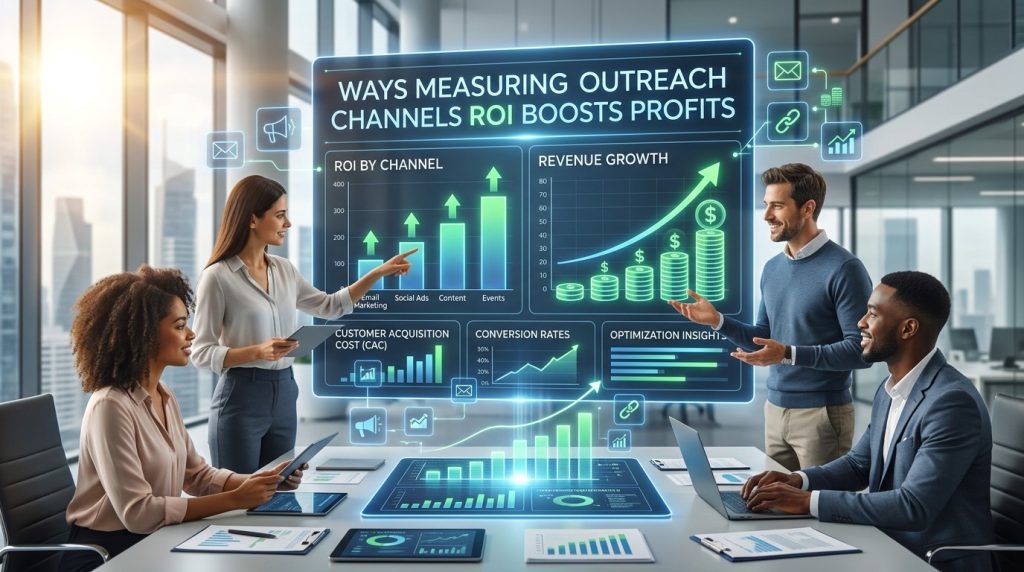
Measuring Outreach Channels ROI helps businesses identify profitable communication sources, control waste, allocate budgets intelligently, improve customer acquisition, and turn outreach data into sustainable profit.
Businesses invest heavily in customer outreach because attention is the starting point of most commercial relationships. Teams send emails, make calls, publish social content, run advertisements, conduct direct messaging, attend events, and create follow-up campaigns. Yet activity does not automatically create profit.
A campaign can generate thousands of clicks and still lose money. Another channel may produce fewer responses but create customers who buy repeatedly and remain valuable for years. Measuring Outreach Channels ROI provides the financial framework needed to understand that difference.
ROI, or return on investment, connects business spending with the value generated from that spending. In outreach, this means moving beyond surface-level activity metrics and asking whether communication is creating enough incremental revenue, contribution margin, or customer value to justify its cost.
The importance of Measuring Outreach Channels ROI becomes clearer when marketing budgets grow. A small company may manage several channels informally. A larger organization may operate email, paid search, social advertising, outbound sales, partnerships, webinars, events, SMS, direct mail, and referral programs simultaneously. Without a consistent measurement framework, budget allocation becomes heavily influenced by assumptions, opinions, or whichever dashboard metric looks impressive.
Measuring Outreach Channels ROI helps replace those assumptions with evidence.
It can reveal which channels attract high-value customers, which channels create inexpensive leads but weak conversions, which campaigns accelerate existing demand rather than generate new demand, and which activities consume resources without producing sufficient business outcomes.
The goal is not simply to identify a winning channel. The goal is to understand how different channels contribute to the customer journey and how their combined performance affects profitability.
What Is Measuring Outreach Channels ROI?
Measuring Outreach Channels ROI is the process of evaluating the financial return generated by different customer communication and outreach channels relative to the resources invested in them.
A basic ROI calculation can be expressed as:
ROI = (Return − Investment) ÷ Investment × 100
For outreach programs, “return” should ideally represent economically meaningful value rather than a superficial activity.
Depending on the business model, return might be:
- Revenue
- Gross profit
- Contribution margin
- Customer lifetime value
- Subscription value
- Qualified pipeline
- Incremental sales
Investment can include:
- Advertising spend
- Software costs
- Sales labor
- Creative production
- Agency fees
- Incentives
- Data costs
- Technology expenses
- Operational time
Measuring Outreach Channels ROI therefore requires a broader view than simply checking how much a campaign spent and how much revenue was attributed to it.
For example, a campaign costing $5,000 and generating $15,000 in revenue appears attractive at first glance. But if the product has a 20% gross margin, the resulting economics may be very different from a product with an 80% margin.
That is why Measuring Outreach Channels ROI should be designed around the financial structure of the business.
Why ROI Measurement Directly Affects Profitability
Profit is influenced by two basic forces:
Revenue generation and cost management.
Outreach affects both.
It can increase revenue by creating customers, encouraging repeat purchases, moving prospects through a sales process, or expanding account value.
It can also increase costs through inefficient targeting, excessive frequency, expensive acquisition, unnecessary software, and labor-intensive processes.
Measuring Outreach Channels ROI connects these two sides.
When a business understands which communication activities generate profitable customers, budget can move toward those activities.
When a business discovers that a supposedly successful campaign generates low-value customers, the strategy can be reconsidered.
When Measuring Outreach Channels ROI is performed consistently, marketing becomes more closely integrated with finance rather than operating as a separate creative function.
The Difference Between Activity and Economic Value
One of the most important concepts in outreach measurement is the difference between activity and value.
Imagine two channels.
Channel A generates:
- 10,000 impressions
- 2,000 clicks
- 400 leads
- 20 customers
Channel B generates:
- 2,000 impressions
- 300 clicks
- 80 leads
- 30 customers
A surface-level dashboard might favor Channel A because the activity numbers are much larger.
But Channel B generates more customers.
Now consider customer quality.
Suppose Channel A customers spend $100 each, while Channel B customers spend $800 each.
The difference becomes even more dramatic.
Measuring Outreach Channels ROI helps prevent teams from confusing volume with value.
High engagement is useful only when that engagement contributes to meaningful business outcomes.
The Core Metrics Behind ROI Measurement
A reliable ROI system usually tracks several metrics together.
Customer Acquisition Cost
Customer Acquisition Cost, or CAC, estimates how much it costs to acquire one customer.
CAC = Total Acquisition Cost ÷ Number of New Customers
Measuring Outreach Channels ROI becomes much more useful when CAC is compared with customer value.
Conversion Rate
Conversion rate measures the percentage of a defined audience that completes the desired action.
The action might be:
- Form submission
- Demo booking
- Purchase
- Subscription
- Account activation
- Contract signing
Average Order Value
Average order value helps determine how much revenue each purchase generates on average.
Customer Lifetime Value
Customer Lifetime Value estimates the economic value a customer can generate across the relationship.
Contribution Margin
Contribution margin accounts for the revenue remaining after relevant variable costs.
This can provide a more useful basis for profitability calculations than revenue alone.
Revenue Attribution vs Profit Attribution
Attribution can make outreach measurement complicated.
Suppose a customer first discovers a company through social media, later reads an email, searches the brand name, clicks a retargeting advertisement, speaks with a salesperson, and finally purchases.
Which channel deserves credit?
Depending on the attribution model, the answer could be:
- First-touch attribution
- Last-touch attribution
- Linear attribution
- Time-decay attribution
- Position-based attribution
- Data-driven attribution
Measuring Outreach Channels ROI requires understanding that attribution is a modeling framework rather than direct proof that one channel caused the entire purchase.
A channel may influence a customer without receiving the final click.
Conversely, a channel may receive the final click even though most of the persuasion happened elsewhere.
That is why Measuring Outreach Channels ROI should ideally combine attribution data with controlled testing and incremental analysis.
Why Last-Click Attribution Can Mislead
Last-click attribution is easy to understand.
The channel receiving the final click gets credit.
But customer journeys rarely happen in a single interaction.
A prospect might see five advertisements, read three articles, receive an email, attend a webinar, and then perform a branded search before purchasing.
The final branded search may receive the last-click credit even though earlier communication influenced awareness and consideration.
Measuring Outreach Channels ROI becomes distorted when teams interpret last-click attribution as a complete representation of causality.
Last-click reporting still has diagnostic value, but it should be interpreted as one perspective rather than the entire economic story.
Understanding the Customer Journey
Before measuring individual channels, businesses should understand the stages customers typically move through.
A simplified journey can look like:
Awareness → Interest → Evaluation → Conversion → Retention → Expansion → Advocacy
Different channels may contribute differently at each stage.
A social campaign may create initial awareness.
A webinar may support evaluation.
A sales call may help conversion.
Email may encourage retention.
A referral program may support advocacy.
Measuring Outreach Channels ROI should therefore consider the role each activity plays within the broader journey.
A channel does not necessarily need to close the sale directly to create value.
First-Touch and Last-Touch Metrics Still Have a Role
Although attribution has limitations, first-touch and last-touch measurements remain useful for directional analysis.
First-touch reporting can show which channels are effective at introducing people to the brand.
Last-touch reporting can show which channels frequently appear near the conversion event.
The insight comes from comparing them.
If one channel frequently appears at the beginning of customer journeys while another repeatedly appears near conversion, their roles may be fundamentally different.
Measuring Outreach Channels ROI should recognize these differences rather than forcing every channel into one performance category.
Multi-Channel Outreach and ROI
Customers rarely interact with one communication source in isolation.
A company may operate a Multi-Channel Outreach strategy involving email, social platforms, paid advertising, events, outbound sales, and content.
The challenge is avoiding double counting.
If multiple channels contribute to one customer, the business needs a framework for understanding overlap.
Measuring Outreach Channels ROI should therefore examine both channel-level efficiency and cross-channel interaction.
One channel may perform better when another channel supplies supporting awareness.
Removing that supporting channel could reduce the performance of the apparently stronger channel.
This is why isolated channel dashboards can sometimes produce misleading conclusions.
The Importance of Channel-Specific Cost Tracking
Accurate ROI requires accurate cost data.
Businesses sometimes calculate marketing return using media spend while ignoring the labor and technology required to operate the program.
For example, an email campaign may appear nearly free when only sending costs are considered.
But the real cost could include:
- Strategy time
- Copywriting
- Design
- Data management
- Marketing automation
- List maintenance
- Deliverability management
- Analytics
- Management time
Measuring Outreach Channels ROI becomes more realistic when relevant direct and indirect costs are included.
However, costs should also be allocated consistently. Overcomplicating cost accounting can make the model unusable.
The objective is meaningful precision rather than perfect theoretical accuracy.
Measuring Outreach Channels ROI for Email
Email marketing provides a relatively rich measurement environment because many interactions can be tracked.
Useful metrics include:
- Delivery rate
- Open rate
- Click rate
- Conversion rate
- Revenue per recipient
- Revenue per campaign
- Unsubscribe rate
- Customer value
However, opens and clicks should not be treated as financial outcomes.
A campaign with a lower click rate can still generate more profit if the people clicking have stronger purchase intent.
Measuring Outreach Channels ROI should connect email engagement with conversions, customer value, and retention.
For customer lifecycle programs, post-purchase behavior can be even more important than the initial click.
Measuring Paid Advertising ROI
Paid advertising introduces direct media costs, making ROI measurement particularly important.
Businesses should track:
- Impressions
- Clicks
- Cost per click
- Leads
- Customers
- Revenue
- Contribution margin
- Customer acquisition cost
- Incremental conversions
Measuring Outreach Channels ROI for advertising should also account for audience overlap.
A person may see multiple advertisements before purchasing.
Frequency and sequencing can influence performance, so channel measurement should not focus entirely on isolated ad-level performance.
The quality of the acquired customer is equally important.
A low-cost acquisition that produces high churn may be less valuable than a higher-cost acquisition that produces long-term customers.
Measuring Sales Outreach ROI
Sales outreach includes activities such as calls, prospecting emails, account-based targeting, meetings, demos, and direct conversations.
The relevant economics may depend on:
- Sales representative time
- Lead quality
- Meeting rate
- Opportunity rate
- Closing rate
- Deal size
- Sales cycle length
- Gross margin
Measuring Outreach Channels ROI for sales can therefore involve longer time horizons than consumer marketing.
A campaign might generate no revenue for several weeks but eventually produce a large contract.
That makes short-term reporting potentially misleading.
Measuring Social Media Outreach ROI
Social media is often difficult to measure because its influence may extend beyond trackable clicks.
Possible outcomes include:
- Website traffic
- Lead creation
- Brand searches
- Community engagement
- Content consumption
- Referral traffic
- Direct inquiries
- Assisted conversions
Measuring Outreach Channels ROI for social platforms may therefore require a combination of direct attribution and broader business indicators.
Controlled experiments can help determine whether social exposure generates incremental outcomes beyond users who would have interacted with the company naturally.
Measuring SMS and Direct Messaging ROI
Direct messaging can generate high response rates because the communication environment is more immediate.
However, higher responsiveness does not automatically mean higher ROI.
Businesses should account for:
- Message costs
- Platform fees
- Staff time
- Consent management
- Conversion value
- Unsubscribe behavior
- Customer relationship effects
Measuring Outreach Channels ROI should include negative outcomes as well as positive responses.
An aggressive campaign that creates short-term sales but damages customer trust may carry long-term costs.
ROI and Customer Lifetime Value
One of the strongest ways to improve outreach decisions is to connect acquisition with customer lifetime economics.
Imagine:
Channel A
CAC = $50
Average first purchase = $100
Expected lifetime contribution = $300
Channel B
CAC = $80
Average first purchase = $160
Expected lifetime contribution = $1,000
Looking only at first-purchase ROI can make the channels appear closer than they really are.
Measuring Outreach Channels ROI using customer lifetime economics can reveal that some acquisition sources justify higher upfront spending because the customers remain more valuable over time.
This is especially important for subscriptions, marketplaces, SaaS businesses, financial services, and repeat-purchase products.
Retention Changes ROI
Acquisition and retention are deeply connected.
If customers acquired through a channel stay for a long time, acquisition costs can be recovered over a larger revenue period.
If customers leave quickly, the same acquisition cost becomes harder to justify.
Mobile Retention Marketing can provide important downstream insights by showing which acquisition sources produce users who continue engaging after the first conversion.
Measuring Outreach Channels ROI should therefore avoid stopping the measurement process immediately after acquisition.
The true economic outcome may appear weeks or months later.
Measuring Profit Instead of Revenue
Revenue is not the same as profit.
Suppose an outreach campaign generates $100,000 in sales.
If associated product costs, fulfillment expenses, discounts, returns, and service costs consume most of that revenue, the campaign may not be highly profitable.
Measuring Outreach Channels ROI should therefore use a financial metric that matches the business decision.
For some organizations, gross margin is sufficient.
For others, contribution margin provides a better perspective.
The important principle is consistency.
Use the same economic definitions when comparing channels.
Building a Channel Profitability Table
A basic reporting table can help management compare performance.
| Channel | Cost | Customers | CAC | Revenue | Contribution | ROI |
|---|---|---|---|---|---|---|
| $5,000 | 250 | $20 | $40,000 | $18,000 | 260% | |
| Paid Search | $18,000 | 300 | $60 | $75,000 | $32,000 | 78% |
| Social Ads | $20,000 | 280 | $71 | $60,000 | $22,000 | 10% |
| Referral | $7,000 | 220 | $32 | $55,000 | $28,000 | 300% |
The numbers above are illustrative rather than universal benchmarks.
The value of the table is that it creates a common framework.
Measuring Outreach Channels ROI becomes easier to communicate when executives can see cost, customer volume, customer acquisition cost, contribution, and return in one place.
Why the Cheapest Channel Is Not Always the Best
Cost efficiency can be seductive.
A channel with a very low CAC may appear highly attractive.
But low CAC can sometimes result from:
- High existing brand awareness
- Strong organic demand
- Existing customer familiarity
- Retargeting an audience already close to purchase
This means the channel may be harvesting demand rather than generating new demand.
Measuring Outreach Channels ROI should therefore include incrementality whenever the business needs to understand true growth contribution.
A more expensive channel may be creating new demand that would otherwise not exist.
Understanding Incrementality
Incrementality asks a critical question:
What additional outcome happened because of the outreach?
A simple attribution report might say a campaign generated 500 purchases.
An incremental analysis might reveal that only 150 of those purchases were additional.
The remaining purchases may have occurred anyway.
Measuring Outreach Channels ROI becomes more reliable when businesses use:
- Holdout groups
- Geographic tests
- Audience experiments
- Conversion lift studies
- Time-based experiments
- Randomized testing
These methods help estimate the difference between attributed results and actual additional impact.
Designing Holdout Tests
A holdout test divides eligible customers into groups.
One group receives the campaign.
Another group does not.
After the observation period, compare outcomes.
Suppose:
Exposed group conversion = 8%
Control group conversion = 6%
The incremental lift is approximately 2 percentage points.
The campaign may therefore have caused additional conversions beyond the baseline.
Measuring Outreach Channels ROI can use incremental conversions to produce a more realistic financial return.
This is particularly valuable for channels where attribution tends to overstate influence.
Measuring Outreach Channels ROI Across the Funnel
ROI can be examined at several funnel stages.
Cost Per Lead
Useful for evaluating initial demand generation.
Cost Per Qualified Lead
More useful when lead quality varies significantly.
Cost Per Opportunity
Helpful for B2B and sales-led businesses.
Cost Per Customer
Connects acquisition spending to actual customers.
Cost Per Profitable Customer
Takes customer economics into account.
Lifetime ROI
Measures longer-term contribution.
Measuring Outreach Channels ROI becomes increasingly meaningful as the analysis moves closer to actual economic value.
Improving ROI Through Better Targeting
Targeting affects profitability because not every prospect has equal likelihood of becoming a valuable customer.
A broad audience may produce many low-quality leads.
A well-defined audience may generate fewer leads but a higher percentage of qualified opportunities.
Behavioral indicators can help identify:
- High purchase intent
- Product interest
- Customer fit
- Engagement level
- Budget potential
- Previous interactions
- Lifecycle stage
Measuring Outreach Channels ROI after improving audience quality can show whether targeting changes produce economically meaningful improvements.
Improving ROI Through Better Messaging
Poor messaging can waste an otherwise strong channel.
The same audience may react differently to messages emphasizing:
- Price
- Convenience
- Quality
- Speed
- Security
- Exclusivity
- Results
- Ease of use
Testing messaging can reveal which value proposition produces stronger downstream outcomes.
Measuring Outreach Channels ROI should ultimately connect creative testing with revenue or customer value rather than stopping at click-through rates.
Improving ROI Through Better Timing
Timing affects relevance.
A customer receiving the right message at the right moment may respond immediately.
The same message delivered too early can be ignored.
The same message delivered too late may no longer matter.
Useful timing signals include:
- Previous engagement
- Purchase cycle
- Local time
- Seasonality
- Product availability
- Customer lifecycle
- Recent behavior
Measuring Outreach Channels ROI can identify whether timing improvements reduce cost per profitable action.
Improving ROI Through Personalization
Personalization can improve relevance by connecting messages with customer context.
Useful variables can include:
- Previous purchases
- Browsing activity
- Product category
- Customer status
- Engagement history
- Location
- Preferences
- Lifecycle stage
However, personalization should serve customer usefulness rather than simply demonstrate data access.
Measuring Outreach Channels ROI can compare personalized campaigns with broader campaigns while monitoring both positive and negative effects.
Using Multi-Channel Sequencing to Improve Efficiency
Customers may need several interactions before converting.
A structured Multi-Channel Sequencing approach can define what happens after each customer behavior.
For example:
First interaction: educational content.
Second interaction: proof or comparison.
Third interaction: product demonstration.
Fourth interaction: conversion opportunity.
Fifth interaction: follow-up based on behavior.
The sequence should adapt when the customer changes state.
Measuring Outreach Channels ROI across a coordinated sequence can reveal whether the combined journey creates stronger economics than isolated campaigns.
Reducing Waste Through Suppression
One of the easiest ways to improve ROI is to stop communicating with people for whom the campaign is no longer appropriate.
Suppression can apply when:
- A customer purchases
- A prospect converts
- A customer unsubscribes
- A lead becomes unqualified
- A customer reaches a frequency limit
- A promotion expires
- Another campaign takes priority
Measuring Outreach Channels ROI after implementing suppression can reveal savings from reduced impressions, messages, sales time, and incentive costs.
Frequency and Diminishing Returns
Increasing outreach frequency can produce additional results at first.
Eventually, additional communication may generate smaller gains.
This creates diminishing returns.
For example:
The first five impressions may meaningfully increase awareness.
The next ten may produce smaller gains.
Additional exposure may create almost no incremental benefit.
Measuring Outreach Channels ROI should therefore analyze marginal return, not only average return.
The key question becomes:
“What happens when we spend the next $1,000?”
That is often more useful for budget allocation than asking what happened with the previous $1,000.
Marginal ROI and Budget Allocation
Suppose a business has:
Channel A: 300% average ROI
Channel B: 180% average ROI
Channel C: 100% average ROI
It does not automatically follow that the company should move all budget into Channel A.
Channel A may already be near saturation.
The next additional dollar could generate much less return than previous dollars.
Measuring Outreach Channels ROI should therefore include marginal performance and capacity.
This allows businesses to identify not only which channels perform well, but where additional investment may still create worthwhile returns.
Forecasting Future ROI
Historical results are useful for forecasting, but they should not be treated as guarantees.
Performance can change because of:
- Competition
- Market conditions
- Seasonality
- Audience saturation
- Pricing
- Creative fatigue
- Product changes
- Platform changes
Measuring Outreach Channels ROI over multiple periods provides a more stable basis for forecasting than relying on one campaign.
Forecasting should include scenarios such as:
Expected case
Conservative case
Expansion case
This helps leadership understand potential outcomes without assuming that past performance will continue indefinitely.
Building an ROI Dashboard
A useful dashboard should allow managers to answer practical questions quickly.
Channel Performance
How much did each channel spend?
Acquisition Efficiency
How many customers did each channel generate?
Economic Value
How much revenue or contribution did those customers create?
Customer Quality
How well do those customers retain and expand?
Incremental Impact
How much of the result appears genuinely additional?
Marginal Performance
What happens as investment increases?
Measuring Outreach Channels ROI becomes easier when these components exist in one decision-oriented dashboard.
Data Quality Determines ROI Quality
Even sophisticated formulas are unreliable when underlying data is incomplete.
Common data problems include:
- Duplicate customer records
- Missing campaign parameters
- Broken attribution
- Incorrect conversion tracking
- Delayed revenue data
- Offline sales not connected to digital interactions
- Inconsistent channel naming
- Missing cost information
Before building complicated ROI models, businesses should establish reliable data definitions.
Measuring Outreach Channels ROI requires consistent tracking across the customer lifecycle.
Creating Consistent Channel Definitions
One business might categorize “email” as one channel.
Another might separate:
- Lifecycle email
- Promotional email
- Sales email
- Newsletter
- Transactional email
There is no universal answer.
The organization should choose definitions that support the decisions it needs to make.
Measuring Outreach Channels ROI becomes confusing when channel definitions change from report to report.
A consistent taxonomy makes historical comparisons much more meaningful.
Attribution Windows Matter
Conversion may occur immediately or weeks after outreach.
A short attribution window can undercount delayed effects.
A very long window can over-credit old interactions.
Businesses should define attribution windows based on realistic customer behavior.
For short-cycle products, a few days may be appropriate.
For complex B2B purchases, several weeks or months may be more reasonable.
Measuring Outreach Channels ROI requires attribution windows that reflect the actual buying cycle.
Comparing Channels Fairly
Channel comparison becomes difficult when channels have different roles.
For example:
- Search may capture existing demand.
- Social may generate awareness.
- Email may activate existing customers.
- Sales outreach may close high-value deals.
- Content may support evaluation.
A single ROI number may not fully explain their strategic roles.
Measuring Outreach Channels ROI should therefore use both quantitative metrics and contextual interpretation.
The right question is not always:
“Which channel has the highest ROI?”
It can instead be:
“What role does each channel play, and is the economic contribution appropriate for that role?”
Measuring Outreach Channels ROI in B2B Marketing
B2B businesses often have:
- Longer sales cycles
- Multiple decision makers
- Larger deal sizes
- Fewer conversions
- Strong sales-marketing interaction
That makes simplistic campaign ROI harder to calculate.
A lead may be generated in January, become an opportunity in March, and close in June.
Measuring Outreach Channels ROI should therefore connect marketing activity with pipeline progression and eventual revenue.
Useful metrics include:
- Qualified pipeline
- Opportunity creation
- Win rate
- Deal size
- Sales cycle
- Customer acquisition cost
- Gross margin
- Lifetime value
Measuring Outreach Channels ROI in E-Commerce
E-commerce often provides faster transaction feedback.
Useful metrics include:
- Revenue
- Orders
- Average order value
- Repeat purchase
- Customer acquisition cost
- Contribution margin
- Return on ad spend
- Discount cost
- Refunds
However, short-term revenue can still be misleading.
A campaign may attract customers who never purchase again.
Measuring Outreach Channels ROI should therefore incorporate repeat purchase and customer lifetime value wherever possible.
Measuring Outreach Channels ROI for Subscription Businesses
Subscriptions change the economics because a customer can generate recurring revenue.
The key variables include:
- Monthly recurring revenue
- Customer acquisition cost
- Churn
- Retention
- Average revenue per account
- Gross margin
- Lifetime value
A high CAC may be acceptable when customers remain for a long period.
But if churn rises, the same CAC can quickly become unattractive.
Measuring Outreach Channels ROI should connect acquisition with retention.
Using Cohort Analysis
Cohort analysis groups customers based on a shared starting point.
Examples:
- Customers acquired in January
- Customers from a specific campaign
- Customers from one channel
- Customers from a specific geographic region
Then compare their behavior over time.
For example:
Month 1 retention
Month 3 retention
Month 6 retention
Cumulative revenue
Cumulative contribution
Measuring Outreach Channels ROI through cohorts can expose differences that first-month reporting hides.
One acquisition source may look average initially but produce stronger long-term customers.
Turning ROI Insights Into Action
Measurement only matters when it changes decisions.
After analyzing channel economics, organizations can:
- Increase investment
- Decrease investment
- Change targeting
- Change messaging
- Adjust frequency
- Improve conversion paths
- Improve retention
- Redesign incentives
- Stop low-value campaigns
- Test alternative channels
Measuring Outreach Channels ROI creates the evidence base for these decisions.
The goal is not to produce another report.
The goal is to make better allocation decisions.
A Step-by-Step ROI Measurement Process
Step 1: Define the Business Goal
Choose whether the campaign objective is revenue, profit, leads, subscriptions, pipeline, retention, or another measurable outcome.
Step 2: Define the Investment
Include meaningful campaign costs consistently.
Step 3: Define the Conversion
Specify exactly what constitutes success.
Step 4: Track Customer Journeys
Connect interactions to outcomes where possible.
Step 5: Select Attribution Methods
Use a method appropriate for the buying cycle.
Step 6: Measure Customer Quality
Include retention, repeat purchase, and customer value.
Step 7: Test Incrementality
Use control groups or other experiments where practical.
Step 8: Calculate ROI
Connect economic return with investment.
Step 9: Evaluate Marginal Performance
Determine whether additional spending is likely to remain productive.
Step 10: Reallocate and Test
Apply the findings and continue learning.
Measuring Outreach Channels ROI becomes a continuous optimization process rather than a monthly reporting exercise.
Advanced ROI Questions Marketers Should Ask
Once basic measurement is established, more sophisticated questions become possible.
Which channel generates the highest-value customers?
Which channel appears efficient only because it captures existing demand?
Which channel produces the strongest retention?
Which channel is reaching saturation?
Which channel performs better when combined with another?
What is the incremental return from additional spending?
How much revenue would disappear if this channel were removed?
These questions move Measuring Outreach Channels ROI from descriptive reporting toward strategic decision-making.
How Human Psychology Influences ROI
ROI is financial, but the behavior creating the financial outcome is psychological.
Customers respond differently based on:
- Trust
- Relevance
- Timing
- Perceived risk
- Familiarity
- Social proof
- Simplicity
- Urgency
- Convenience
A channel can have strong technical reach but poor psychological fit.
For example, a communication may technically reach the right audience but fail because the message is too complicated or arrives before the customer understands the problem.
Measuring Outreach Channels ROI should therefore encourage experimentation with human behavior rather than focusing only on media mechanics.
Personalization and the Risk of Over-Communication
Personalization can increase relevance, but excessive personalization may feel intrusive.
Similarly, increasing communication frequency may initially improve conversions but eventually reduce trust.
The negative effects can include:
- Unsubscribes
- Complaints
- Reduced engagement
- App deletions
- Brand fatigue
- Lower future responsiveness
A complete ROI model should recognize these effects.
Measuring Outreach Channels ROI should include both short-term value and potential long-term customer costs.
Building a Long-Term Profit Model
The most mature organizations connect outreach metrics to a broader economic model.
A simplified model might include:
Acquisition cost
plus
Marketing and sales operating costs
minus
Incremental revenue
minus
Variable fulfillment costs
plus or minus
Future customer value
This produces a more comprehensive view of profitability.
Measuring Outreach Channels ROI should support this broader model without becoming so complex that teams cannot maintain it.
The best system is understandable enough for marketers, credible enough for finance teams, and actionable enough for executives.
Common ROI Measurement Mistakes
Mistake 1: Measuring clicks instead of profit
Clicks can signal engagement but do not automatically create economic value.
Mistake 2: Ignoring customer quality
A cheap customer with high churn may be economically weak.
Mistake 3: Using inconsistent costs
Comparisons become unreliable when some channel costs include labor and others do not.
Mistake 4: Treating attribution as causality
Being the credited channel does not necessarily mean being the sole cause.
Mistake 5: Ignoring incrementality
Some conversions would happen without outreach.
Mistake 6: Ignoring retention
Short-term conversion may hide long-term customer differences.
Mistake 7: Scaling based on average ROI
Marginal ROI can decline as spending increases.
Mistake 8: Failing to act on findings
A sophisticated dashboard has limited value if budget decisions never change.
Avoiding these mistakes makes Measuring Outreach Channels ROI much more useful for real business decisions.
How to Build a Better ROI Culture
An organization improves measurement when marketing, sales, finance, analytics, and product teams share common definitions.
They should agree on:
- Customer
- Lead
- Qualified lead
- Revenue
- Contribution
- Acquisition cost
- Attribution
- Incremental revenue
- Retention
- ROI
Without shared definitions, each department can produce a different interpretation of the same campaign.
Measuring Outreach Channels ROI becomes far more powerful when the organization uses one financial language.
The Future of Outreach ROI Measurement
As customer journeys become more complex, traditional single-touch attribution is likely to become less sufficient for many organizations.
Businesses increasingly have access to behavioral data, experimentation platforms, predictive analytics, and machine-learning systems.
These tools can help estimate:
- Customer propensity
- Incremental lift
- Expected lifetime value
- Marginal channel response
- Audience saturation
- Optimal spending levels
However, more technology does not automatically create better measurement.
The underlying questions remain:
What did we spend?
What additional value did we create?
How confident are we in the causal relationship?
What happened after acquisition?
And what happens when we invest more?
Measuring Outreach Channels ROI will continue to depend on disciplined thinking even as analytical technology becomes more sophisticated.
Final Practical Framework
A useful outreach ROI framework can be summarized in seven stages:
1. Identify the customer.
Understand who is being reached and what value they represent.
2. Identify the behavior.
Understand where the customer is in the journey.
3. Identify the channel.
Determine where communication happens.
4. Identify the cost.
Capture relevant investment.
5. Identify the outcome.
Measure meaningful business behavior.
6. Identify incremental value.
Estimate what happened because of the outreach.
7. Identify long-term economics.
Measure retention, expansion, and customer lifetime contribution.
Measuring Outreach Channels ROI becomes much more actionable when these stages are connected.
Final Checklist for Profitable Outreach
Before increasing investment in any channel, ask:
Do we know the true cost?
Do we know what outcome defines success?
Are we measuring customers instead of clicks?
Are we accounting for customer quality?
Are we considering retention?
Are we distinguishing attribution from incrementality?
Are channel definitions consistent?
Are we checking marginal returns?
Are we testing assumptions?
Will the results actually change our budget decisions?
If the answer to these questions is yes, the business is in a much stronger position to use outreach data for profit optimization.
Conclusion
Measuring Outreach Channels ROI transforms outreach from an activity-driven function into a profitability-focused discipline. By connecting costs with meaningful outcomes, businesses can distinguish high-value channels from those that merely generate attention. Strong measurement also considers customer acquisition cost, contribution margin, lifetime value, retention, attribution, incrementality, and marginal returns. The most useful framework does not blindly reward the cheapest or highest-volume channel; it evaluates how each channel contributes to sustainable customer value. When marketing, sales, analytics, and finance use consistent definitions and continuously test assumptions, Measuring Outreach Channels ROI becomes a practical engine for smarter allocation, lower waste, stronger customer economics, and long-term profit growth.
Frequently Asked Questions (FAQ)
What does Measuring Outreach Channels ROI mean?
Measuring Outreach Channels ROI means evaluating the financial return produced by outreach activities relative to the investment required to operate those channels.
Why is ROI more useful than engagement metrics?
Engagement metrics such as clicks or opens show activity, but ROI connects that activity to economic outcomes such as revenue, contribution, and customer value.
What formula is commonly used for ROI?
A basic formula is (Return − Investment) ÷ Investment × 100. Businesses should define return and investment consistently according to their financial model.
Should ROI be calculated using revenue or profit?
Profit or contribution-based measurements can provide a more realistic view of financial performance because revenue does not account for variable costs.
What is the difference between attribution and incrementality?
Attribution assigns credit according to a defined model, while incrementality estimates the additional outcome caused by the outreach beyond what would likely have happened naturally.
Why does customer lifetime value matter in ROI measurement?
Customer lifetime value helps reveal the longer-term economic contribution of customers. A channel with a higher initial acquisition cost can still produce strong economics when customers remain valuable over time.
Can one channel have a high ROI but still be difficult to scale?
Yes. A channel may perform strongly at its current spending level while experiencing declining marginal returns as additional budget is added.
How should businesses compare different outreach channels?
Businesses should compare channels using consistent definitions for costs, customers, economic value, attribution, retention, and incremental contribution while also recognizing that different channels may serve different roles in the customer journey.
How often should outreach ROI be measured?
Frequency depends on the buying cycle. Fast-moving businesses may review results frequently, while businesses with long sales cycles may need monthly, quarterly, or cohort-based analysis.
What is the biggest mistake businesses make when measuring outreach ROI?
One major mistake is treating attributed revenue as entirely caused by the campaign. Strong measurement combines attribution with customer quality, retention, financial costs, and incremental testing where practical.