Sync Email LinkedIn and Phone for B2B Growth
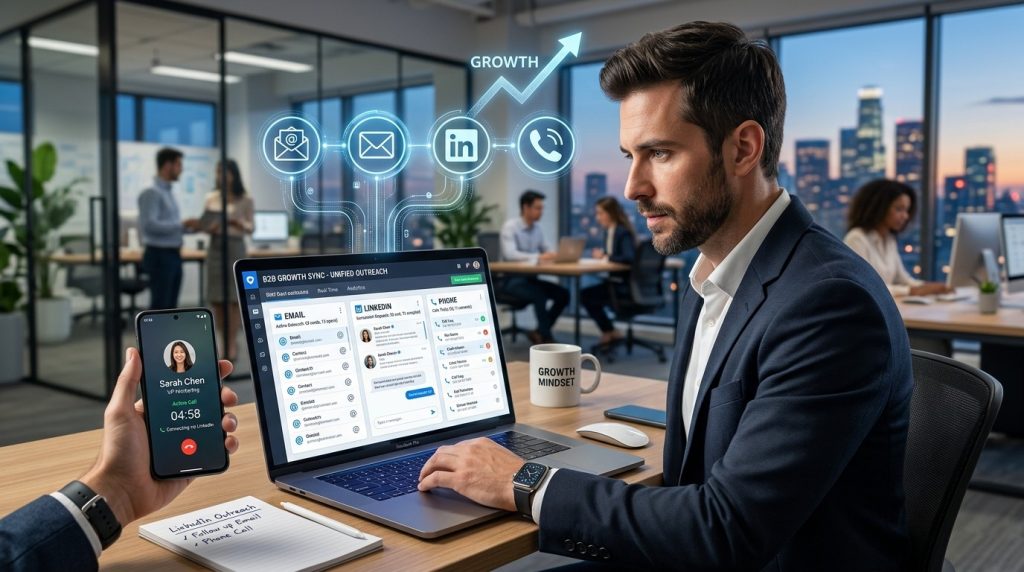
Sync email, LinkedIn, and phone outreach into one coordinated B2B system that improves relevance, trust, timing, personalization, sales productivity, pipeline visibility, and sustainable revenue growth.
B2B buyers rarely follow one predictable communication path. A prospect may see a company on LinkedIn, notice an email several hours later, receive a phone call days afterward, visit the website, and then return to LinkedIn before deciding whether to engage. This fragmented behavior creates both an opportunity and a challenge for sales teams.
The opportunity is obvious: multiple channels create multiple opportunities to become visible. The challenge is that disconnected channels can make a company appear repetitive, aggressive, or poorly organized.
This is why Sync Email LinkedIn and Phone has become such an important approach for modern B2B growth. The objective is not simply to communicate through three different channels. The objective is to make email, LinkedIn, and phone work together as one connected buyer experience.
When a salesperson sends an email, the next LinkedIn interaction should make sense. When a phone call follows, the salesperson should understand what has already happened. When a prospect replies, the automated sequence should adapt immediately. That consistency creates the feeling of one intelligent conversation instead of three separate campaigns.
Sync Email LinkedIn and Phone can be particularly effective for businesses with longer sales cycles, high customer value, multiple decision-makers, complex products, and trust-sensitive purchasing decisions.
The central principle is simple: every interaction should have a reason, every channel should have a role, and every prospect action should influence what happens next.
What Does Sync Email LinkedIn and Phone Mean?
Sync Email LinkedIn and Phone refers to the strategic coordination of three major B2B communication channels around one prospect, account, message, and sales objective.
Instead of operating email campaigns, LinkedIn outreach, and phone prospecting as separate activities, sales teams connect them through a common workflow.
A coordinated sequence might look like this:
- Identify an ideal account.
- Research the relevant decision-maker.
- Send a concise and relevant email.
- Review the prospect’s professional LinkedIn activity.
- Engage only where meaningful context exists.
- Make a phone call connected to the original message.
- Record the response.
- Adjust the next communication according to buyer behavior.
- Continue nurturing or move into a sales conversation.
Sync Email LinkedIn and Phone therefore represents an operating model rather than a simple software feature.
The strategy works because each channel performs a different job.
Email can deliver context and information.
LinkedIn can build familiarity and professional recognition.
Phone can create real-time dialogue.
When those functions are connected, each touchpoint strengthens the next.
Multichannel is not the same as synchronized
A business can technically use multiple channels and still have a poor strategy.
Imagine a salesperson sends five emails, makes three calls, and sends two LinkedIn messages without knowing what happened between those actions.
That is multichannel outreach, but it is not coordinated outreach.
Sync Email LinkedIn and Phone requires shared visibility.
The salesperson should know:
- what was sent
- what was opened or answered
- whether the prospect connected on LinkedIn
- whether a call was answered
- what the prospect said
- what objections appeared
- what action should happen next
The more complete the context, the more naturally the salesperson can communicate.
Why Synchronization Matters in B2B Growth
B2B decisions are usually driven by more than product features.
Prospects evaluate:
- credibility
- relevance
- business impact
- risk
- implementation effort
- expected return
- vendor confidence
- timing
- internal approval
- competitive alternatives
Sync Email LinkedIn and Phone allows these concerns to be addressed progressively.
An email can introduce the business problem.
LinkedIn can reinforce professional context.
A phone conversation can discover whether the problem actually exists.
A second email can provide evidence.
A later phone call can address implementation concerns.
This progressive communication reduces pressure because the buyer receives useful context rather than repeated pitches.
Familiarity reduces resistance
Cold communication often creates uncertainty.
The prospect may ask:
“Who is this person?”
“Why are they contacting me?”
“Do they actually understand our business?”
“Is this another generic sales pitch?”
Repeated but coordinated exposure can reduce some of that uncertainty.
When an email introduces the salesperson, LinkedIn establishes a professional identity, and a later phone call continues the same conversation, the prospect may experience greater familiarity.
Sync Email LinkedIn and Phone can therefore create continuity without requiring every interaction to be highly personalized.
Build One Prospect Record
The foundation of Sync Email LinkedIn and Phone is a unified prospect profile.
If the email platform stores one version of the prospect, the CRM stores another, and the salesperson separately tracks phone notes, synchronization will quickly break.
A central account record should contain relevant information.
| Information | Examples |
|---|---|
| Identity | Name, title, company |
| Contact Data | Email, business phone, LinkedIn |
| Account Data | Industry, size, location |
| Qualification | Role, fit, potential value |
| Intent | Interest, pain point, buying timing |
| Activity | Email, call, LinkedIn interactions |
| Response | Positive, negative, neutral, no response |
| Ownership | Salesperson, territory, account owner |
| Next Action | Call, email, nurture, meeting |
| Preferences | Opt-out or communication restrictions |
Sync Email LinkedIn and Phone becomes substantially easier when everyone works from one source of truth.
Standardize data fields
Data quality problems can cause major operational mistakes.
For example:
- duplicate contacts
- incorrect phone numbers
- obsolete email addresses
- missing account owners
- incomplete job titles
- multiple LinkedIn URLs
- outdated company information
Before launching a coordinated sequence, standardize the fields used by marketing, sales, and operations.
The purpose is not to create the largest database.
The purpose is to create a reliable communication record.
Define the Target Account Before Choosing Channels
Channel synchronization starts with targeting.
A sales team should define its ideal customer profile before building sequences.
Consider:
Industry: Which business categories have the strongest fit?
Company size: Which businesses have the economic capacity and operational need?
Role: Who owns the problem?
Revenue: Which accounts can realistically support the offer?
Growth stage: Which companies are experiencing the relevant challenge?
Geography: Where is the solution commercially viable?
Technology: What existing tools or systems indicate relevance?
Sync Email LinkedIn and Phone works better when every channel is focused on a clearly defined account universe.
Without good targeting, synchronization simply makes irrelevant outreach more efficient.
Map the B2B Buyer Journey
A useful buyer journey may include:
Awareness
The prospect recognizes a business issue.
Investigation
The prospect begins exploring possible solutions.
Comparison
Different approaches and providers are considered.
Validation
Internal stakeholders evaluate risks and benefits.
Decision
The organization chooses an option.
Implementation
The selected provider or solution is introduced.
The communication strategy should adapt to the stage.
Sync Email LinkedIn and Phone is strongest when the sequence helps buyers progress instead of repeatedly asking them to book a meeting.
Match communication to intent
A low-intent prospect may need education.
A medium-intent prospect may need proof.
A high-intent prospect may need a conversation.
This means the same channel can serve different purposes at different points in the journey.
Give Each Channel a Specific Job
The best Sync Email LinkedIn and Phone systems do not ask every channel to do everything.
Email is particularly useful for:
- detailed context
- insights
- case studies
- business observations
- follow-up summaries
- next-step information
LinkedIn can help with:
- professional familiarity
- relationship building
- social context
- credibility
- relevant engagement
- account research
Phone
Phone is particularly valuable for:
- real-time conversation
- qualification
- objection handling
- urgency discovery
- relationship development
- meeting confirmation
The channels work best when they complement one another.
Create a Coordinated Outreach Sequence
A practical sequence can be built around progressive value.
Day 1: Relevant email
Start with a business observation, problem, or opportunity.
Day 2: LinkedIn research and engagement
Review relevant activity and engage only where there is authentic context.
Day 4: Phone call
Use the original email as context rather than repeating the full pitch.
Day 6: Follow-up email
Introduce another useful insight, proof point, or business example.
Day 8: LinkedIn interaction
Continue professional engagement where appropriate.
Day 10: Phone follow-up
Use the accumulated context to make the conversation more specific.
Day 13: Value-based email
Address a likely objection or provide a useful resource.
Day 17: Final call
Offer a clear and respectful next step.
This structure should not be treated as a universal formula.
Timing depends on industry, deal value, buyer seniority, urgency, and communication norms.
Sync Email LinkedIn and Phone means adapting the sequence to the prospect rather than blindly applying one cadence.
Make Every Touchpoint Different
One of the fastest ways to create fatigue is to repeat the same message on every channel.
For example:
Email: “Can we schedule a call?”
LinkedIn: “Can we schedule a call?”
Phone: “I wanted to schedule a call.”
This creates no additional value.
A better sequence could be:
Email: identify a possible business challenge.
LinkedIn: demonstrate professional context.
Phone: ask whether that challenge is actually relevant.
Follow-up email: provide evidence.
Second call: discuss potential next steps.
Sync Email LinkedIn and Phone becomes powerful when each interaction introduces a new layer.
Build a Consistent Narrative
Although the communication format changes, the central message should remain coherent.
Suppose the offer helps companies improve sales productivity.
The email might discuss productivity loss.
LinkedIn engagement might relate to sales-team expansion.
The phone conversation might investigate rep efficiency.
The follow-up email could explain how similar organizations improved productivity.
The narrative remains consistent.
The prospect does not feel as though different departments are contacting them with unrelated stories.
That consistency is one of the most important benefits of Sync Email LinkedIn and Phone.
Personalize Around Business Relevance
Personalization should not exist merely to insert a first name.
Low-quality personalization:
“Hi Sarah, I saw your LinkedIn profile.”
Higher-quality personalization:
“I noticed your company is expanding its enterprise sales team into new markets. That kind of expansion often creates pressure around pipeline consistency and rep productivity.”
The second message gives the prospect a reason to care.
Sync Email LinkedIn and Phone should use personalization to demonstrate understanding rather than to decorate templates.
Three useful personalization levels
Level One: Account context
Industry, company size, market, location.
Level Two: Trigger context
Funding, expansion, leadership changes, hiring, partnerships, launches.
Level Three: Problem context
A specific challenge the business may plausibly be experiencing.
The deeper the relevance, the more valuable the interaction can become.
Use Email for Context, Not Just Promotion
Email gives salespeople more room to explain.
But that does not mean every email should be long.
A useful B2B email often contains:
- a relevant observation
- a business implication
- a concise reason for contacting
- one clear CTA
For example:
“You recently expanded your sales team across two markets. Teams making that transition often see inconsistent qualification and longer follow-up cycles. I wanted to ask whether that is becoming visible in your pipeline.”
That is conversational and diagnostic.
Sync Email LinkedIn and Phone becomes more effective when email creates a reason for the phone conversation.
Use LinkedIn as a Familiarity Layer
LinkedIn has a different communication culture from email.
A salesperson should generally avoid turning every professional interaction into a sales pitch.
Useful LinkedIn behaviors can include:
- following relevant people
- reading recent posts
- understanding professional interests
- engaging with genuinely relevant content
- recognizing role changes
- observing company developments
A salesperson may then reference relevant public information during an email or call.
Sync Email LinkedIn and Phone becomes stronger when LinkedIn helps the salesperson understand context.
Avoid artificial social activity
Excessive liking, generic comments, or automated-looking messages can reduce credibility.
Professional networks work best when engagement feels authentic.
The goal is not to create the illusion of a relationship.
The goal is to build a legitimate one.
Use Phone for Conversation
Phone is uniquely valuable because it allows immediate feedback.
Email can show whether a prospect responded.
LinkedIn can show engagement.
Phone can reveal:
- hesitation
- urgency
- confusion
- objections
- interest
- internal priorities
- timing
Sync Email LinkedIn and Phone should use phone conversations to gather information that improves subsequent messaging.
Prepare before every important call
Before calling, review:
- last email
- previous replies
- LinkedIn context
- company developments
- prior phone outcomes
- objections
- known priorities
- next desired outcome
A prepared call can sound natural without becoming scripted.
Create Shared Call Outcomes
After each call, record a standardized result.
Useful options include:
Connected — Qualified
Move toward a meeting or opportunity.
Connected — Needs More Information
Send targeted material.
Connected — Not Now
Set an appropriate future date.
Connected — Wrong Person
Research the correct stakeholder.
Connected — Not Relevant
Exit or reroute.
No Answer
Continue only if future contact is justified.
This structure allows the next channel to respond intelligently.
Sync Email LinkedIn and Phone depends on accurate activity data.
Connect Replies to Automation
Automation should react to buyer behavior.
For example:
Positive email reply → remove from automated sequence and assign human follow-up.
Meeting booked → suppress prospecting.
Negative response → stop sequence.
Unsubscribe → remove from marketing and sales communication according to policy.
Referral → assign appropriate owner.
High-intent signal → prioritize for sales review.
This dynamic approach is much better than letting static sequences continue regardless of what the prospect does.
Connect Outreach to Account-Based Sales
Large B2B opportunities require account-level thinking.
A company may have:
- a CEO
- a VP of Sales
- a marketing director
- an operations lead
- finance
- procurement
Each stakeholder has different concerns.
Sync Email LinkedIn and Phone can coordinate communication across the buying group while maintaining individual context.
Create stakeholder-specific narratives
For a CFO:
Focus on economic impact.
For a sales leader:
Focus on pipeline, conversion, productivity.
For marketing:
Focus on demand, acquisition efficiency, and campaign performance.
For operations:
Focus on workflow and implementation.
For executives:
Focus on strategic impact.
The company problem may remain the same while the business argument changes.
Determine the Right Channel Mix
Different prospects behave differently.
An executive might respond to a direct email and later accept a phone conversation.
A younger digital-native buyer might be more responsive on LinkedIn.
A traditional industry may rely more heavily on phone.
A warm referral may make email the easiest follow-up channel.
When assessing channel effectiveness, teams should look at the full business journey rather than isolated activity.
Sync Email LinkedIn and Phone gives sales leaders the flexibility to adjust channel emphasis by segment.
Measure Multi-Channel Outcomes
The evaluation should include:
- response
- conversation
- meetings
- qualified opportunities
- pipeline
- revenue
- acquisition cost
- win rate
- sales-cycle length
A channel may produce few direct replies while still increasing total conversion.
That is why Multi-Channel Outreach And ROI should be evaluated across the complete buying journey rather than judging each channel independently.
Build a Channel Strategy by Buyer Type
Consider a simple framework:
| Buyer Type | Phone | ||
|---|---|---|---|
| Executive | High | Medium | High |
| Sales Leader | High | High | High |
| Marketing Leader | High | High | Medium |
| Operations | High | Medium | High |
| Technical Buyer | High | Medium | Medium |
| Existing Customer | Medium | Medium | High |
These are starting assumptions rather than universal rules.
Actual results should drive optimization.
Sync Email LinkedIn and Phone becomes more efficient when channel usage reflects buyer preferences.
Capture Useful Buyer Information
Personalization improves when buyers voluntarily provide relevant preferences.
You might ask:
- What is your biggest growth priority?
- Which challenge is most urgent?
- What solution are you currently using?
- When are you considering a change?
- What type of resources would be useful?
This creates information that can improve future communication.
Zero-Party Data Collection can be especially useful because the information comes directly from the prospect instead of relying entirely on assumptions or inferred intent.
The key is to explain why the information is useful and avoid collecting unnecessary details.
Protect Privacy Across Channels
Synchronization should never become an excuse to ignore privacy expectations.
Email addresses, business phone numbers, professional profiles, and behavioral signals should be handled responsibly.
A good workflow includes:
- clear preference management
- appropriate data access
- accurate suppression lists
- limited retention
- secure storage
- transparent communication
- reasonable contact frequency
Sync Email LinkedIn and Phone should create better coordination, not more intrusive surveillance.
Respect channel expectations
Information being publicly visible does not automatically mean every use of that information is appropriate.
A public LinkedIn profile can provide professional context, but outreach should still remain relevant.
A business phone number allows professional communication, but not unlimited calling.
Respect creates trust.
Integrate Referral Activity Carefully
Referrals can improve response because they transfer an existing relationship into a new introduction.
But referral outreach should be clearly contextual.
The recipient should understand:
- who referred them
- why the introduction is relevant
- what company is contacting them
- why the conversation may be useful
- how to control future communication
Privacy-First Referral Funnels can help organizations introduce referred prospects without creating unnecessary confusion or aggressive follow-up behavior.
Sync Email LinkedIn and Phone can then continue the conversation after a legitimate introduction.
Prevent Over-Contacting
One of the most common B2B communication problems is internal duplication.
Marketing sends an email.
An SDR sends another email.
A second SDR sends a LinkedIn message.
The account executive calls.
The prospect then receives another automated sequence.
From the prospect’s perspective, this can look chaotic.
A shared CRM and ownership model can prevent that.
Set simple rules such as:
- one account owner
- one active outbound sequence
- immediate automation suppression after meaningful engagement
- clear transfer rules
- shared notes
Sync Email LinkedIn and Phone works only when the entire organization communicates from the same context.
Build a Unified Conversation Timeline
The ideal CRM timeline may look like:
Email → LinkedIn → Call → Email reply → Meeting → Follow-up
This timeline makes the entire relationship visible.
A new salesperson can understand the account quickly.
Managers can audit execution.
Marketing can identify messaging patterns.
Operations can identify process problems.
Sync Email LinkedIn and Phone becomes scalable when conversation history stays centralized.
Introduce Lead and Account Scoring
Scoring can help prioritize effort.
Example model:
| Signal | Example Points |
|---|---|
| ICP fit | +15 |
| Relevant role | +10 |
| Company trigger | +10 |
| Email engagement | +5 |
| Meaningful LinkedIn engagement | +5 |
| Positive response | +25 |
| Meeting request | +40 |
| Wrong person | -20 |
| Explicit opt-out | -50 |
Scores should support prioritization, not replace human judgment.
A high score means the account deserves attention.
It does not guarantee that the prospect is ready to buy.
Sync Email LinkedIn and Phone performs best when scoring and human interpretation work together.
Use Intent Signals Carefully
Not all engagement signals are equal.
A LinkedIn reaction is weak.
An email reply is stronger.
A product page visit can be meaningful.
A direct request for pricing is much stronger.
Repeated engagement across channels can provide a better indication than any individual activity.
The key is signal combination.
Sync Email LinkedIn and Phone can bring these signals together so sales teams can understand the overall engagement pattern.
Build Trigger-Based Sequences
Timing often matters as much as messaging.
Useful B2B triggers include:
- funding
- leadership changes
- market expansion
- hiring
- acquisitions
- new product launches
- partnerships
- major technology changes
- regulatory developments
Suppose a company announces expansion into three new regions.
The sales team could:
Email: Mention the expansion and a related business challenge.
LinkedIn: Engage with the announcement if appropriate.
Phone: Ask how the expansion affects current operations.
Follow-up: Share relevant evidence or a customer example.
The trigger creates a legitimate reason for the conversation.
Sync Email LinkedIn and Phone becomes much stronger when Best Channel Mix for Sales Outreach aligns with real business events.
Handle Non-Responses Correctly
No response does not necessarily mean no interest.
The prospect may simply be busy.
However, repeated generic follow-ups rarely solve that problem.
A strong follow-up adds a reason to continue.
Instead of:
“Just checking in.”
Try:
“I wanted to share one benchmark because it may help you assess whether the issue I mentioned is relevant to your current growth plan.”
That gives the prospect something useful.
Sync Email LinkedIn and Phone should treat non-response as uncertainty rather than automatic rejection.
Build Re-Engagement Paths
Not every cold prospect should stay in an aggressive sequence.
After enough inactivity, reduce frequency.
Then re-engage when a meaningful trigger appears.
Examples include:
- company expansion
- new executive
- new funding
- product launch
- market change
- new content
- relevant event
This creates a more sustainable approach.
Sync Email LinkedIn and Phone should include a clear transition between active prospecting and longer-term nurturing.
Coordinate With Marketing
Marketing and sales should share information.
Marketing can provide:
- account insights
- content
- event information
- intent signals
- customer stories
- industry research
Sales can provide:
- objections
- buyer questions
- lost-deal reasons
- messaging feedback
- market language
- common pain points
This feedback loop improves communication quality.
Sync Email LinkedIn and Phone becomes stronger when sales and marketing operate from the same buyer understanding.
Use Content as a Communication Bridge
Content can connect multiple channels.
For example:
Email: Highlight an operational challenge.
LinkedIn: Share a relevant industry insight.
Phone: Ask how the issue affects the prospect.
Email: Send a practical framework.
LinkedIn: Continue professional engagement.
The content makes communication useful rather than promotional.
The salesperson becomes a source of insight rather than simply another seller.
Create Role-Based Messaging Frameworks
Different job roles require different business reasons.
CEO or Founder
Focus on:
- growth
- strategic advantage
- efficiency
- revenue
- risk
Sales Leader
Focus on:
- pipeline
- conversion
- sales productivity
- forecasting
Marketing Leader
Focus on:
- demand
- acquisition
- campaign efficiency
- attribution
Operations Leader
Focus on:
- workflow
- consistency
- productivity
- implementation
Finance Leader
Focus on:
- cost
- efficiency
- return
- risk
Sync Email LinkedIn and Phone works better when communication reflects the recipient’s actual responsibilities.
Build Industry-Specific Sequences
A technology company and a manufacturing company may have completely different buying environments.
Technology buyers may respond to:
- productivity
- integration
- scalability
- innovation
Manufacturing buyers may prioritize:
- efficiency
- reliability
- operational continuity
- cost
Professional services may prioritize:
- expertise
- reputation
- relationship quality
Industry-specific language can therefore improve relevance.
Create an Executive Dashboard
Leadership should be able to evaluate the system without reviewing individual messages.
Important metrics include:
- accounts contacted
- contacts engaged
- conversations
- meetings
- qualified opportunities
- pipeline value
- revenue
- conversion rate
- sales-cycle length
- customer acquisition cost
The dashboard should make channel comparisons possible while preserving the overall view.
Sync Email LinkedIn and Phone should ultimately be judged by business outcomes rather than activity volume.
Track Sequence Performance
Consider two sequences.
Sequence A
Email reply rate: 10%
Phone connect rate: 5%
Meetings: 3 per 100 prospects
Sequence B
Email reply rate: 7%
Phone connect rate: 9%
Meetings: 7 per 100 prospects
Sequence B may be significantly stronger even though its email response rate is lower.
This is why channel-level metrics need to connect to sales outcomes.
Sync Email LinkedIn and Phone should optimize for progression, not vanity metrics.
Test the Psychology of Messaging
Do not test only subject lines.
Test different buyer motivations.
Efficiency
“Reduce wasted sales effort.”
Growth
“Create more qualified pipeline.”
Risk
“Reduce dependence on one acquisition channel.”
Competitive advantage
“Improve sales execution as competitors accelerate.”
Simplicity
“Remove friction from your sales workflow.”
Different buyers respond to different motivations.
Sync Email LinkedIn and Phone should allow messaging to evolve according to segment performance.
Automate Repetitive Work
Automation is valuable for:
- reminders
- task creation
- sequence timing
- CRM updates
- routing
- status changes
- reporting
- suppression
But human decisions should remain central for:
- high-value accounts
- unusual objections
- important negotiations
- complex business cases
- sensitive interactions
The goal is not maximum automation.
The goal is maximum productivity without losing human judgment.
Know What Should Never Continue Automatically
Certain events should change the workflow immediately.
Meeting booked
Stop prospecting automation.
Positive reply
Move to human follow-up.
Explicit opt-out
Stop relevant outreach according to policy.
Wrong contact
Update ownership or routing.
Serious objection
Route to a salesperson.
Strategic opportunity
Elevate account priority.
Sync Email LinkedIn and Phone becomes intelligent when the system responds to these events.
Train Salespeople on Context
Salespeople should not only learn how to send messages.
They should learn how to interpret the complete interaction history.
Before calling, the salesperson should know:
“What have we already said?”
“What did the buyer do?”
“What problem might matter?”
“What is the likely next question?”
“What should this conversation accomplish?”
This creates more natural conversations.
Sync Email LinkedIn and Phone is therefore partly a technology strategy and partly a sales training strategy.
Create a Daily Operating Rhythm
A practical salesperson workflow could include:
Morning: Review account signals and active conversations.
First work block: Handle high-priority personalized outreach.
Second block: Conduct priority phone calls.
Midday: Respond to conversations.
Afternoon: Run follow-up calls and meetings.
End of day: Update CRM and establish next actions.
This rhythm prevents digital work from becoming disconnected from phone activity.
Prioritize Accounts Intelligently
Not every prospect deserves identical effort.
| Fit | Intent | Effort |
|---|---|---|
| High | High | Maximum |
| High | Low | Medium |
| Low | High | Qualification |
| Low | Low | Minimal |
A high-fit, high-intent account may justify deeply personalized email, LinkedIn context, and direct phone contact.
A low-fit, low-intent prospect may belong in light nurture instead.
Sync Email LinkedIn and Phone works best when human attention is allocated according to potential value.
Improve Data Quality Continuously
Data becomes outdated quickly.
Companies change.
People change roles.
Phone numbers change.
Email addresses become inactive.
LinkedIn profiles update.
Regular cleansing should therefore be part of the operating system.
Remove duplicates.
Update roles.
Verify contact information.
Archive irrelevant records.
Maintain suppression lists.
Sync Email LinkedIn and Phone depends on current information to deliver relevant communication.
Protect the Brand
Every outbound message contributes to brand perception.
Poor outreach can make a high-quality company look careless.
A professional workflow therefore needs:
- consistent messaging
- correct names
- accurate company information
- respectful follow-up
- sensible frequency
- fast response to objections
- clear opt-out handling
The salesperson is not merely selling.
The salesperson is representing the company.
Build a Respectful Contact Policy
Create explicit guidelines for:
- frequency
- working hours
- channel transitions
- opt-outs
- follow-up limits
- personal versus professional information
- escalation
- consent and preference management
This makes execution more consistent.
Sync Email LinkedIn and Phone should always preserve the prospect’s ability to control communication.
Common Mistakes to Avoid
Using identical messaging across all channels
This produces repetition instead of reinforcement.
Making too many contacts too quickly
Frequency without relevance creates fatigue.
Calling without reviewing context
This makes the conversation feel disconnected.
Treating LinkedIn like an email inbox
Professional networking and direct sales communication are not identical.
Measuring only email opens
Activity metrics do not equal commercial results.
Ignoring negative signals
A synchronized system must respond to objections and opt-outs.
Using excessive automation
Automation can improve consistency, but excessive automation can destroy authenticity.
Collecting unnecessary personal information
Data should have a clear business purpose.
Allowing multiple salespeople to contact the same account
Ownership and account coordination are essential.
Scaling before testing
A poor process becomes more expensive when automated.
Build a 30-Day Implementation Plan
Days 1–5: Audit
Review:
- CRM
- email processes
- LinkedIn workflows
- phone activity
- data quality
- current sequences
Identify duplication and gaps.
Days 6–10: Define targeting
Create:
- ICP
- personas
- account tiers
- triggers
- qualification criteria
Days 11–15: Build the data foundation
Standardize:
- contact fields
- activity fields
- ownership
- stages
- suppression rules
Days 16–20: Build sequences
Create coordinated email, LinkedIn, and phone workflows.
Keep the first version focused.
Days 21–25: Train
Teach:
- contextual outreach
- calls
- personalization
- CRM updates
- objection handling
- channel transitions
Days 26–30: Pilot
Start with a controlled account set.
Measure:
- engagement
- conversations
- meetings
- opportunities
- data quality
- negative signals
- sales feedback
Then optimize.
Build a Pilot Before Scaling
A smaller pilot provides better learning.
Choose perhaps one industry, one persona, and one account tier.
This makes it easier to identify:
- which messages work
- which channels contribute
- where prospects disengage
- where automation fails
- where data is incomplete
Once the process is reliable, expand.
Sync Email LinkedIn and Phone should scale from proven behavior, not assumptions.
Advanced Strategy: Dynamic Sequences
Static sequences treat every prospect equally.
Dynamic sequences adapt.
For example:
Prospect replies positively → salesperson takes over.
Prospect engages repeatedly → priority increases.
Prospect shows no engagement → frequency decreases.
Company trigger appears → sequence is refreshed.
Meeting is scheduled → outbound automation stops.
This creates a more intelligent workflow.
Advanced Strategy: Account-Based Orchestration
For strategic accounts, coordinate contacts across the buying committee.
For example:
The VP of Sales receives a business-performance message.
The marketing leader receives a demand-generation message.
The operations leader receives an efficiency message.
The executive receives a strategic summary.
Every message is different but connected to the same account objective.
Sync Email LinkedIn and Phone becomes an account orchestration framework instead of a single-contact sequence.
Advanced Strategy: Customer Expansion
Synchronization does not have to stop after acquisition.
Existing customers may receive:
- renewal communication
- upsell messaging
- cross-sell opportunities
- customer success calls
- LinkedIn relationship activity
- executive outreach
This transforms the model from pure prospecting into lifecycle communication.
Advanced Strategy: Referral and Advocacy
Satisfied customers can become introduction sources.
The business can ask:
“Who else on your network faces a similar challenge?”
Once the introduction is made, coordinated email, LinkedIn, and phone communication can create a smoother transition.
The important principle remains consent, relevance, and context.
Use Social Proof Carefully
Proof can reduce uncertainty.
Useful examples include:
- customer outcomes
- industry benchmarks
- case studies
- expert insights
- implementation stories
Do not overload early outreach with proof.
One highly relevant example can be more powerful than five generic statistics.
Sync Email LinkedIn and Phone should use social proof to answer specific buyer concerns.
Make Follow-Ups More Valuable
A follow-up should ideally introduce at least one of these:
- new evidence
- new insight
- relevant benchmark
- helpful resource
- specific observation
- answer to an objection
A message that simply asks again for attention contributes little.
A message that reduces uncertainty contributes value.
Improve Conversation Quality
The ultimate purpose of synchronization is not more touches.
It is better conversations.
A useful phone call may uncover:
- current process
- internal priorities
- implementation constraints
- timeline
- budget
- decision-makers
- existing alternatives
That information improves the next communication.
Sync Email LinkedIn and Phone therefore creates a learning loop.
Each interaction improves the next.
Build Feedback From Sales Back Into Messaging
When salespeople repeatedly hear:
“We already have a solution.”
or
“We are not ready because implementation is difficult.”
or
“Budget is the main problem.”
those objections should influence future messaging.
The marketing and sales team can then update:
- email narratives
- LinkedIn content
- call scripts
- case studies
- qualification questions
This closes the loop between real conversations and campaign strategy.
How to Scale Without Becoming Generic
Scale through structure, not repetition.
Create:
- segment-specific templates
- trigger libraries
- personalization fields
- role-specific messaging
- account tiers
- channel rules
- dynamic outcomes
Then give salespeople room to personalize where account value justifies it.
Sync Email LinkedIn and Phone can support high-volume sales without forcing every prospect into exactly the same conversation.
Measure the Economics
A strong B2B operation should calculate:
Meeting Conversion Rate
Meetings ÷ contacted prospects.
Opportunity Rate
Qualified opportunities ÷ meetings.
Win Rate
Closed deals ÷ opportunities.
Revenue per Account
Revenue ÷ acquired accounts.
Acquisition Cost
Total acquisition expense ÷ new customers.
Sales Velocity
Rate at which qualified opportunities become revenue.
The purpose of these measures is to identify where the system creates economic value.
Sync Email LinkedIn and Phone should ultimately improve sales productivity and revenue efficiency.
Evaluate the Customer Experience
Ask the following:
Does the prospect understand why we are contacting them?
Does every new interaction add context?
Can the salesperson see the previous conversation?
Does the next message make sense?
Do we stop when the buyer asks us to?
Are our messages relevant?
Do we respect privacy and preferences?
Can the prospect clearly identify who is contacting them?
These questions reveal whether the strategy works from the buyer’s perspective.
A Complete Synchronization Checklist
Before launching, verify that:
- email and CRM data are connected
- LinkedIn context is visible to salespeople
- phone activity is recorded
- account ownership is clear
- message narratives are consistent
- each channel has a defined role
- follow-ups add value
- automated sequences respond to buyer actions
- meetings suppress prospecting
- opt-outs stop inappropriate communication
- personalization uses relevant information
- channel frequency is controlled
- data is maintained accurately
- marketing and sales share feedback
- performance is measured through business outcomes
Sync Email LinkedIn and Phone should become an operating discipline rather than a temporary campaign.
The Strategic Advantage of Synchronization
The strongest advantage of Sync Email LinkedIn and Phone is not simply that a buyer sees more messages.
It is that the buyer experiences a more continuous relationship.
The salesperson can remember what happened.
Marketing can understand what sales learned.
The CRM can preserve the account history.
Automation can react to behavior.
Management can identify profitable sequences.
The prospect can receive communication that feels connected.
That combination creates a more mature B2B growth system.
Final Takeaway
B2B buyers do not experience your automation platform, CRM architecture, internal workflow, or channel strategy. They experience people, conversations, messages, calls, timing, and trust.
That is why synchronization should always be evaluated from the buyer’s perspective.
Does the message feel relevant?
Does the phone call make sense after the email?
Does LinkedIn reinforce credibility without becoming spam?
Does the salesperson remember the last interaction?
Does the business respect the prospect’s preferences?
Does each touchpoint move the conversation forward?
When those questions have strong answers, Sync Email LinkedIn and Phone becomes more than a multichannel tactic.
It becomes a coordinated B2B growth system.
The strongest teams will not win because they send the largest number of messages. They will win because they understand context, timing, intent, channel behavior, and human psychology.
They will know when to email.
They will know when to engage professionally on LinkedIn.
They will know when a phone call adds value.
They will know when to stop.
And they will know how to turn information from one interaction into a better next interaction.
That is the real strategic power of Sync Email LinkedIn and Phone.
Conclusion
Sync Email LinkedIn and Phone creates a connected B2B communication system where email, LinkedIn, and phone support one unified buyer journey. The strongest approach combines reliable data, clear targeting, role-based messaging, intelligent timing, useful personalization, privacy-aware processes, and dynamic follow-up rules. Email provides context, LinkedIn creates professional familiarity, and phone enables real conversation. The goal should never be to maximize contact volume. Instead, businesses should maximize relevance, trust, conversation quality, qualified opportunities, and revenue efficiency. With centralized account visibility and continuous optimization, Sync Email LinkedIn and Phone can help sales teams reduce repetition, improve productivity, strengthen relationships, and create a more consistent path from first touch to closed business.
Frequently Asked Questions (FAQ)
What is Sync Email LinkedIn and Phone?
Sync Email LinkedIn and Phone is a B2B outreach approach that coordinates email, LinkedIn, and phone communication around the same prospect, account, message, and sales objective.
Why is Sync Email LinkedIn and Phone important for B2B sales?
Sync Email LinkedIn and Phone can improve continuity because salespeople can coordinate timing, messaging, activity history, and follow-ups instead of treating each channel as an independent campaign.
Does using three channels guarantee better sales results?
No. More channels do not automatically mean better performance. The channels must be coordinated, relevant to the buyer, and measured according to business outcomes.
Which channel should a B2B salesperson use first?
There is no universal starting channel. The correct first channel depends on account value, buyer preferences, urgency, available context, industry behavior, and relationship strength.
How does Sync Email LinkedIn and Phone reduce repetitive outreach?
A centralized activity history helps salespeople see previous communication. This makes it easier to avoid sending the same message repeatedly or contacting prospects through several disconnected workflows.
How should LinkedIn support B2B outreach?
LinkedIn can provide professional context, relationship-building opportunities, company insights, and credibility. It should support the broader strategy rather than become another place for repetitive sales messages.
How can phone calls be improved through synchronization?
Salespeople can review previous emails, LinkedIn context, account information, objections, and previous call outcomes before dialing. This allows the conversation to be more contextual and relevant.
How much personalization should B2B outreach use?
Personalization should focus primarily on meaningful business relevance. Account context, role, triggers, and plausible business problems are generally more useful than superficial details.
How can businesses protect privacy while synchronizing multiple channels?
Businesses should collect relevant information responsibly, maintain accurate preferences and suppression rules, control data access, avoid unnecessary data collection, and respect channel expectations and communication restrictions.
What is the most important metric for synchronized outreach?
The most important measurement is the business outcome generated by the complete process, including qualified conversations, meetings, opportunities, pipeline, revenue, acquisition efficiency, win rate, and customer quality.