Multi-Channel Outreach And ROI Ultimate Guide
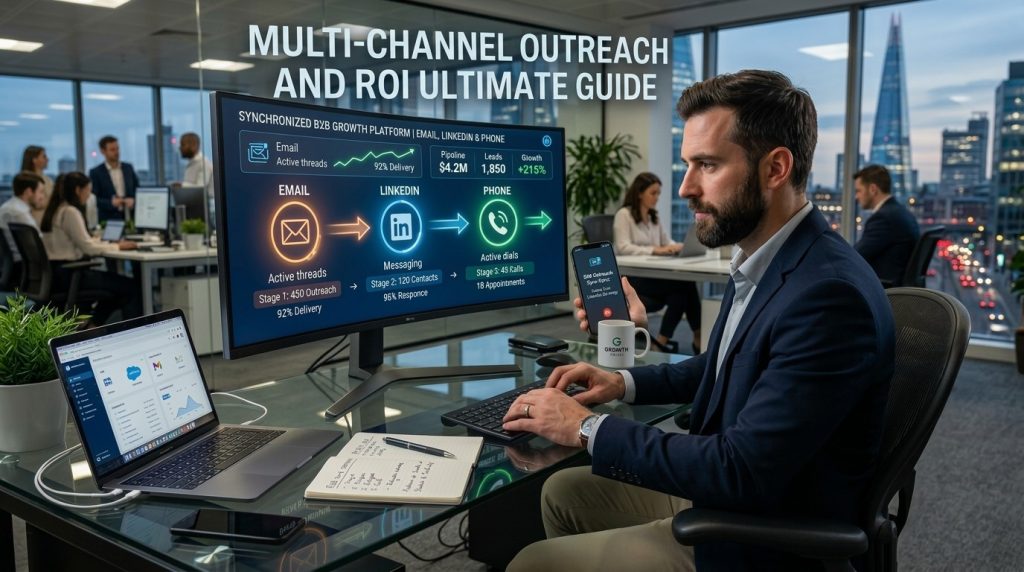
Multi-channel outreach works when channels reinforce one another, customer intent guides timing, and ROI connects every interaction to qualified pipeline, revenue, and sustainable sales efficiency.
Sales outreach has changed dramatically. Buyers can discover a company through search, social media, communities, referrals, events, creators, email, or professional networks before they ever speak with a salesperson. They may read a message in the morning, notice a LinkedIn interaction later, receive a follow-up email the next day, and finally answer a phone call after several other touchpoints. Because modern buyers move across multiple environments, evaluating Multi-Channel Outreach And ROI requires more than counting emails sent or calls completed.
The fundamental purpose of outreach is not to create activity. It is to create movement toward a commercial outcome.
That movement can begin with awareness, continue through recognition, develop into engagement, and eventually become a qualified sales conversation. Each communication channel can support a different psychological step. Email can introduce an idea. LinkedIn can establish professional context. Phone can create immediate dialogue. Social content can reinforce familiarity. A referral can remove uncertainty. A carefully timed follow-up can turn passive awareness into active consideration.
The challenge is that adding channels also adds complexity. More channels require more coordination, more data, more testing, more attribution discipline, and more careful frequency management. Without those controls, an organization can increase outreach volume while actually decreasing efficiency.
Understanding Multi-Channel Outreach And ROI therefore requires a framework that connects channel selection, message quality, buyer psychology, timing, operational effort, attribution, and revenue outcomes.
This ultimate guide explains how to build that framework from the ground up.
What Multi-Channel Outreach Actually Means
Multi-channel outreach is a coordinated sales communication strategy that uses more than one channel to reach the same target audience or account.
The important word is coordinated.
Sending an email, a LinkedIn message, and a phone call does not automatically create a strong strategy. Those actions become true multi-channel outreach when they share a common objective and communicate with the prospect as part of one continuous buyer journey.
A useful Multi-Channel Outreach And ROI strategy recognizes that channels perform different jobs.
Email is usually strong for structured information and asynchronous follow-up.
Phone is useful for immediate dialogue, qualification, objection discovery, and relationship development.
LinkedIn provides professional context and can make a salesperson more recognizable before a direct conversation.
Social content can create familiarity before the salesperson asks for attention.
Messaging channels can support ongoing communication when the prospect has shown sufficient willingness to engage.
Events, communities, webinars, and referrals can introduce credibility that cold outreach alone may not create.
The goal is not to use every available platform.
The goal is to determine which combination helps the buyer move from unfamiliarity to trust and then toward action.
That distinction is central to Multi-Channel Outreach And ROI because channel count itself has no economic value. Results matter.
Why One-Channel Outreach Often Breaks Down
Single-channel strategies have a structural weakness: they depend on one communication environment.
A prospect may rarely answer unknown calls. Another may ignore cold emails. Someone else may use LinkedIn every day but treat direct messages with caution.
Even when a prospect is interested, timing can still cause a channel failure.
A relevant email may arrive during a busy meeting. A phone call may happen while the prospect is traveling. A LinkedIn request may appear while hundreds of notifications compete for attention.
Multi-channel sequencing creates additional opportunities for a relevant message to be noticed.
However, Multi-Channel Outreach And ROI should never be interpreted as “contact prospects more often.” The objective is to create better opportunities to communicate.
Consider two scenarios.
In the first, a salesperson sends five generic emails.
In the second, the salesperson sends one relevant email, engages with a prospect’s professional content, makes a contextual phone call, and follows up with a useful resource.
The second sequence may involve fewer total touches while creating substantially better engagement.
The difference is coordination.
The Psychology Behind Multi-Channel Outreach

Every sales interaction creates a psychological reaction.
A prospect unconsciously asks:
“Why is this person contacting me?”
“Is this relevant to my current priorities?”
“Do I trust this company?”
“How much effort will this conversation require?”
“Will responding create more work?”
“Is the proposed outcome worth my time?”
A strong Multi-Channel Outreach And ROI approach answers these questions progressively instead of forcing every channel to deliver the complete sales argument immediately.
This matters because human attention is selective.
People do not evaluate every message equally. They rapidly filter information based on relevance, familiarity, perceived risk, social proof, timing, and effort.
A useful email can reduce uncertainty.
A credible case study can reduce perceived risk.
A professional interaction can increase familiarity.
A phone conversation can uncover hidden objections.
A well-timed follow-up can reduce procrastination.
Each touchpoint can therefore perform a different psychological function.
Familiarity
Repeated but relevant exposure can make a company feel more recognizable.
Credibility
Evidence, expertise, customer outcomes, and professional context can strengthen confidence.
Relevance
A message connected to a current business problem is more likely to receive attention.
Reciprocity
Useful information can create a natural reason to continue the conversation.
Commitment
Small interactions can gradually make larger actions feel easier.
Risk Reduction
Clear expectations, examples, proof, and transparent communication reduce uncertainty.
A sophisticated Multi-Channel Outreach And ROI model uses these psychological principles without manipulating the prospect. The goal is to reduce friction and improve decision quality.
Start With the Customer Journey
Before deciding which channels to use, map how your buyers typically move from problem recognition to purchase.
Ask:
Where do they discover solutions?
How do they research vendors?
Whose opinions influence them?
Where do they ask questions?
Who participates in the decision?
What objections appear?
What creates urgency?
What causes deals to stall?
This research creates the foundation for Multi-Channel Outreach And ROI because channel selection should reflect the actual journey.
For example, an enterprise software buyer may require research, internal discussions, demonstrations, technical validation, financial review, legal approval, and executive sign-off.
A small business purchasing a simple service may need only a few steps.
Using the same outreach architecture for both audiences wastes effort.
Defining the Ideal Customer Profile
A strong multi-channel strategy begins with a clear ideal customer profile.
Your ICP should describe more than company size.
Consider:
| ICP Dimension | Questions to Answer |
|---|---|
| Industry | Which sectors experience the problem most strongly? |
| Company size | Which organizations have sufficient need and budget? |
| Role | Who experiences the problem directly? |
| Decision authority | Who influences or approves the purchase? |
| Business model | What operating model affects the solution? |
| Geography | Where are buyers located? |
| Technology | What systems influence their needs? |
| Trigger events | What causes urgency? |
| Budget | What economic threshold supports the offer? |
| Buying stage | Are they unaware, researching, comparing, or ready? |
The more precise the ICP, the easier it becomes to build Multi-Channel Outreach And ROI around high-potential accounts.
Poor targeting creates a false impression that channels are underperforming when the real problem is audience quality.
Choosing the Right Channels
There is no universal channel combination.
However, most sales organizations evaluate several core options.
Email remains powerful because it is scalable, asynchronous, and relatively easy to measure.
The best sales emails focus on one relevant problem and one clear next step.
They avoid unnecessary introductions, inflated claims, and long company histories.
Phone
Phone is valuable when the sales process benefits from dialogue.
Its unique advantage is speed. A call can reveal urgency, objections, authority, and fit within minutes.
For Multi-Channel Outreach And ROI, phone should be evaluated by qualified opportunities and revenue contribution rather than raw call volume.
LinkedIn can help salespeople research prospects, understand professional context, engage with relevant content, and establish familiarity.
A common mistake is treating LinkedIn as another place to paste the same email script.
The strongest use is contextual.
Messaging Platforms
Messaging can be highly responsive but also highly personal.
It is generally more appropriate when there is an existing relationship, explicit permission, or a business context where messaging is expected.
Communities and Events
Industry communities, conferences, webinars, associations, and professional groups can create warmer forms of attention.
They can be especially useful when trust and expertise are central to the buying process.
Social Content
Organic content can support direct outreach by building familiarity before a salesperson starts a conversation.
This is particularly relevant when buyers research a person or company before responding.
Building the Best Channel Mix
The right combination depends on audience behavior, offer complexity, buying cycle, and sales capacity.
A practical approach is to start with two or three primary channels and expand only when evidence supports expansion.
For example:
| Business Situation | Primary Channels |
|---|---|
| Fast-moving SMB sale | Email + Phone |
| Professional service | Email + LinkedIn + Phone |
| Enterprise solution | Email + LinkedIn + Phone + Events |
| Community-driven market | Social + Community + Email |
| Warm referral-led sale | Email + Phone + Meeting |
| Long nurture cycle | Content + Email + LinkedIn |
A company looking for the Best Channel Mix for Sales Outreach should resist the temptation to copy another company’s sequence without understanding the underlying buyer behavior.
What works for a venture-backed SaaS company may not work for a professional consulting firm.
Creating Channel Roles
One of the most important principles in Multi-Channel Outreach And ROI is assigning every channel a job.
Do not ask every channel to sell.
Instead, define roles.
Email may create the opening.
LinkedIn may create recognition.
Phone may qualify.
Content may educate.
A webinar may demonstrate expertise.
A referral may establish trust.
An executive conversation may remove commercial barriers.
A meeting may move the opportunity into a structured evaluation.
When each channel has a distinct purpose, the sequence feels intentional rather than repetitive.
How to Sync Email, LinkedIn, and Phone
The customer should experience one conversation, not three unrelated campaigns.
When teams Sync Email LinkedIn and Phone properly, they create continuity.
Imagine an outreach sequence:
Day 1: A personalized email introduces a relevant challenge.
Day 2: The salesperson interacts with a relevant LinkedIn post.
Day 4: A phone call references the business issue from the email.
Day 6: A follow-up email provides a useful resource.
Day 9: Another call seeks to understand timing.
The important part is not the schedule itself. The important part is that each interaction builds on previous context.
A prospect should never feel as though three separate automation systems are fighting for attention.
This coordination improves Multi-Channel Outreach And ROI because the organization gets more value from every interaction.
Personalization That Actually Works
Personalization is frequently misunderstood.
Adding a prospect’s first name is basic personalization.
Mentioning the prospect’s company is slightly better.
Connecting the message to a recent business development is more meaningful.
The strongest personalization explains why the prospect is relevant to the solution.
For example, instead of saying:
“I noticed your company is growing.”
A better message might explain how a specific type of growth creates a particular operational challenge.
Useful personalization should answer:
Why this company?
Why this person?
Why now?
Why this problem?
Why should they care?
That logic is essential to Multi-Channel Outreach And ROI because irrelevant personalization only creates the appearance of effort.
Message-Market Relevance
Your message should match the level of awareness.
An unaware prospect needs context.
A problem-aware prospect needs diagnosis.
A solution-aware prospect needs differentiation.
A decision-ready prospect needs confidence.
Using a pricing-heavy message with an unaware audience usually creates friction.
Using a basic educational message with a buyer already comparing vendors can feel unhelpfully vague.
The best Multi-Channel Outreach And ROI strategy changes the message as the buyer advances.
Designing Outreach Sequences
A sequence should be long enough to create reasonable visibility but short enough to preserve relevance.
A simple framework might be:
Touch 1: Problem Recognition
Introduce a specific issue relevant to the prospect.
Touch 2: Professional Context
Use social or LinkedIn engagement to increase familiarity.
Touch 3: Direct Conversation
Use phone or another appropriate live channel.
Touch 4: Evidence
Provide proof such as a case study, benchmark, framework, or insight.
Touch 5: Objection Reduction
Address a common concern.
Touch 6: Clear Next Step
Make the requested action easy.
The sequence should not repeat the same pitch six times.
Every touch should contribute something new.
The Importance of Timing
Timing changes results.
A highly relevant message can fail if delivered at the wrong moment.
Relevant timing signals can include:
- New leadership
- Funding
- Product launch
- Expansion
- Hiring
- Regulatory changes
- New technology adoption
- Market disruption
- Seasonal demand
- Competitive pressure
- Publicly announced strategic priorities
These events can create urgency.
The Best Channel Mix for Sales Outreach becomes stronger when channel timing is tied to business context rather than random intervals.
Trigger-Based Outreach
Trigger-based outreach uses observable events to decide when to contact a prospect.
For example, if a company suddenly hires ten sales representatives, a sales enablement provider may have a relevant reason to reach out.
If a business opens new locations, a marketing agency may identify a need for scalable customer acquisition.
If a company changes technology infrastructure, implementation services may become more relevant.
Trigger-based outreach improves Multi-Channel Outreach And ROI because relevance can increase without requiring excessive personalization.
Attribution: The Hardest Part of ROI
Attribution is one of the most difficult components of multi-channel measurement.
Suppose a prospect receives an email, views LinkedIn content, attends a webinar, visits the website, speaks with a salesperson, and then purchases.
Which channel deserves credit?
The answer depends on your attribution model.
First-Touch Attribution
Gives credit to the initial interaction.
Useful for understanding discovery.
Last-Touch Attribution
Credits the final interaction before conversion.
Useful for identifying conversion assists but potentially misleading when used alone.
Linear Attribution
Distributes credit across interactions.
Useful for understanding multi-touch journeys.
Position-Based Attribution
Gives more weight to first and last interactions while distributing remaining credit among middle touches.
Data-Driven Attribution
Uses observed conversion patterns to estimate the contribution of interactions.
No attribution model is perfect.
Therefore, Multi-Channel Outreach And ROI should not depend on a single number viewed without context.
Measuring the Economics of Outreach
A useful ROI framework connects effort to commercial outcomes.
Basic ROI can be expressed as:
ROI = (Revenue Attributed to Outreach − Outreach Cost) ÷ Outreach Cost
However, this simple equation is only a starting point.
Outreach cost can include:
- Sales salaries
- Tools
- Data providers
- Automation software
- Calling platforms
- Content production
- Research time
- Management time
- Training
- Creative resources
- Opportunity cost
Revenue also needs careful definition.
Closed-won revenue is stronger than projected pipeline.
Gross margin can be more meaningful than top-line revenue for some businesses.
Customer lifetime value may matter more than first-year revenue for subscription companies.
The more mature the organization, the more sophisticated Multi-Channel Outreach And ROI measurement should become.
Activity Metrics Versus Outcome Metrics
Activity metrics include:
- Emails sent
- Calls made
- LinkedIn touches
- Meetings booked
- Follow-ups completed
Outcome metrics include:
- Positive replies
- Qualified meetings
- Sales opportunities
- Pipeline generated
- Win rate
- Revenue
- Customer acquisition cost
- Payback period
Activity metrics tell you what the team did.
Outcome metrics tell you what happened.
Both matter.
But when Multi-Channel Outreach And ROI decisions are being made, outcome metrics should receive greater strategic weight.
A team can double calls and still reduce revenue if targeting and messaging deteriorate.
Measuring Channel Efficiency
A useful channel metric is:
Qualified Opportunities ÷ Sales Effort
Suppose email creates 15 qualified opportunities through 100 hours of effort while phone generates 12 qualified opportunities through 50 hours.
Phone may be more efficient despite generating fewer total opportunities.
Another useful measure is:
Revenue ÷ Total Outreach Cost
You can also compare:
Pipeline Generated ÷ Sales Hours
These calculations help reveal which channels deserve more investment.
The best Multi-Channel Outreach And ROI decisions consider both scale and efficiency.
Measuring Incremental Contribution
A major attribution mistake is assuming that a channel deserves credit simply because it was present.
Imagine a prospect who was already ready to buy.
A salesperson calls them after they completed extensive research.
The call happened before purchase, but did the call create the demand?
Not necessarily.
Incremental analysis asks:
Would the outcome have happened without this touch?
Perfect experiments are difficult in sales, but holdout groups, controlled sequences, and historical comparison can improve understanding.
This is especially important when evaluating Multi-Channel Outreach And ROI for mature sales organizations with many overlapping campaigns.
The Role of Sales Technology
Technology can significantly improve execution.
A modern sales stack may include:
- CRM
- Email sequencing
- Sales engagement platforms
- Calling systems
- Contact intelligence
- Data enrichment
- Analytics
- Conversation intelligence
- Workflow automation
- Reporting dashboards
Technology creates leverage.
But technology does not automatically create relevance.
Bad strategy executed faster remains bad strategy.
A sophisticated Multi-Channel Outreach And ROI framework uses automation for repeatable work while keeping strategic decisions human-led.
Automation Versus Human Judgment
Automation is excellent for:
- Scheduling
- Data entry
- Reminders
- Sequence progression
- Basic segmentation
- Reporting
- Trigger detection
Humans are better suited for:
- Interpreting objections
- Handling nuanced conversations
- Building trust
- Responding to unusual situations
- Negotiating
- Understanding organizational politics
- Adjusting messaging creatively
The highest-performing organizations combine both.
They automate repetition while preserving human attention for moments that actually matter.
Managing Outreach Frequency
Frequency is a strategic variable.
Too little outreach may create invisibility.
Too much outreach can create fatigue.
The ideal frequency depends on:
- Buyer seniority
- Channel
- Purchase value
- Relationship stage
- Urgency
- Industry norms
- Buyer behavior
- Existing engagement
A prospect who replied positively should receive different treatment from someone who has ignored every interaction.
The Best Channel Mix for Sales Outreach should therefore include engagement-based branching.
Sequence Branching
A modern sequence should not force every prospect through the same path.
For example:
Positive reply → Human follow-up
Meeting request → Scheduling workflow
Pricing question → Commercial response
Technical objection → Subject-matter specialist
Not now → Nurture
Opt-out → Suppression
No response → Alternative message or pause
Branching allows the outreach system to react intelligently.
This improves Multi-Channel Outreach And ROI by reducing unnecessary touches and increasing relevance.
Lead Scoring and Intent
Lead scoring can help teams prioritize opportunities.
A simple scoring system might assign points for:
- Relevant company size
- Target industry
- Senior decision-maker
- Email engagement
- Website engagement
- Content interaction
- Meeting attendance
- Product interest
- Trigger event
Intent data can supplement this model.
However, teams should avoid treating every digital signal as buying intent.
A website visit may simply reflect curiosity.
A content download may not indicate readiness to buy.
Context matters.
The best Multi-Channel Outreach And ROI system combines behavioral signals with firmographic and commercial information.
Account-Based Outreach
Account-based outreach focuses on strategic organizations rather than isolated leads.
Instead of contacting one person repeatedly, the team may map:
- Economic buyer
- Operational buyer
- Technical evaluator
- Procurement
- Executive sponsor
- Internal influencer
Different stakeholders may require different messages.
An executive may care about financial impact.
An operations leader may care about implementation.
A technical stakeholder may focus on integrations.
A procurement team may focus on risk and commercial terms.
Coordinating these stakeholders can significantly improve Multi-Channel Outreach And ROI for complex sales.
Multi-Threading the Sales Process
Multi-threading means creating relationships with multiple relevant stakeholders within an account.
This reduces dependency on one contact.
Suppose a salesperson spends four months developing one relationship and that person leaves the company. The opportunity may collapse.
Multi-threaded outreach reduces that risk.
However, it should not become indiscriminate communication with everyone in the organization.
Each person should have a legitimate reason for being involved.
Social Proof and Trust
Trust is one of the strongest psychological factors influencing buyer behavior.
Useful trust signals include:
- Customer results
- Testimonials
- Case studies
- Expert opinions
- Certifications
- Recognized partnerships
- Public evidence
- Demonstrations
- Independent validation
These assets can support Multi-Channel Outreach And ROI by helping prospects evaluate risk.
A salesperson does not always need to make a stronger claim.
Sometimes the better strategy is to provide stronger evidence.
The Emerging Role of Creators
Creators increasingly influence how audiences discover products, tools, services, and ideas.
A creator may introduce a problem before a traditional salesperson ever appears.
This can create an interesting connection between demand generation and outreach.
A potential buyer may discover educational content from a trusted expert, become familiar with the category, and later respond more positively to direct sales communication.
Creator Commerce illustrates how distribution, influence, and product discovery can converge.
The strategic lesson is that sales outreach does not have to create every layer of demand from zero.
Creators can contribute awareness and trust, while sales teams convert qualified interest into commercial conversations.
Creator-Based Product Awareness
Creator-led demonstrations can also reduce uncertainty.
When a product is shown within a realistic use case, buyers can visualize how it fits into their own environment.
Creator Product Promotion can support the broader customer journey when the content is educational, credible, and aligned with buyer needs.
For sales teams, creator activity should not simply be treated as another traffic source.
It can become a pre-sales trust layer.
That makes it potentially valuable within a broader Multi-Channel Outreach And ROI framework.
Content as a Sales Touchpoint
Content can support every stage of outreach.
At the top of the funnel, educational content can help prospects understand a problem.
In the middle, comparison guides and frameworks can support evaluation.
Later, case studies, implementation guides, and ROI models can reduce purchase risk.
Salespeople can therefore use content as a reason to continue communication.
The best content answers questions the buyer is already asking.
Generic company brochures are often less useful than specific problem-solving resources.
Using the Website as a Conversion Layer

Your website is another part of the outreach experience.
A prospect who receives an email will often visit the website before replying.
That means website messaging should support outreach.
The prospect should be able to quickly understand:
What does the company do?
Who is it for?
What problem does it solve?
Why should I believe it?
What evidence exists?
What should I do next?
A strong website can improve Multi-Channel Outreach And ROI without requiring more sales activity because it supports conversion after a touchpoint.
Common Multi-Channel Mistakes
Mistake 1: Adding Channels Without Strategy
More platforms do not automatically create more revenue.
Mistake 2: Repeating the Same Pitch
A new channel does not make a repeated message valuable.
Mistake 3: Measuring Vanity Metrics
High activity does not prove high commercial impact.
Mistake 4: Ignoring Cost
A channel that produces meetings may still be unprofitable if it requires excessive human effort.
Mistake 5: Over-Automating
Prospects can recognize robotic communication quickly.
Mistake 6: Poor CRM Hygiene
Incorrect records create duplicate or contradictory outreach.
Mistake 7: Ignoring Negative Signals
Continuing after a clear refusal damages trust.
Mistake 8: Failing to Test
A channel strategy that worked last year may not work today.
These mistakes can destroy Multi-Channel Outreach And ROI even when the sales team appears highly active.
How to Run Controlled Experiments
Testing should be systematic.
Start with a hypothesis.
For example:
“Adding a personalized phone call after the second email will increase qualified meeting rates among enterprise prospects.”
Then define:
- Target audience
- Control sequence
- Test sequence
- Sample size
- Measurement window
- Primary metric
- Secondary metrics
- Success threshold
Avoid changing ten variables simultaneously.
Otherwise, you will not know what caused the improvement.
This discipline makes Multi-Channel Outreach And ROI optimization more scientific.
Example Experiment Matrix
| Test | Control | Variation | Primary KPI |
|---|---|---|---|
| Timing | Email Monday | Email Tuesday | Positive reply rate |
| Channel | Email only | Email + phone | Qualified meetings |
| Personalization | Generic | Trigger-based | Positive replies |
| Sequence | 5 touches | 7 touches | Opportunity rate |
| CTA | Demo request | Short conversation | Meeting quality |
The strongest experiment is usually one where the business outcome is far enough downstream to matter.
A higher open rate is interesting.
A higher qualified opportunity rate is more important.
Optimizing for Quality, Not Volume
Many sales organizations create pressure around daily activity.
Salespeople are asked to send more messages, make more calls, and add more contacts.
Activity targets can be useful for maintaining discipline.
But they can also produce dysfunctional behavior.
Salespeople may send low-quality messages simply to hit a number.
The result is lower engagement, weaker brand perception, and poor Multi-Channel Outreach And ROI.
A better management system balances activity with outcome quality.
Track:
- Positive response rate
- Qualified meeting rate
- Opportunity rate
- Revenue per sequence
- Revenue per seller hour
- Cost per opportunity
This keeps productivity connected to economic value.
Revenue Per Sales Hour
One of the most practical metrics is revenue generated per sales hour.
Imagine:
Campaign A produces $20,000 in revenue from 500 hours.
Campaign B produces $15,000 from 150 hours.
Campaign A creates more revenue.
Campaign B creates much stronger efficiency.
The strategic answer may be to keep Campaign A for scale while improving Campaign B for efficiency.
This is a more mature way of interpreting Multi-Channel Outreach And ROI.
Customer Acquisition Cost
Customer acquisition cost, or CAC, should include the costs involved in generating customers.
That can include marketing, data, sales salaries, commissions, technology, content, events, and other resources.
If a multi-channel campaign increases conversions but also dramatically increases acquisition cost, the campaign may not actually be improving economics.
Therefore, measure both conversion and cost.
Payback Period
For subscription businesses, payback period can be especially important.
A campaign may generate customers at attractive contract values but require extensive sales effort.
If the company spends heavily upfront and recovers acquisition costs slowly, growth may become financially constrained.
The Best Channel Mix for Sales Outreach should therefore be evaluated not just on how many customers it creates but how quickly the economics become sustainable.
Customer Lifetime Value
Some businesses generate most of their economic value after the initial purchase.
Renewals, expansions, upgrades, cross-sells, and referrals can increase long-term value.
This means a channel generating fewer initial customers may still be superior if those customers have greater lifetime value.
That is another reason Multi-Channel Outreach And ROI should extend beyond first-touch metrics.
Building a Practical Dashboard
A sales leader can build a dashboard around five categories.
Reach
Contacts reached, accounts engaged, delivery rate.
Engagement
Replies, connection rates, meaningful interactions.
Qualification
Qualified meetings, opportunities, opportunity conversion.
Economics
Pipeline value, revenue, cost per opportunity, CAC.
Efficiency
Revenue per seller hour, cycle length, conversion speed.
A dashboard should help management make decisions.
It should not simply display dozens of numbers.
A 30-Day Optimization Process
Week One: Audit
Review current channels, sequences, audience segments, metrics, costs, and sales workflows.
Identify the biggest leaks.
Week Two: Simplify
Remove redundant steps, clarify message positioning, improve segmentation, and define channel roles.
Week Three: Test
Run controlled experiments involving sequence order, timing, channel combinations, and messaging.
Week Four: Measure
Compare the results using qualified opportunities, revenue, efficiency, and cost.
Then decide what to scale, modify, or eliminate.
This process creates a repeatable Multi-Channel Outreach And ROI improvement loop.
A 90-Day Strategic Roadmap
For organizations wanting a deeper transformation, use three phases.
Days 1–30: Foundation
Define ICPs, buyer personas, triggers, channel roles, messaging, CRM fields, and baseline metrics.
Days 31–60: Experimentation
Test channel combinations, timing, personalization, CTA structure, and account prioritization.
Days 61–90: Scale
Invest more heavily in combinations that produce the strongest qualified revenue outcomes.
The goal is not to create a complicated system.
The goal is to create a predictable system.
How AI Can Improve Outreach
AI can assist with:
- Research summarization
- Account prioritization
- Message drafting
- Signal detection
- Call analysis
- Objection classification
- Follow-up suggestions
- Data organization
- Pattern detection
However, AI-generated messaging still requires human quality control.
The most valuable use is often decision support rather than uncontrolled message production.
For Multi-Channel Outreach And ROI, AI should help sellers spend more time on high-value conversations and less time on repetitive administrative tasks.
Privacy, Permission, and Reputation
Outreach strategy should also respect legal requirements, platform policies, privacy expectations, and recipient preferences.
High-pressure communication can create short-term activity and long-term reputational damage.
Businesses should maintain clear opt-out processes, suppress contacts who request no further communication, and avoid misleading claims.
Trust is an asset.
A campaign that damages trust may reduce future revenue even if its immediate numbers appear acceptable.
How to Know When to Add a New Channel
A new channel should solve a specific problem.
Add a channel when:
- Existing channels have plateaued.
- The audience actively uses another channel.
- A specific stage of the journey needs support.
- A new channel can improve response quality.
- Additional touches can be personalized meaningfully.
- The expected economic return exceeds operational cost.
Do not add channels simply because competitors use them.
The objective of Multi-Channel Outreach And ROI is economic effectiveness, not tactical imitation.
When to Remove a Channel
A channel should be reconsidered when:
- Engagement is consistently weak.
- Qualified opportunities are minimal.
- Cost is too high.
- The channel creates customer complaints.
- It overlaps heavily with another channel.
- Salespeople cannot execute it well.
- The audience does not actually use it.
Strategic subtraction can be just as valuable as strategic addition.
A Complete Multi-Channel Outreach Framework
A mature system can be summarized in ten stages:
1. Define the ICP
Know exactly who you are trying to reach.
2. Identify Triggers
Find events that create relevance.
3. Map Buyer Roles
Understand decision-makers and influencers.
4. Select Core Channels
Choose channels based on actual buyer behavior.
5. Assign Channel Roles
Determine what each channel is supposed to accomplish.
6. Build the Sequence
Create a logical progression rather than repetitive touches.
7. Add Branching
Let behavior change the next step.
8. Measure Economics
Connect activities to pipeline, revenue, and cost.
9. Test Continuously
Use controlled experiments.
10. Scale Carefully
Invest more where evidence supports the decision.
This framework turns Multi-Channel Outreach And ROI from a marketing phrase into an operating discipline.
The Future of Multi-Channel Sales Outreach

The future will likely involve even more fragmented buyer journeys.
Prospects may interact with AI search tools, professional communities, short-form content, creators, podcasts, newsletters, digital events, social networks, messaging platforms, and traditional sales channels.
That complexity increases the importance of orchestration.
The winning organizations will not necessarily be the ones using the most channels.
They will be the organizations capable of recognizing buyer intent, interpreting context, coordinating communication, and measuring commercial impact.
The core principle will remain simple:
Be relevant.
Be useful.
Be timely.
Be consistent.
Know when to continue.
Know when to stop.
That is the foundation of sustainable Multi-Channel Outreach And ROI.
Final Implementation Checklist
Before launching or rebuilding your outreach program, confirm the following:
| Area | Check |
|---|---|
| ICP | Clearly defined target accounts |
| Personas | Buyer roles mapped |
| Triggers | Relevant business events identified |
| Channels | Selected based on buyer behavior |
| Roles | Each channel has a clear purpose |
| Messaging | Relevant and stage-specific |
| Sequence | Logical and non-repetitive |
| Personalization | Based on meaningful context |
| CRM | Interaction history is accurate |
| Automation | Used for repetitive work |
| Branching | Behavior changes the next step |
| Measurement | Pipeline and revenue tracked |
| Economics | Cost and efficiency included |
| Testing | Controlled experiments scheduled |
| Compliance | Preferences and opt-outs respected |
When these foundations are in place, organizations can make better decisions about channel allocation, sales productivity, and revenue efficiency.
Conclusion
Multi-channel outreach becomes commercially powerful when every channel has a clear role, every interaction reflects buyer context, and every investment is measured against meaningful business outcomes. Multi-Channel Outreach And ROI should never be reduced to message volume or platform popularity. The strongest systems combine email, phone, professional networks, content, social engagement, events, and emerging influence channels according to audience behavior and sales complexity. They use automation for efficiency but retain human judgment for important conversations. Most importantly, they optimize for qualified pipeline, revenue, customer value, and seller productivity rather than vanity metrics. With disciplined attribution, continuous experimentation, careful frequency control, and buyer-centered messaging, Multi-Channel Outreach And ROI becomes a repeatable framework for sustainable sales growth.
Frequently Asked Questions (FAQ)
What does multi-channel outreach mean?
Multi-channel outreach means coordinating multiple communication channels, such as email, phone, LinkedIn, social platforms, messaging, events, and content, within a unified sales process.
Why is Multi-Channel Outreach And ROI important?
It helps businesses determine whether combining several outreach channels actually improves qualified engagement, pipeline, revenue, and efficiency compared with relying on isolated communication methods.
How many channels should a sales outreach campaign use?
There is no universal number. Most organizations should start with a small number of relevant channels and expand only when data demonstrates that an additional channel improves outcomes.
Is email still effective for sales outreach?
Email remains useful because it is scalable, measurable, asynchronous, and widely understood. Its effectiveness increases when messaging is relevant and coordinated with other appropriate channels.
Should phone calls be included in a multi-channel sequence?
Phone can be highly valuable when live discussion, qualification, or objection handling is important. Its performance should be evaluated using qualified outcomes rather than call volume alone.
How can LinkedIn support sales outreach?
LinkedIn can help with prospect research, relationship development, professional context, content engagement, and communication. It works best when it adds something different from the email or phone interaction.
What is the most important ROI metric?
Revenue is ultimately important, but teams should also track qualified meetings, opportunities, conversion rates, sales effort, acquisition cost, revenue per seller hour, and customer lifetime value.
How should companies attribute revenue across multiple channels?
Organizations can use first-touch, last-touch, linear, position-based, or data-driven attribution. Comparing several perspectives is often more useful than relying on a single attribution method.
Can automation improve multi-channel outreach?
Yes. Automation can handle scheduling, reminders, data entry, segmentation, reporting, and sequence management. Human judgment should remain central to high-value conversations and responses.
How often should a multi-channel strategy be optimized?
Performance should be reviewed regularly, with formal testing cycles conducted frequently enough to identify meaningful changes. The strategy should evolve as buyer behavior, market conditions, messaging, and channel effectiveness change.