Mastering GDPR and Beyond: Compliance Strategies for Outbound Marketing Success

This guide explains GDPR principles, global privacy laws, and compliant outbound marketing practices. It covers consent workflows, data ethics, CRM integration, privacy culture, ROI benefits, future trends, tools, and FAQs to help marketers build trust, ensure compliance, and improve performance.
In an era where data privacy regulations are evolving at breakneck speed, outbound marketers must stay ahead of the curve. The General Data Protection Regulation (GDPR) set the gold standard for personal data protection and privacy when it came into force in May 2018. Although it originated in the European Union, its ripple effects are felt worldwide as businesses strive to honor consumer rights and avoid hefty fines. This comprehensive guide will walk you through the essential principles of GDPR, global data privacy considerations beyond Europe, and practical steps to ensure your outbound marketing campaigns are fully compliant—and even more effective because of it.
Understanding GDPR and Its Impact on Outbound Marketing
GDPR was designed to give EU citizens clear control over their personal data, and it applies to any company processing EU residents’ data, regardless of their location. For outbound marketing teams, this means every email address, phone number, or mailing list targeting an EU contact must be handled with explicit consent, transparency, and lawful purpose. Non-compliance can lead to fines up to €20 million or 4% of global annual turnover, whichever is higher. Beyond penalties, ignoring GDPR can degrade brand trust and customer relationships.
Key Principles of GDPR for Marketers

- Lawfulness, Fairness & Transparency: Always obtain explicit consent for marketing outreach. Inform contacts why you are processing their data and how it will be used.
- Purpose Limitation: Use data only for the stated marketing reasons. Re-purposing a list without consent breaches GDPR.
- Data Minimization: Collect only the data you need (e.g., name and business email). Avoid bulky profiles that increase risk.
- Accuracy: Regularly update and scrub your contact lists to ensure you’re not sending outdated or incorrect information.
- Storage Limitation: Don’t hoard personal data. Define retention periods and securely delete contacts who opt out.
- Integrity & Confidentiality: Encrypt databases, use secure email protocols, and restrict access to marketing data to authorized personnel only.
- Accountability: Document processing activities, consent logs, and compliance measures to prove you follow the rules.
Building a GDPR-Compliant Email Outreach Workflow
Designing an outbound email campaign that respects GDPR isn’t just legal—it boosts performance. When recipients know you have their permission, open and click-through rates improve. Here’s a step-by-step workflow that balances marketing goals with compliance:
- Step 1: Double Opt-In Sign-Up—Use a two-step verification (sign-up form + confirmation email) to ensure genuine consent. Store consent timestamps.
- Step 2: Clear Privacy Notices—On every form, include a link to your privacy policy and a brief statement about how you’ll use the data.
- Step 3: Segmentation by Consent—Tag contacts by campaign source, consent date, and content preferences. This enables relevant, personalized outreach.
- Step 4: Automated Preference Center—Let subscribers update their communication preferences or withdraw consent at any time, with immediate effect.
- Step 5: Email Authentication Protocols—Implement SPF, DKIM, and DMARC to secure your sending domain and boost deliverability.
- Step 6: Audit Trails—Log each email send, consent change, bounce, and unsubscribe. Regularly review these logs for anomalies.
Beyond GDPR: Other Global Data Privacy Regulations
While GDPR is the benchmark, outbound marketers must also navigate other regional laws:
- California Consumer Privacy Act (CCPA)—Applies to businesses selling to Californian residents. Grants rights to access, delete, and opt out of the sale of personal data.
- Brazil’s LGPD Mirrors GDPR principles with local nuances, such as specific requirements for data protection officers.
- Canada’s PIPEDA—Focuses on consent and accountability for companies engaged in commercial activities.
- Asia-Pacific Regulations—Singapore’s PDPA, Australia’s Privacy Act, and Japan’s Act on Protection of Personal Information each have consent and breach notification requirements.
Map out where your prospects reside and align your processes to the strictest applicable law. This “highest common denominator” approach simplifies compliance and builds trust globally.
Practical Steps to Ensure Ongoing Compliance
Staying compliant is an ongoing commitment, not a one-time project. Here are actionable steps you can integrate into your marketing operations:
- Regular Training—Host quarterly workshops on data protection for marketing, sales, and IT teams.
- Biannual Audits—Engage an external auditor to review your data collection, storage, and outreach processes.
- Data Protection Officer (DPO)—Appoint or contract a DPO responsible for monitoring compliance and being the point of contact for regulators.
- Consent Refresh Campaigns—Every 12–18 months, run a campaign asking existing contacts to renew their consent, keeping your lists clean and engaged.
- Incident Response Plan—Document steps for breach detection, notification, and mitigation. Practice tabletop exercises to prepare teams.
- Vendor Management—Ensure your SaaS providers and data processors meet GDPR and local regulation standards. Require Data Processing Agreements.
Tools and Resources for Compliance Management

Leverage technology to streamline your compliance efforts. Here are some categories and examples:
- Consent Management Platforms (CMP)—OneTrust, CookiePro, and TrustArc help you collect, store, and manage user consents.
- Email Verification Services—NeverBounce and ZeroBounce reduce bounce rates and ensure your lists contain valid, GDPR-compliant addresses.
- Data Encryption & Security—Vormetric, Symantec, and AWS KMS secure data at rest and in transit, satisfying integrity requirements.
- Privacy Policy Generators—Tools like iubenda and Termly produce customizable, up-to-date privacy notices for your website forms.
- Audit & Monitoring—Splunk and Sumo Logic can ingest logs from your email platform and detect abnormal patterns that may indicate breaches.
Leveraging Data Ethics to Strengthen Brand Reputation
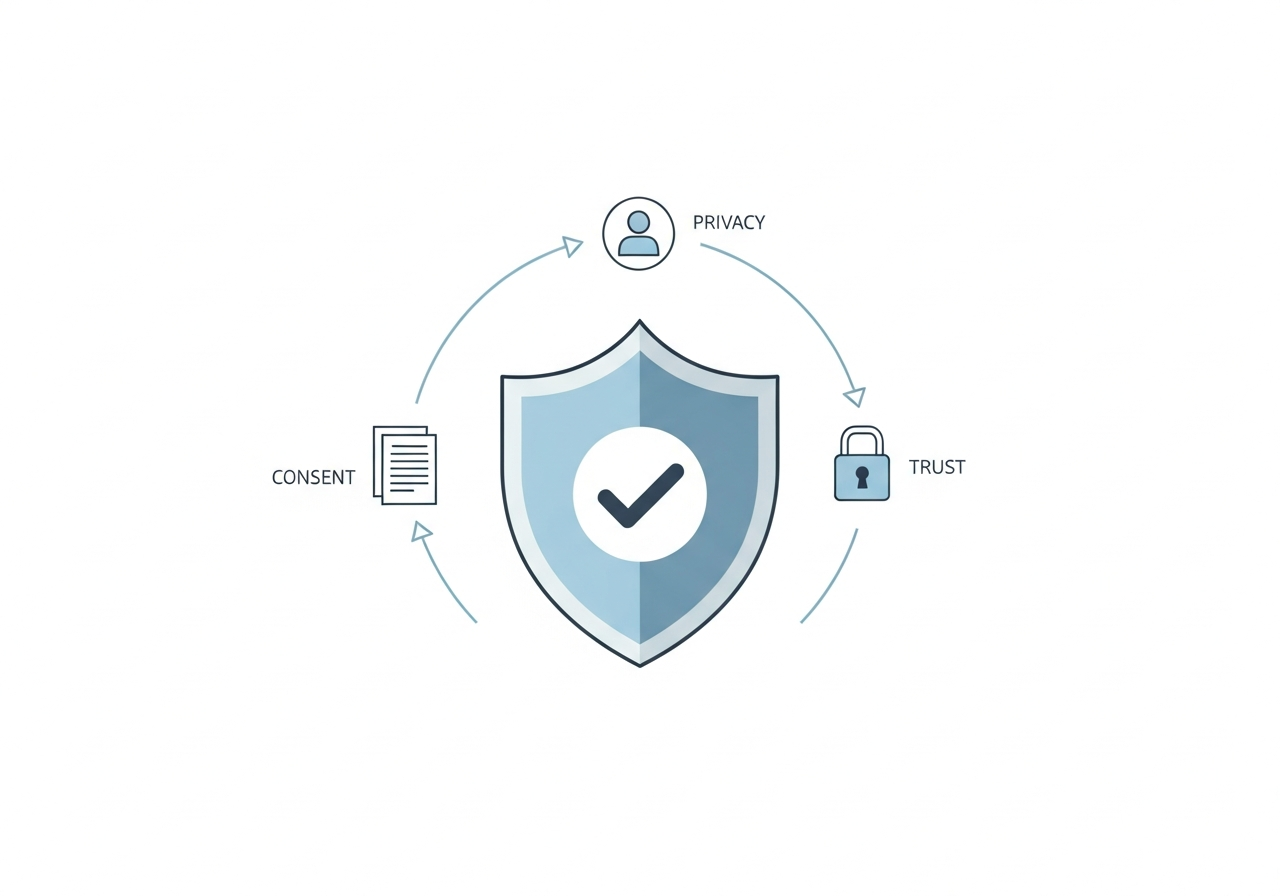
In the modern marketing landscape, data ethics goes hand-in-hand with legal compliance. Outbound marketers who prioritize ethical data use not only avoid penalties but also differentiate their brand as trustworthy and customer-centric. Ethical practices create long-term loyalty and reduce churn, as consumers increasingly value transparency and responsible data handling.
Key Practices for Ethical Outbound Marketing:
- Respect User Autonomy: Always give prospects the choice to control what data they share and how it is used.
- Honesty in Messaging: Avoid misleading subject lines or content. Clear communication strengthens credibility.
- Limit Behavioral Profiling: Collect only necessary behavioral data for personalization, and never overstep boundaries.
- Responsible Data Sharing: If you partner with third parties, ensure they adhere to your ethical standards and regulatory obligations.
Example Table: Ethical vs. Unethical Practices
| Practice | Ethical Approach | Unethical Approach |
|---|---|---|
| Collecting user preferences | Use explicit consent forms and preference centers | Track every click without consent |
| Sharing data with partners | Signed agreements and GDPR-compliant transfers | Sell or share without notice |
| Email content personalization | Use only relevant data from opted-in contacts | Over-target based on inferred data |
| Handling opt-outs | Immediate deletion or suppression | Delay removal, continue outreach |
Ethical marketing reinforces GDPR compliance while signaling to customers that your business is trustworthy, which can translate into higher engagement and brand advocacy.
Integrating Compliance Into CRM and Marketing Automation Systems
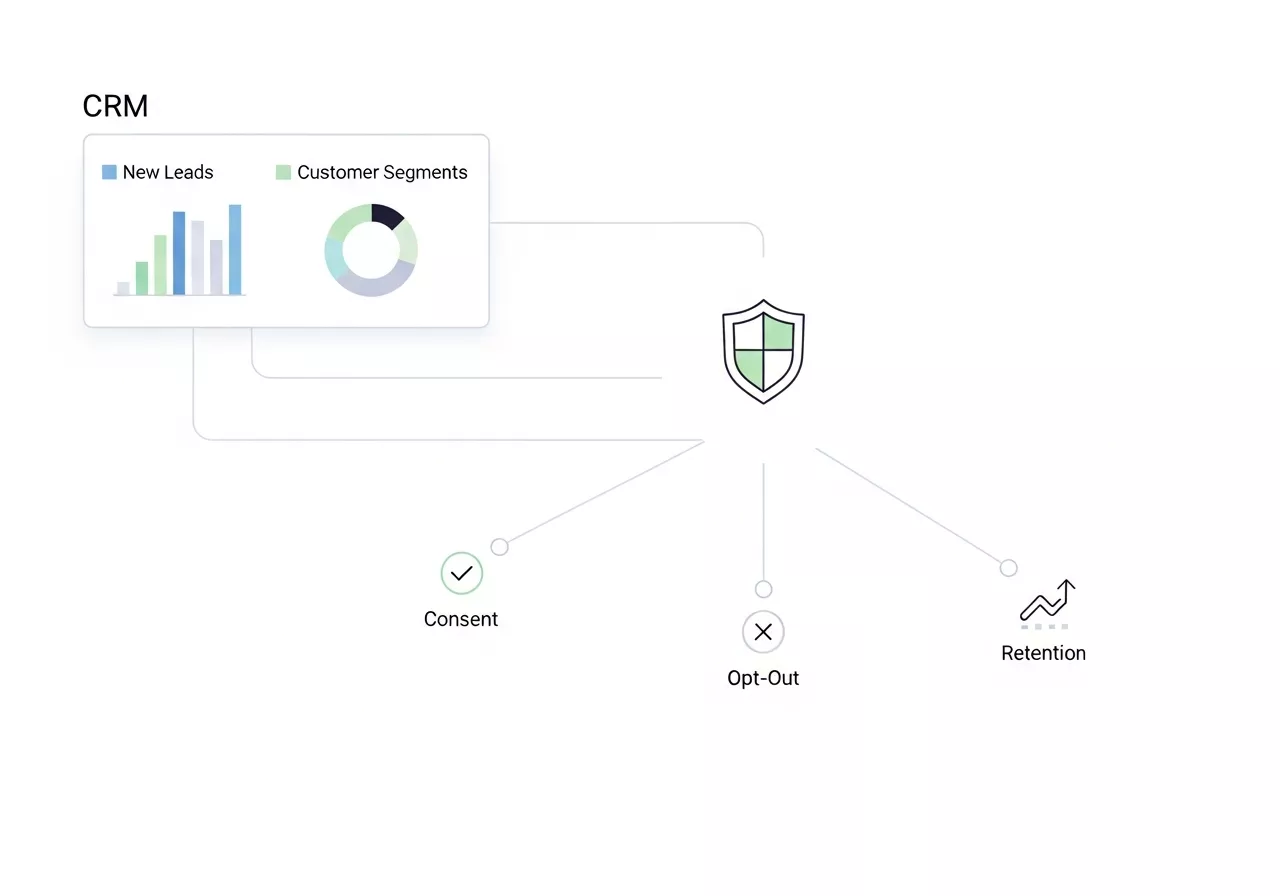
CRM platforms and marketing automation tools are at the heart of outbound campaigns, but without careful integration, they can become compliance liabilities. By designing workflows that embed GDPR and global privacy rules, you can maintain operational efficiency without risking regulatory breaches.
Key Integration Steps:
- Consent Metadata Tagging: Ensure your CRM stores consent timestamps, opt-in sources, and preferences. This enables accurate segmentation and audit trails.
- Automated Consent Updates: Sync preference centers with your CRM so opt-outs or updates reflect immediately across all systems.
- Data Retention Policies: Configure automation tools to automatically archive or delete records once retention periods expire.
- Segmentation Based on Privacy Profiles: Use GDPR and other regional flags to ensure campaigns target only legally compliant audiences.
Practical Tip: Many CRMs now support GDPR modules or integrations. For example, Salesforce and HubSpot allow automatic tagging of consent status, while Mailchimp supports compliance workflows that manage unsubscribes and double opt-ins.
Embedding compliance directly into your marketing technology reduces human error, improves customer experience, and creates a defensible audit trail for regulators.
Measuring the ROI of Compliance-First Outbound Marketing
While compliance may seem like an added cost, it can actually enhance ROI by improving deliverability, engagement, and brand reputation. Companies that adopt GDPR-first strategies often see tangible performance gains over time.
Key Metrics to Track Compliance ROI:
- Deliverability Rate: Fewer spam complaints and bounces result in higher inbox placement.
- Open & Click Rates: Consent-based campaigns yield more engaged recipients.
- Customer Retention: Transparency and ethical practices enhance loyalty and repeat business.
- Cost Savings: Reducing fines, mitigating breach risks, and streamlining processes lowers operational expenses.
Example Table: Compliance vs. Traditional Outbound Marketing Performance
| Metric | Compliance-First Approach | Traditional Approach |
|---|---|---|
| Open Rate | 32% increase | Flat/Declining |
| Spam Complaints | 67% decrease | Unchanged/Increased |
| Conversion Rate | +19% on demo requests | Lower |
| Legal/Regulatory Costs | Minimal | High risk |
By framing compliance as an ROI driver rather than a burden, marketing teams can justify investments in privacy-first technologies, training, and data management practices.
Preparing for the Future: Emerging Privacy Trends and AI Considerations
These emerging trends are reshaping the future of outbound marketing, pushing brands to adopt privacy-first strategies, ethical data practices, and AI-driven personalization to stay compliant and competitive.
Emerging Trends:
- AI-Driven Personalization and Consent: AI tools that automate outreach must be trained on consented data only. Using non-compliant datasets could create significant regulatory and reputational risks.
- Cross-Border Data Transfers: Privacy frameworks like GDPR, LGPD, and CCPA require extra caution when transferring data outside approved jurisdictions. Marketers must implement standard contractual clauses or rely on local hosting solutions.
- Privacy-by-Design in Campaign Planning: New laws increasingly expect privacy considerations to be embedded at the design stage, not added as an afterthought.
- Enhanced Consumer Rights: Expect regulations to expand rights to data portability, algorithmic transparency, and AI-based decision appeals, impacting how outbound campaigns operate.
Action Steps for Future-Proofing:
- Conduct annual reviews of international privacy laws relevant to your prospects.
- Train teams on AI ethics, responsible use of data, and transparency in automated messaging.
- Maintain flexible consent management processes that can accommodate new regulatory requirements quickly.
- Monitor industry best practices and benchmark against peers who have successfully integrated privacy-first AI marketing.
Preparing now ensures your marketing strategy remains compliant, customer-friendly, and adaptable as regulations evolve.
Case Study: How AcmeCorp Boosted Response Rates with Ethical Outreach
AcmeCorp, a mid-sized B2B software vendor, was struggling with low engagement and spam complaints. After implementing a GDPR-first strategy—double opt-in, a transparent privacy notice, and segmented campaigns by consent date—they achieved the following within six months:
- +32% open rate after cleansing their list and targeting only opted-in contacts.
- -67% spam complaints due to clear unsubscribe links and preference center.
- +19% conversion rate on outbound demo requests, thanks to personalized messaging based on consent metadata.
Their legal and marketing teams now collaborate monthly to refresh consent logs and plan outreach aligned with regulatory updates.
Building a Culture of Privacy Across Your Organization
Compliance isn’t just a legal or marketing responsibility—it’s an organizational mindset. Companies that embed privacy into their culture gain a competitive edge, foster employee accountability, and reduce the risk of costly mistakes.
Key Components of a Privacy-First Culture:
-
Leadership Buy-In:
-
Executives should actively champion privacy initiatives and demonstrate commitment through policies, resources, and strategic decisions.
-
-
Cross-Functional Collaboration:
-
Marketing, sales, legal, IT, and customer support teams must collaborate regularly to ensure data practices are consistent and compliant.
-
Example: Legal reviews email templates, IT ensures secure data storage, and marketing confirms consent tagging.
-
-
Continuous Education & Awareness:
-
Host regular workshops, newsletters, or e-learning modules about privacy laws, consent best practices, and emerging trends.
-
Include scenario-based training, e.g., “What do you do if a prospect asks for all their stored data?”
-
-
Recognition & Accountability:
-
Reward teams or employees who demonstrate privacy-conscious decision-making.
-
Track metrics such as timely consent updates, correct data handling, and minimal compliance errors.
-
-
Privacy Champions Program:
-
Appoint privacy ambassadors in each department who act as go-to resources and help monitor compliance on a day-to-day basis.
-
Benefits of a Privacy-First Culture:
- Reduced risk of breaches and regulatory fines
- Improved customer trust and satisfaction
- Better collaboration across departments
- A proactive approach to future regulations
By making privacy a core value rather than a checkbox, organizations transform compliance from a reactive obligation into a strategic differentiator.
Conclusion
Compliance with GDPR and global data privacy regulations is no longer optional for outbound marketers—it’s a competitive advantage. By adopting transparent consent practices, secure data handling, and continuous monitoring, you build trust, enhance deliverability, and ultimately drive better campaign performance. Start by auditing your current processes, choosing the right tools, and educating your teams. With these strategies in place, you can master GDPR—and any future regulations—to power your outbound marketing success for years to come.
FAQ: GDPR and Outbound Marketing Compliance
1. What is GDPR and why does it matter for outbound marketing?
The General Data Protection Regulation (GDPR) is an EU law that governs how personal data of EU residents can be collected, stored, and used. For outbound marketers, it ensures that any email, phone, or mailing campaigns are conducted only with explicit consent, protecting both the customer and your business from legal penalties and reputational damage.
2. Do I need to comply with GDPR if my business is outside the EU?
Yes. GDPR applies to any organization processing the data of EU residents, regardless of your company’s location. This means global businesses must adopt GDPR-compliant practices for their EU contacts.
3. How can I collect consent legally for marketing campaigns?
- Use a double opt-in process (sign-up + confirmation).
- Clearly explain how the data will be used in a privacy notice.
- Allow subscribers to update or withdraw consent at any time through a preference center.
4. How often should I refresh consent from my contacts?
Most companies run consent refresh campaigns every 12–18 months. This keeps your contact list up-to-date, ensures continued compliance, and maintains engagement.
5. What is the difference between GDPR and other privacy laws like CCPA or LGPD?
- GDPR: EU-focused, emphasizes consent, transparency, and user rights.
- CCPA: US law for California residents; focuses on the right to access, delete, and opt out of data sales.
- LGPD: Brazil’s law, similar to GDPR but includes local nuances like mandatory appointment of a Data Protection Officer (DPO).
Businesses targeting multiple regions should align with the strictest applicable regulation.
6. How does GDPR compliance improve marketing results?
- Higher open and click-through rates due to permission-based targeting.
- Fewer spam complaints and better deliverability.
- Increased trust and loyalty which can improve conversion rates and long-term ROI.
7. What tools can help manage GDPR compliance for outbound marketing?
- Consent Management Platforms (CMPs): OneTrust, CookiePro, TrustArc
- Email verification services: ZeroBounce, NeverBounce
- CRM/automation integrations: Salesforce, HubSpot with GDPR modules
- Encryption & security: AWS KMS, Symantec, Vormetric
8. What happens if I violate GDPR?
Non-compliance can result in fines up to €20 million or 4% of global annual turnover, whichever is higher. Additionally, it can severely damage your brand reputation and customer trust.
Learn more about: The Psychology Behind Outbound Marketing: Why It Still Works